Table of contents (12)
- Why Geography Isn't a Cost Question, It's a Structural One
- The Real Cost Stack: Fully Loaded, Not Salary
- Time Zone Overlap: The Hidden Speed Multiplier
- Wage Inflation & 3-5 Year Cost Stability
- Hiring Velocity: The Compounding Edge
- Compliance & Entity Risk: The Non-Obvious Cost
- Risk Profile & Execution Control
- The CFO Decision Matrix: Quantified Tradeoffs
- The Hybrid Model: Distributed by Design, Not Accident
- When Each Model Wins: Go-to-Market Playbook
- When India-Native EOR Becomes the Tiebreaker
- FAQs
What Actually Changes in Cost, Risk, and Speed: A CFO Decision Framework

Onshore vs offshore isn't a binary choice. It's a multidimensional structural decision. Here's how CFOs quantify cost, risk, speed, and wage stability to choose the right hiring model.
Why Geography Isn't a Cost Question, It's a Structural One
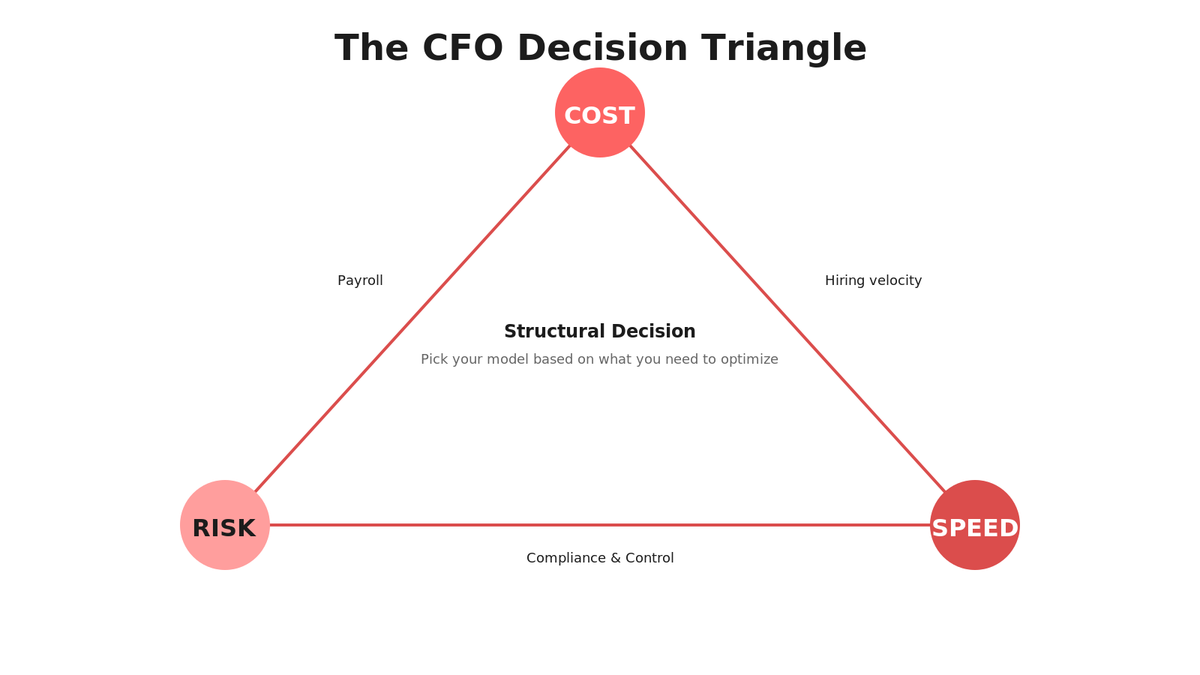
When you walk into a board meeting and someone says, "Offshore is cheaper, let's go offshore," they've already lost the thread. Cost is the hook. Structural impact is the real conversation.
For a US-based CFO, the hiring decision isn't binary: onshore vs offshore. It's multidimensional. Each model changes:
- EBITDA trajectory - Not just salary, but ramp time, attrition, and compliance opex.
- Hiring velocity - Time to productive engineer differs by 50+ days across models.
- Execution risk - Coordination overhead, time zone friction, IP/compliance exposure.
- Scalability ceiling - How many engineers can you onboard per quarter?
- Working capital drag - Training load, turnover, productivity ramp.
The boards that win model these tradeoffs explicitly. They don't choose onshore vs offshore. They choose which structural risks they can live with.
This is a CFO's playbook to offshoring ROI in practice.
The real cost of misalignment becomes apparent over 18-24 months. Many US tech companies hire onshore initially because it's familiar, not because the financial model supports it. They rationalize: "We need full control for culture." But at scale, that control is expensive and doesn't scale. Your first 5 engineers need cultural integration. Your next 50 don't. They need clear processes, documentation, and a team structure that works async.
This guide provides a quantified, stage-appropriate framework for the hiring location decision. It's not ideology. It's structured finance applied to hiring. We'll walk through the cost, risk, and speed tradeoffs, then show you how to model the decision like a CFO actually would: weights, scoring, situational outcomes.
The Real Cost Stack: Fully Loaded, Not Salary
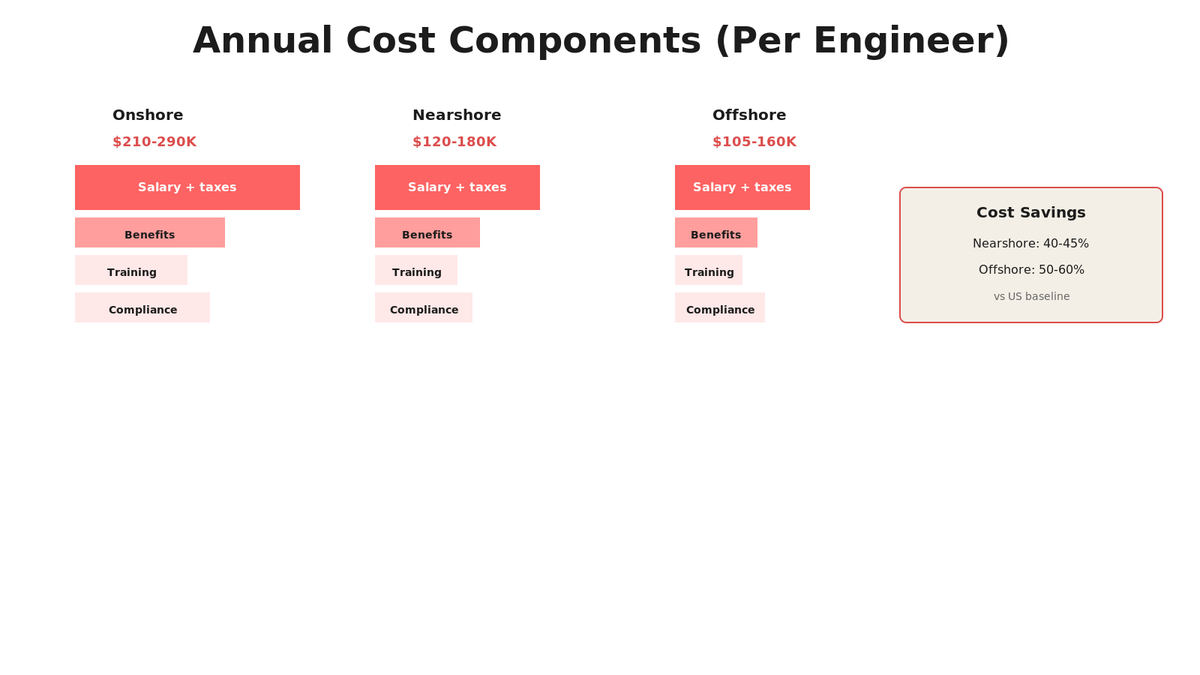
The most visible error in location strategy is comparing salaries as if they're costs. They aren't. Total landed cost includes payroll burden, benefits, compliance infrastructure, training, and attrition insurance.
Here's the full stack for a senior engineer (US market baseline):
| Cost Component | Onshore (US) | Nearshore (LATAM/EU) | Offshore (India/SEA) |
| Base salary (annual) | $140K-$170K | $70K-$110K | $50K-$85K |
| Payroll taxes & benefits (as % of base) | 25-40% | 15-30% | 15-25% |
| Home office / equipment allowance | $3K-$5K | $2K-$3K | $1.5K-$2K |
| Compliance & payroll infrastructure (shared) | $8K-$12K per hire | $4K-$8K per hire | $6K-$10K per hire |
| Training & ramp (3-6 months) | $12K-$18K | $10K-$15K | $8K-$12K |
| First-year turnover insurance (attrition risk) | $15K-$25K | $10K-$18K | $12K-$20K |
| Fully Loaded Year 1 Cost | $210K-$290K | $120K-$180K | $105K-$160K |
| Fully Loaded Year 2+ (steady state) | $190K-$250K | $105K-$160K | $95K-$145K |
Why does compliance cost vary so much? In the US, you're mainly managing state taxes and federal withholding. Onshore compliance is procedural but straightforward. With nearshore, you add international tax treaties, foreign earned income exclusion questions, and IP assignment across borders. Offshore adds all of that plus mandatory benefit systems (like India's Employees' Provident Fund), which are employer-managed and non-negotiable by law.
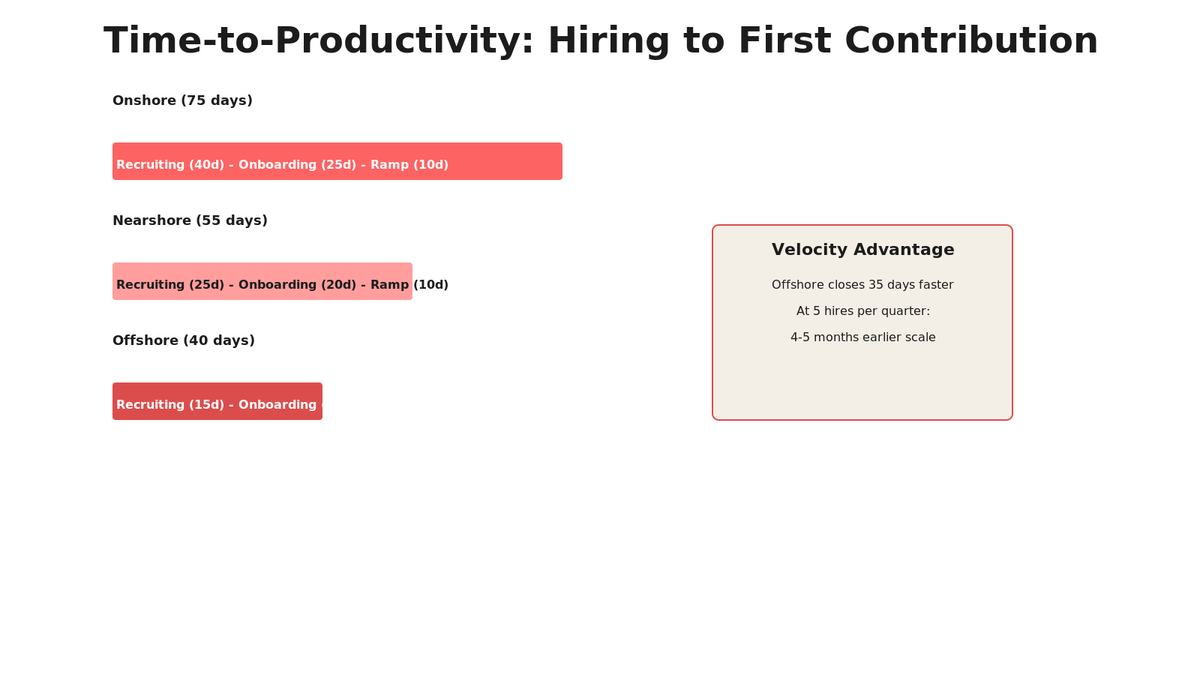
The attrition insurance line item often surprises CFOs. It's not a literal insurance product. It's the productivity loss from replacing an engineer who leaves in year one. A 75-day hiring cycle means 2.5 months of reduced capacity when a junior hire leaves. At offshore velocity, you lose 40 days. That's a real competitive advantage in high-volatility talent markets like India.
The narrative flips when you see the full stack. Onshore doesn't just cost more in salary. It compounds:- Onshore Year 2 cost: $190K-$250K (flat/high compliance, low turnover risk, fast ramp).
- Nearshore Year 2 cost: $105K-$160K (40-50% reduction, moderate compliance, some ramp variability).
- Offshore Year 2 cost: $95K-$145K (50-60% reduction, higher compliance overhead per hire, variable attrition).
But here's the twist: payroll cost is only 60% of the decision. The other 40% is timing.
See how hiring dedicated developers works across each model - and what velocity looks like in practice.
Time Zone Overlap: The Hidden Speed Multiplier
If your team operates in real-time-daily standups, pair programming, synchronous code review-time zone overlap is infrastructure. If you operate async-first, it's a non-factor.
Most US tech companies *think* they operate async, then default to synchronous.
Here's the real overlap picture:
| Model | Time Zone Offset | Synchronous Window | Operational Implication |
| Onshore (US Central/West) | 0-3 hours | 8 AM-6 PM ET (full day) | No friction. Collaborate in real-time. High meeting load. |
| Nearshore (LATAM: Colombia/Mexico) | 5-6 hours behind | 10 AM-3 PM ET (5 hours) | Strong overlap. Standup + async design docs. Moderate meeting load. |
| Nearshore (Eastern Europe: Romania/Poland) | 6-7 hours ahead | 1 PM-6 PM ET (5 hours) | Morning standup + evening async. Moderate meeting load. |
| Offshore (India: IST, UTC+5:30) | 9.5-10.5 hours ahead | 8:30 AM-12 PM ET (3.5 hours) | Morning standup + follow-the-sun design. High async discipline required. |
| Offshore (SEA: Vietnam/Thailand, UTC+7) | 11-12 hours ahead | 7 AM-11 AM ET (4 hours) | Brief standup + overnight turnaround. Strict async required. |
The cost of time zone friction is hidden in cycle time. When onshore engineers spend 4 hours waiting for offshore feedback, that's real productivity drag. In a 2-week sprint, tight time zone misalignment can add 1-2 days of latency.
But it's not all drag. Offshore models enable follow-the-sun delivery. If your US East Coast engineers pass code to India at 5 PM ET, it's fully reviewed and shipped by morning stand-up. That's a genuine velocity advantage-if you structure for it.
The honest read: time zone overlap matters only if your product development model *needs* real-time collaboration. Most fast-growing companies can operate async if they invest in documentation, design-first workflows, and clearer handoff points. Async-first product development playbooks exist for this reason.
This is why managing distributed engineering teams isn't a burden-it's a skill.
Wage Inflation & 3-5 Year Cost Stability
CFOs are paid to predict payroll costs. Most stop at next quarter. The conversation should extend to 3-5 years.
US tech wage inflation has historically been volatile. During growth cycles (2020-2021), senior engineer salaries in top hubs (SF, NYC, Boston) increased 12-18% annually. That compounds. A $150K engineer becomes $210K in 5 years if trends hold.
Offshore markets have different inflation curves:
| Region | Base Salary (Year 1) | Historical Inflation Rate | Projected Year 5 Salary | Volatility Risk |
| US Tech Hubs (SF/NYC/Boston) | $150K-$170K | 8-12% annually | $220K-$260K | High (supply shocks, macro cycles) |
| US Secondary Tier 2 (Austin, Denver) | $130K-$150K | 6-9% annually | $180K-$210K | Moderate (catching up to hubs) |
| LATAM (Mexico City, Bogotá) | $80K-$100K | 5-8% annually | $105K-$145K | Moderate (supply growth, brain drain to US) |
| India (Bangalore, Hyderabad) | $50K-$70K | 6-10% annually | $75K-$115K | Moderate (supply large, but attrition in high hubs can spike 8-12%) |
| Southeast Asia (Bangkok, Ho Chi Minh) | $45K-$65K | 5-9% annually | $60K-$105K | Moderate-Low (emerging hubs, less competition from US firms) |
The insight: offshore doesn't eliminate wage pressure, but it may dampen volatility. US tech hubs see feast-famine cycles tied to fundraising and VC appetite. India's salary growth is steadier, less tied to US market cycles. If your 5-year model values *predictability* over absolute cost, offshore stabilizes payroll variance.
That said, offshore attrition in high-demand hubs (Bangalore, especially) can spike to 20-30% annually during competition cycles. Your "stable" offshore salary becomes unstable if you're losing 1-in-3 hires per year.
This is where engineering hiring strategy meets retention design. See payroll forecasting practices for how to model long-term wage pressure. See payroll forecasting practices for how to model long-term wage pressure.
Hiring Velocity: The Compounding Edge
Most CFOs compare salary. Almost none compare time-to-hire. That's a structural error.
Time-to-hire directly impacts revenue. An engineer hired 60 days earlier is generating value 60 days earlier. In a fast-growth company, that's not trivial.
Here's the empirical breakdown:
| Model | Time-to-Hire (Best Case) | Time-to-Hire (Typical) | Talent Pool Depth | Scaling Capacity (hires/quarter) |
| Onshore (US) | 45 days | 75-90 days | Competitive, supply-constrained | 2-4 per quarter (limited by recruiting) |
| Nearshore (LATAM) | 30 days | 50-70 days | Growing, moderate depth | 4-8 per quarter |
| Offshore (India) | 20 days | 35-50 days | Deep, high availability | 8-15 per quarter |
| Offshore (SEA) | 25 days | 40-60 days | Moderate-deep, emerging | 6-12 per quarter |
The compounding math: if you're at $2M ARR and need to hire 12 engineers this year to hit $5M, onshore hiring (75 days per engineer) means you're still recruiting in November. Offshore hiring (35 days) means you're scaling hard by August, giving Q4 to optimize product and sales.
That 40-day gap isn't just faster hiring. It's a strategic advantage in market velocity. See startup hiring playbooks for how to scale hiring without destroying culture.
One more layer: the real hiring cost isn't salary. It's recruiter capacity. US recruiting for senior engineers takes 40% of a full-time tech recruiter's time. Offshore recruiting (with established vendor ecosystems) takes 15%. That recruiter capacity unlocks at offshore scale, which you can redeploy to sales hiring, operations, or product.
Here's a CFO-level insight most founders miss: compliance complexity isn't uniformly distributed. If you're hiring contractors (1099s) offshore, your legal and accounting costs are front-loaded (setup) but ongoing costs are low. If you're hiring through an EOR, you pay a recurring fee but eliminate legal overhead. If you're setting up an entity, you front-load all costs (entity setup, tax registration, transfer pricing documentation) then carry ongoing compliance indefinitely.
Many founders choose the wrong model because they optimize for the wrong cost dimension. They save $3K on entity setup but incur $50K in annual accounting fees. Or they use a contractor network to save on EOR fees but hire a CPA for $150/hour to manage international tax compliance. The CFO's real job is optimizing total cost of ownership across 3-5 years, not minimizing setup friction.
Compliance & Entity Risk: The Non-Obvious Cost
Compliance complexity varies by geography, but it's not linear. Offshore isn't automatically "more complex." It's *differently* complex.
Here's the real cost structure:
| Model | Employment Law Risk | Payroll Admin Complexity | Annual Compliance Opex (est. per 10 engineers) | Setup Time |
| Onshore (direct hire) | Low (familiar framework) | Low (domestic payroll systems) | $8K-$15K (ERC filing, state compliance) | 2-4 weeks |
| Nearshore (independent contractor) | Moderate (cross-border tax, IP assignment) | Moderate (1099s, IP agreements, tax docs) | $15K-$25K (tax prep, legal review, escrow) | 3-6 weeks |
| Nearshore (via EOR) | Low (EOR handles compliance) | Low (EOR payroll) | $20K-$35K (EOR fees, typically 8-12% of salary + benefits) | 1 week |
| Offshore (independent contractor, no entity) | High (IP risk, FCPA exposure, US tax reporting) | High (foreign tax forms, withholding uncertainty) | $25K-$40K (legal, CPA, escrow, tax treaties) | 4-8 weeks |
| Offshore (via India-native EOR) | Low (EOR in-country employment law) | Low (EOR handles payroll, compliance) | $18K-$32K (EOR fees, typically 6-10% of salary + benefits) | 3-5 days |
| Offshore (via subsidiary entity) | Low (owned subsidiary) | High (multi-country accounting, transfer pricing) | $40K-$60K (entity setup, tax filing, audit readiness) | 8-12 weeks |
The insight that matters: offshore compliance isn't automatically expensive. It's expensive if you go it alone with contractors. It becomes *predictable* and sometimes *cheaper* if you use an India-native EOR service.
Why? An EOR in India (like Versatile) absorbs all employment law risk, payroll processing, tax compliance, and mandatory benefit administration into a fixed fee (typically 6-10% of salary). That fee is often *lower* than the legal, accounting, and escrow costs of managing offshore contractors DIY.
From a CFO's view: an EOR model for hiring converts a compliance liability into a measurable opex line item. That's the real unlock.
The trade-off is control. With an EOR, employment decisions (raise, termination, benefits changes) flow through the EOR, not directly from your company. That's a process tax. Most founders find it worth it.
Risk Profile & Execution Control
Every location model carries distinct risk. The question isn't "Which is safest?" but "Which risks can we absorb?"
Onshore risks:
- Payroll burn rate. Onshore salaries at scale become the largest fixed cost. Once you're at 30+ engineers, that's $6M-$8M annually. Headcount leverage is limited.
- Hiring bottlenecks. US recruiting capacity is constrained in hot markets. Scaling from 10 to 25 engineers can take 9-12 months because talent is competitive.
- Wage pressure cycles. During growth phases, competitors bid up salaries. Your team becomes acquisition targets mid-year.
Nearshore risks:
- Cultural friction. Language barriers (even fluent English) slow pairing and code review. Your real collaboration cost is 20-30% higher than onshore.
- Currency exposure. If hiring in Mexico or Colombia, salary inflation in those markets can outpace your cost model. 5-7% annual currency variance is normal.
- Political/macro shifts. Nearshore markets are more exposed to currency crises, visa policy changes, or political instability. 2020 saw nearshore hiring drag 2-3 months due to lockdowns.
Offshore risks:
- Attrition variability. In high-competition hubs (Bangalore), first-year attrition can be 20-30%. A cohort of 5 new hires might lose 1-2 within 12 months to competitors or burnout.
- Time zone coordination. If you run synchronous standups, offshore requires a 6 AM meeting for US teams or a 10 PM call for India. Fatigue compounds.
- IP & data security. Managing IP assignment across borders adds legal cost. Data residency regulations (GDPR, CCPA) complicate offshore cloud infrastructure.
- Compliance surprises. India labor law is stricter than the US on termination. Without an EOR, you might face unexpected severance obligations or notice periods.
The honest assessment: onshore is simplest, most expensive. Nearshore is moderate. Offshore is cheapest but requires tighter process discipline.
This is why distributed team best practices matter-they're not optional with offshore. They're foundational.
The CFO Decision Matrix: Quantified Tradeoffs
Here's the tool that separates opinion from strategy:
Step 1: Assign strategic weights to your priorities.
- Cost Efficiency: 30% (you need margin)
- Speed to Scale: 20% (velocity matters)
- Operational Risk: 20% (burn management)
- Compliance Simplicity: 15% (legal risk)
- Long-Term Wage Stability: 15% (3-5 year predictability)
Adjust weights to your company stage. Early-stage (pre-product-market-fit) might weight Speed heavier (25%). Late-stage scaling might weight Cost higher (40%).
Step 2: Score each model 1-5 on each criterion.
Here's a template:
Step 3: Multiply score × weight, sum across all criteria.
Example (high-growth startup):
- Onshore: (4 × 0.30) + (3 × 0.20) + (4 × 0.20) + (5 × 0.15) + (2 × 0.15) = 1.2 + 0.6 + 0.8 + 0.75 + 0.3 = 3.65
- Nearshore: (3 × 0.30) + (4 × 0.20) + (3 × 0.20) + (3 × 0.15) + (3 × 0.15) = 0.9 + 0.8 + 0.6 + 0.45 + 0.45 = 3.20
- Offshore: (5 × 0.30) + (4 × 0.20) + (2 × 0.20) + (3 × 0.15) + (4 × 0.15) = 1.5 + 0.8 + 0.4 + 0.45 + 0.6 = 3.75
In this scenario, offshore edges onshore because the company has strong async discipline and high cost sensitivity. If the company weighted Compliance Simplicity at 30% (instead of 15%), onshore would win.
That's the point. The decision framework isn't universal. It's situational. Cost-benefit analysis for outsourcing requires tailoring to your company's operating model.
The Hybrid Model: Distributed by Design, Not Accident
The cleanest companies don't choose one model. They architect hybrid:
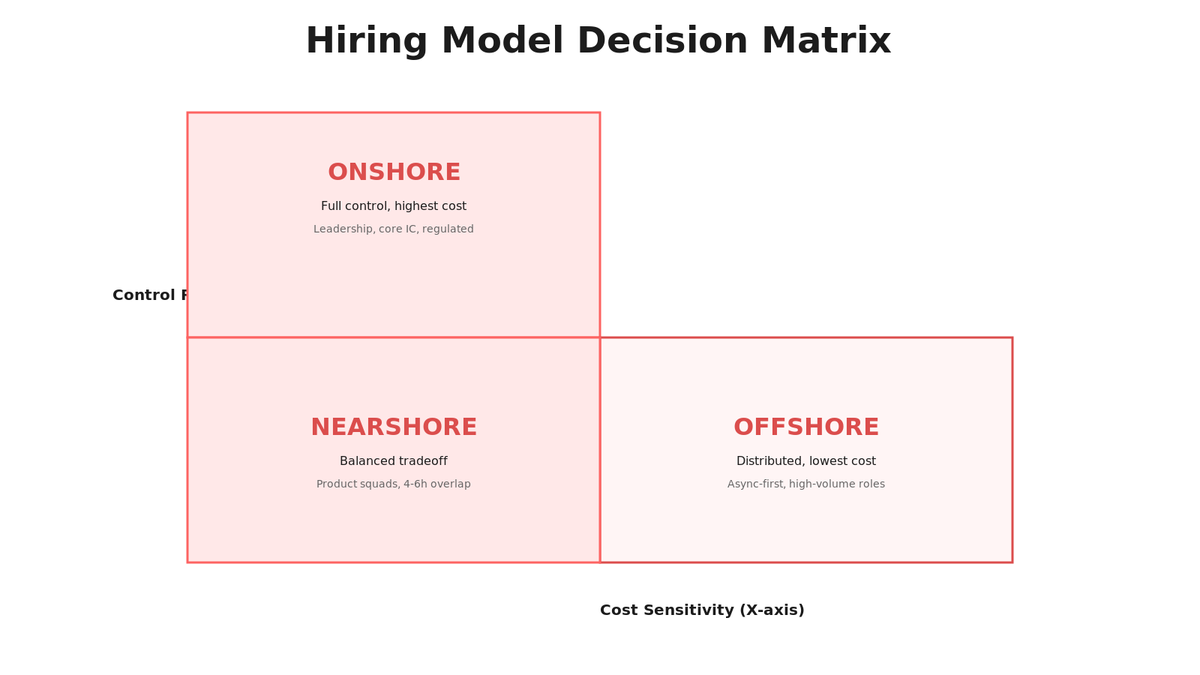
- Core leadership + key IC roles: Onshore (full-time, synchronized, highest context).
- Scaling product squads: Nearshore (4-6 hour overlap, faster hiring, 40% cost reduction).
- High-volume backend/infrastructure teams: Offshore (async-friendly work, 50-60% cost reduction, deep talent supply).
This architecture:
- Optimizes cost by putting expensive roles (founding architects, product leads) onshore and high-volume roles (backend scaling, DevOps) offshore.
- Manages risk by keeping critical path onshore and distributing non-critical work offshore.
- Accelerates hiring because you can hire nearshore quickly for product and offshore quickly for scale work, while staying selective onshore.
- Stabilizes payroll by distributing across three wage markets instead of being concentrated in expensive US hubs.
The tech giants (Meta, Google, Amazon) run this model. They're not onshore-only or offshore-only. They're hybrids. And they built the remote-first infrastructure to run it.
For mid-market startups, a hybrid model requires one thing: clarity.
This is where the competitive edge appears. Most tech companies that scale successfully don't pick a single model. They architect deliberately. The architecture looks like this: your founding engineering team and architects stay onshore (or in a single zone). Product engineering moves to nearshore once you have product-market fit. Infrastructure, data, QA, and other high-volume roles go offshore. That's not cost-cutting. That's capital efficiency. You're applying the right location model to the right team structure.
The key enabler: clear role definition from day one. If you haven't defined what "product engineer" means vs "infrastructure engineer," you can't distribute hiring. If you haven't built async-first processes (documentation, design-first development, async code review), distributed hiring becomes coordination overhead instead of velocity.
Hiring remote engineering teams works when you've defined which roles are which and why.When Each Model Wins: Go-to-Market Playbook
Hire onshore when:
- Your product is complex and requires deep domain context (ML, hardware, high-security).
- You're in a regulated industry (fintech, healthcare, defense) where compliance overhead is non-negotiable.
- Your leadership team has zero distributed management experience and can't afford to build async infrastructure.
- You're hiring for founding-team-level roles where cultural fit is paramount and can't be onboarded async.
Hire nearshore when:
- You need 4-6 hours of real-time collaboration for your core product work.
- Your team is 10-30 engineers and you need your next 5-10 to integrate quickly into culture.
- You have strong remote management practices but haven't built full async discipline yet.
- You're willing to trade 40% cost savings for 80% of onshore collaboration quality.
Hire offshore when:
- You need to scale headcount rapidly (10+ engineers in 3 months) to hit product milestones.
- Your company has strong documentation, async-first processes, and clear handoff rituals.
- You're in a capital-efficient phase where payroll reduction directly impacts runway or profitability.
- Your hiring need is in high-supply roles (backend scaling, DevOps, data infrastructure, QA) not specialized domains.
- You've successfully managed distributed teams and understand the process overhead required.
See building a global development team for the playbook.
When India-Native EOR Becomes the Tiebreaker
Once your decision matrix points toward offshore hiring, the next question isn't "onshore vs offshore." It's "contractor network vs EOR."
The CFO's honest read: managing offshore contractors (1099s, IP assignment, foreign tax withholding) costs $3K-$6K per hire in legal and accounting overhead, plus ongoing risk. An India-native EOR firm absorbs that complexity into a per-hire fee (typically 6-10% of salary + benefits) and handles employment compliance, tax filing, and statutory benefits as in-country legal requirements.
The trade-off: you lose direct employment control. Salary changes, performance improvements, termination notices-all flow through the EOR. That's a process tax, but it's predictable and legal.
Why India specifically? India has the deepest tech talent pool (4M+ engineers), the largest EOR ecosystem (40+ licensed operators), and the most established compliance framework for remote work. When your decision matrix points to offshore + cost + scale + compliance certainty, India-native EOR is the pragmatic choice.
See hiring engineers from India for the full setup guide.
FAQs
What if we hire offshore but lack async discipline? Can we force synchronous standups instead?
Technically yes, but you'll lose the cost advantage and inherit the coordination cost. You'll also burn out your offshore team (6 AM standups for India engineers are brutal long-term). The real insight: offshore hiring only makes sense if you have (or are willing to build) strong async processes-clear documentation, design-first workflows, asynchronous code review, written decision-making. If you can't do that, nearshore is a better fit.
Is India-native EOR actually cheaper than US onshore, or just a slightly cheaper offshore option?
India-native EOR is cheaper than US onshore (50-60% fully loaded cost reduction), not just "slightly cheaper." The tradeoff is control: you hire through the EOR's employment structure, not direct hire. But for high-volume scaling (backend engineers, infrastructure), that control trade is worth the 50%+ cost savings. See cost breakdown for hiring from India.
How do we manage IP assignment with offshore contractors? Can they actually own the code they write?
IP assignment is automatic if you hire through a proper EOR or employment structure. Contractor agreements must have explicit IP assignment clauses, but those are standard and legally sound in India (where work-for-hire is enforceable). The risk is hiring through informal networks without clear IP agreements-avoid that. With a licensed EOR, IP assignment is baked into the employment contract and managed by the in-country firm.
Can a 20-person startup really hire 8-15 engineers per quarter offshore?
In theory, yes. In practice, it depends on your onboarding infrastructure. Hiring 8 engineers/quarter requires: clear documentation, strong squad leads, defined onboarding rituals, and a support system. Most startups that try hit 4-6 engineers/quarter initially, then scale to 10+ once processes are tightened. The constraint isn't talent supply (India has it), it's your team's onboarding capacity. Invest in documentation and you unlock the velocity.
What happens to compliance if we hire offshore engineers but later decide to set up an India subsidiary?
Employees hired through an EOR can transition to a subsidiary if you later decide to establish one. The key is ensuring clean IP assignment and employment records from day one. Most well-managed EOR relationships have transition-ready structures. Plan for this upfront if you think you'll eventually set up an entity. See entity setup in India for details on the transition path.
How much of our CFO decision framework should change if we're capital-constrained vs well-funded?
Significantly. If you're well-funded (Series B+), you might weight Cost lower (20%) and Operational Risk higher (30%), favoring onshore or nearshore for stability. If you're bootstrap or early-stage, weight Cost highest (40%) and Speed highest (25%), favoring offshore. Your weights should reflect your runway and burn rate. Capital constraint is a real strategic input to the model, not a side note.
Where my head is right now
My prediction: by 2028, the "onshore vs offshore" debate disappears. The smart companies already operate hybrid-onshore for core IC roles and leadership, nearshore for product squads, offshore for scale work. The question stops being "where do we hire?" and becomes "how do we architect hiring to match our operating model?" The competitive edge shifts from location to process. Companies with async-first infrastructure, clear handoff discipline, and structured async hiring will hire and scale 2-3x faster than companies stuck in synchronous, onshore-only hiring.
If you're building a US-based company and facing the hire/scale decision, message me directly on WhatsApp through our contact page, or book a consultation. I can walk your CFO through the decision matrix and help you pick the right model for your stage. What's your current team structure and how much hiring velocity do you actually need?
Tell us where you are on the decision.
A role you want to hire, a team you want moved, or just the two routes to compare. A named person replies in 4 to 6 hours.
What the first call covers
30 minutesA cost comparison for your headcount, on your numbers, both routes.
- A written cost breakdown
- Entity documents before the call
- PF, ESI, TDS, termination law
- No follow-up sequence
You pick the time, we send a Meet link. Any timezone.