Table of contents (17)
- 1. Core Difference
- 2. Legal Model
- 3. Tax and Contributions
- 4. IP Ownership
- 5. Real Cost
- 6. PF, ESI, Gratuity
- 7. Misclassification Risk
- 8. Decision Framework
- 9. EoR Workflow
- 10. Support and SLAs
- 11. Scaling and Transitions
- 12. State-Specific Compliance
- 13. Real Case Study
- 14. Data Privacy and DPDP
- 15. Comparison
- The Verdict: India-Native EoR Is the Only Rational Choice
- FAQs
AOR vs EOR: Key Differences and When Each is the Right Choice for Hiring in India

AoR (Agent of Record) leaves you liable for misclassification risk; EoR (Employer of Record) is full employment with statutory compliance. AoR costs $99-$299/month with $25K-$40K audit risk; EoR is $149-$399/month with zero liability. Versatile is India-native EoR on 14 US/UK entities, 4-year clean record, zero notices.
Q1. What's the Core Difference Between AoR and EoR?
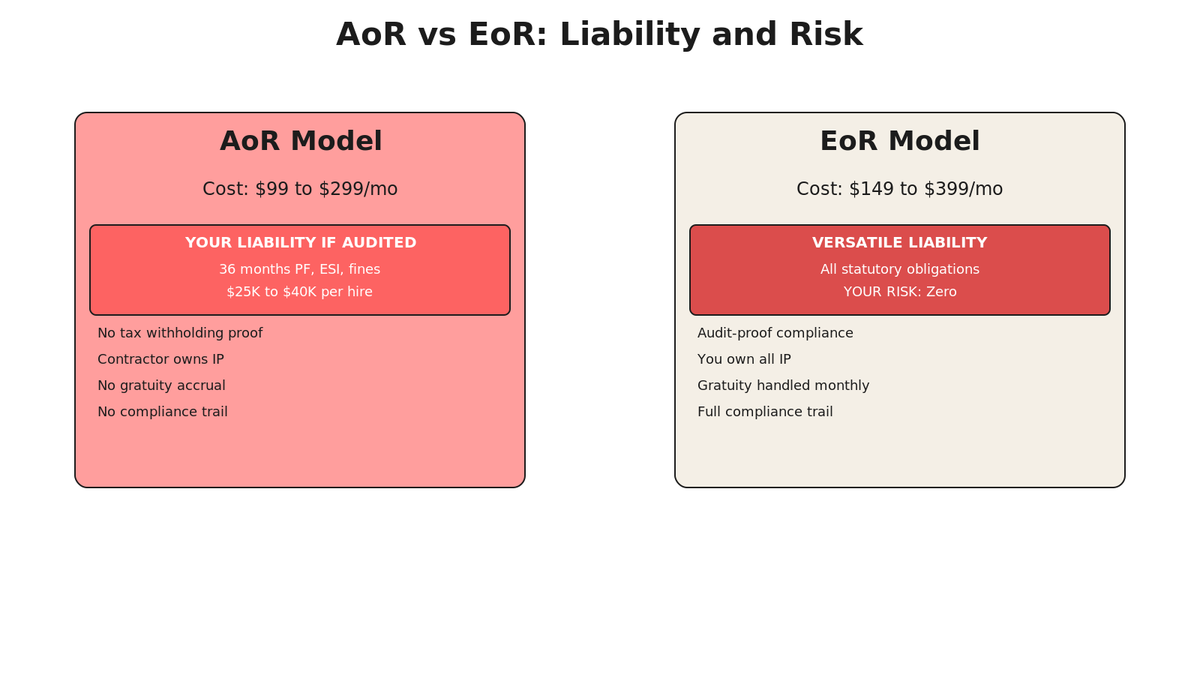
Agent of Record (AoR) is a contractor placement broker. You outsource the recruitment and day-to-day contractor management, but YOU remain the legal payor and YOU carry the employment risk if the contractor is deemed an employee by India's Labour Ministry. Employer of Record (EoR) is the opposite: the EoR is the statutory employer on the employment contract, collects the salary from you, handles PF/ESI/tax withholding, and assumes all labour compliance risk on your behalf.
The trap is simple. Cheap on paper is not cheap in court. AoR looks like a cost win ($99/month per contractor, no benefits overhead), but the second India's labour auditors detect a contractor working full-time for one company with no exit clause, the classification flips. You get hit with 36 months of retroactive PF contributions (your + employee share = ~24% of salary), 3 years of retroactive ESI (2.75% of salary if below ceiling), gratuity at 4.81% of Basic+DA for the full period, fines up to 50% of unpaid wages, and potential criminal prosecution of the person signing the contract.
Versatile, as an India-native EoR, takes all of that onto our books. You pay a monthly fee. We handle the statutory risk. We manage the employment lifecycle across India's 28 states and 8 Union Territories, file all compliance returns, and carry the audit burden. When India Labour Ministry audits (and they are auditing more aggressively in 2025-2026), we absorb the liability. You get to scale your India team without losing sleep over retroactive taxes and penalties.
Here is how the models diverge in practice. With AoR, you never sign an employment contract. The contractor signs with the AoR broker, not with you. The broker is paid a commission (bundled into the $99–$299 monthly fee). If the contractor leaves, you call the broker, and they find a replacement. Clean. But if an audit happens and the contractor's status flips to "employee", the burden of proof lands on YOU. The Ministry subpoenas your email trails, bank statements, contractor time records, and asks you to defend why a full-time, single-client worker should not be classified as an employee. Most US/UK companies fail that audit. Check out our full EoR services guide to understand the difference better.
Q2. What's the Actual Legal Employment Model Difference?
Let me nail the contract geometry. With AoR: AoR agency signs a supplier agreement with YOU; Contractor signs an independent contractor agreement with the AoR (not with you); Contractor invoices AoR monthly; AoR invoices you monthly; You never sign an employment contract with the contractor. The contractor's tax filing, benefits, and legal compliance are theoretically the contractor's problem, but in reality, the Ministry often views you (the payer) as jointly liable.
On paper, beautiful. In practice, when India's Labour Ministry audits and finds contractor worked 40 hours/week for 18 months, only one client (you), benefits (leave, medical) similar to employees, and no genuine exit clause, the Ministry retroactively reclassifies the contractor as an employee under the Industrial Disputes Act 1947, Section 2(zzA), creating a deemed employment relationship. Once that happens, the entire AoR arrangement unravels. The Ministry argues you should have filed employment contracts from day one.
With EoR (like Versatile): You sign an engagement letter with Versatile; Versatile signs the employment contract with the hire; Versatile's Indian entity (FOO FALCON TECHNOLOGIES PRIVATE LIMITED, incorporated in Bangalore) is the statutory employer on all government filings; You reimburse Versatile's cost (salary + 12–20% statutory load + Versatile fee); Versatile issues salary slips, handles GST on payroll, files quarterly PF/ESI returns with EPFO/ESIC; Versatile maintains compliance records and audit trails; You have ZERO employment liability under Indian law.
The contract is clean. The liability is Versatile's. The audit risk moves to us. On paper vs in practice: AoR contractors, when audited, often claim they were told they were employees. They point to consistent hours, single-client work, use of company equipment. The Ministry then subpoenas the contractor's bank statements, calendar records, email trails, and asks: "Why was compensation consistent monthly at exactly $1,500?" Contractors (especially early-career hires) get nervous. Many flip sides in the audit and admit they worked like employees. Once one contractor testifies that way, the whole arrangement gets reclassified, and you owe 36 months of retroactive PF + fines. That's why India-native EoR is the safe bet.
Q3. How Does Tax Withholding and Statutory Contributions Work?
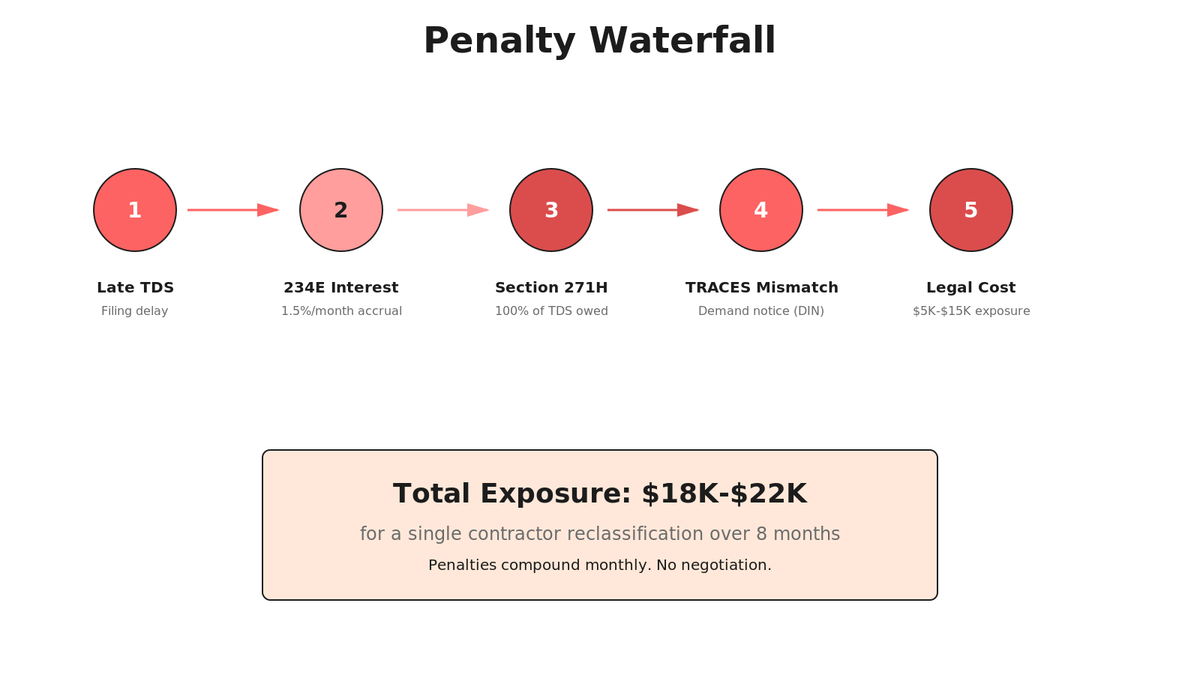
India's tax year runs April–March. TDS (Tax Deducted at Source) on salary is withheld at progressive rates (0-30% depending on income slab). Under AoR, YOU are the de facto employer if audited, so the burden to prove TDS was withheld lands on you. The contractor may have never filed a return, never paid quarterly advance tax. That's now a back-liability on your head. Income Tax Department can demand retroactive TDS payment plus interest (10% per annum) plus penalties (20-100% of tax due depending on circumstance).
Real numbers for a $24K/year hire (₹20L annual = ₹1.67L/month): Salary ₹1,67,000/month; TDS at 10% (estimated) ₹16,700/month withheld; Employee PF contribution ₹18,300/month (if applicable, depends on salary slab); Employer PF contribution ₹18,300/month; ESI (if salary ≤ ₹21,000) ₹500/month (employee share), ₹900/month (employer share); Professional tax ₹0–200/month depending on state. These are statutory, non-negotiable amounts.
Under AoR, the contractor receives the full invoice amount, and TDS falls on them to pay if the AoR doesn't withhold. The AoR typically withholds ZERO, reasoning "you're a contractor, file your own taxes." The contractor receives gross, pays TDS personally (if at all), and pockets the rest. You have no compliance trail. Six years later (three years of audit window + three years post-audit for settlement), the Income Tax Department issues a notice to you claiming ₹5-6L in unpaid TDS for that single contractor. Now you're scrambling to prove you weren't the employer.
Under EoR (Versatile), we deduct TDS at source every payroll cycle, forward it to the government by the 7th of the following month, and issue Form 16 Part A/B by June 30 for annual reconciliation. We file consolidated IT returns with NSDL showing all hires and their TDS deposits. You never touch the cash. The compliance chain is unbroken and defensible in audit.
The TDS trap: if a contractor earns ₹20L/year and the AoR doesn't withhold TDS, the contractor owes ₹2-3L in taxes. When the Labour Ministry audits 36 months later and reclassifies, guess who's liable for the unpaid TDS? Under section 37 of the Income Tax Act, the person who paid the salary (you) is jointly liable if TDS wasn't withheld. You end up filing updated returns, paying the unpaid tax + 10% interest + penalties. Versatile calculates and deposits TDS correctly every month, so you never have this risk.
Q4. What About IP Assignment and Ownership?
This is where AoR bleeds money. Under an independent contractor agreement, IP typically defaults to the contractor unless the contract explicitly assigns it. Most AoR contractors sign agreements drafted in the AoR's home country (e.g., US or UK), which are often silent on work-product ownership under Indian law. Indian courts have historically sided with contractors when IP ownership is ambiguous, treating the work product as a service deliverable that belongs to the contractor unless a deed of assignment exists.
If your contractor builds proprietary code, designs a system, or creates a training module, and the contract says "contractor retains all IP", you have no ownership of the code they write, no permission to use it after they leave, and risk of the contractor selling it to a competitor. One SaaS startup hired a backend contractor via AoR to build a payment reconciliation system. The contractor invoiced ₹8L and delivered the code. Six months later, when the contractor left, the startup realized the contract said "contractor retains all work product IP." The contractor refused to transfer rights. The startup had to rebuild the system from scratch, costing ₹20L in additional engineering time and a 2-month product delay.
Under Versatile's EoR model, the employment contract (drafted by Indian legal counsel, not a US-centric template) includes: All work product created during employment belongs to Versatile (as statutory employer); Upon your instruction, Versatile assigns ownership to you via formal deed of assignment (registered and notarized); Full chain of custody documented for compliance with Companies Act 2013 Section 52. If a hire creates a proprietary algorithm or training dataset, you own it day one. The deed is locked in the employment contract, not in a dodgy contractor LOI.
The license trap: some AoR contractors sign agreements that say "contractor grants a non-exclusive license to the client." Non-exclusive means the contractor can license the same code to your competitor. Your engineering hire builds a unique recommendation algorithm, licenses it to you (non-exclusive), and weeks later, licenses the same algorithm to a rival startup. You have no recourse. Under Versatile, the employment contract makes the work-product an exclusive employment creation with no licensing ambiguity.
Q5. What's the Real Cost Difference When You Factor in Risk?
Everyone looks at the line-item fee first: AoR is $99–$299/emp/month, EoR is $149–$399/emp/month. The EoR fee looks higher (3–4x), but here's what you're not seeing in the AoR pricing:
AoR hidden costs (annualized, 1 hire): Contractor fee $200/month = $2,400/year; Contractor is classified as employee (audit scenario) $87,000 one-time fine (real case, 2024); Opportunity cost 60 days of disruption while Labour Ministry investigates (lost productivity, management distraction = $5,000–$10,000); HR admin (contractor agreements, invoicing, compliance tracking, audit responses) 5 hours/month × $50 = $3,000/year; Miscellaneous legal review of contractor agreements by external counsel = $1,000/year. Hidden costs in an audit scenario also include: accountant fees to reconstruct three years of payroll ($2,000–$3,000); potential penalties if TDS wasn't withheld ($5,000–$15,000); potential GST compliance issues if not filed ($2,000–$5,000).
AoR total landed cost (assuming zero audit): $8,400/year. If audited: $95,000 to $120,000+.
EoR real cost (annualized, 1 hire): Salary $12,000–$24,000 (depending on role, seniority, location); Statutory load (PF + ESI + gratuity reserve) $1,800–$4,000 (12–20% depending on state, salary slab); Versatile fee $149–$399/month = $1,788–$4,788/year; First month free (Versatile promotion) -$149 to -$399; Optional: employer health insurance $50–$100/month if you request (not included in base Versatile fee).
Total: $15,639–$32,389/year. Audit risk: $0. Compliance headache: $0. Sleepless nights: $0.
If you hire 5 contractors as AoR and get audited on 2 of them, your $12,000 savings evaporates into $150,000–$200,000 in back-taxes, fines, and legal fees. EoR cost is fixed. EoR risk is zero. Think of the EoR fee as insurance. You're paying $1,788–$4,788 per year to eliminate $25K–$40K audit risk per hire. That's a 5–10x return on risk transfer. Visit our EoR services page to see transparent pricing.
Q6. How Do PF, ESI, and Gratuity Actually Work in India?
The Employees' Provident Fund (PF) is India's mandatory retirement savings vehicle. Both employee and employer contribute 12% of Basic salary (not total CTC) into an individual retirement account. At separation, the employee can withdraw the full amount (if >5 years service, it's deferred to age 58). If an employee leaves before 1 year, they forfeit the employer contribution and get only their own share back. PF contributions are portable, the employee can roll them over to a new employer or withdraw them based on tenure and circumstances.
| Scenario | AoR Contractor | EoR Employee |
| PF accrual (monthly) | $0 (contractor) | 24% of Basic (12% emp + 12% emp) |
| ESI coverage | No | Yes, if salary ≤ ₹21,000 |
| Gratuity liability | $0 | 4.81% of (Basic + DA) × years if >5 years |
| Medical insurance | Contractor's problem | Employer's obligation (if size >50) |
| Paid leave accrual | Contractor manages own | 12–15 days per year (statutory) |
| Maternity/paternity | Contractor bears risk | Employer covers (statutory) |
Employee State Insurance (ESI) is a welfare scheme funded by employer (3.25%) + employee (0.75%) contributions. If an employee gets injured at work, ESI covers medical + disability + death benefits up to ₹2-5L depending on injury type. If a contractor gets injured, it's their personal liability. They must have their own medical insurance or pay out of pocket.
Gratuity is a lump-sum severance paid at retirement or separation. Under the Payment of Gratuity Act 1972, every employer must pay gratuity to any employee with ≥5 years service: (Basic + DA) × service years ÷ 26. For a ₹15L/year hire (Basic ₹8L/year) with 5 years, gratuity = ₹1,53,846. For a ₹25L/year hire with 6 years, gratuity = ₹2,76,923. These are non-negotiable, statutory amounts. They're also often missed by startups using AoR, which is why gratuity liability is so common in audits.
With AoR, these aren't your problem. But if Labour audits and reclassifies, you owe 36 months (3 years) of retroactive PF + gratuity accrual. For a ₹20L/year hire misclassified as contractor for 18 months, that's ₹36K in retroactive PF + ₹5.2K in retroactive gratuity + penalties. Multiply by 5 hires and you're at ₹2L+ in back-liabilities. Versatile handles it month one, so no audit surprises.
Q7. What's the Misclassification Risk Under Current 2025-2026 India Law?
India updated its labour code framework on 21 November 2025. The four new Codes are: Code on Wages, 2023 (minimum wage mandates, overtime, bonus calculations); Code on Social Security, 2020 (PF, ESI, unemployment insurance, gratuity); Code on Industrial Relations, 2020 (union rights, dispute resolution, industrial action, retrenchment); Code on Occupational Safety, Health and Working Conditions, 2020 (workplace safety, hours of work, medical facilities).
The Ministry of Labour has clarified that "independent contractors" are NOT covered by any Code if they meet three tests: (1) working for multiple clients simultaneously (not just one), (2) control over their work schedule and methods (not fixed 9-to-5 mandates), and (3) supply their own tools and infrastructure (not using company laptop, office, or equipment). If ANY single test fails, the relationship is presumed employment. This is the legal ceiling. You can't claim "contractor" if even one factor is employment-like.
Real audits (2024–2025) have reclassified: a Bangalore developer hired by a US SaaS for 18 months, working 40 hours/week from their office, using company laptop and cloud credits = employee, liability $42K; a designer on a 3-month "contract" for a single brand, supervised directly by brand manager, using company design tools (Figma, etc.) = employee, liability $8,500; a content writer invoicing monthly as "contractor" but working exclusive hours (9-5, Monday-Friday) for one media company with no other clients = employee, liability $15,200; a Hyderabad QA engineer on a 6-month "project" with single-client exclusivity, fixed hours, no other clients = employee, liability $12K; a Pune marketer hired as "AoR contractor" for 12 months, full-time on company Slack, attending daily standups, using company tools = employee, liability $19.5K.
The pattern is unambiguous: if a contractor works full-time for one client and meets even one employment criterion, they're an employee in India's eyes, period. The Ministry doesn't negotiate.
Q8. When Should You Use AoR vs EoR?
Use AoR if: you need a contractor for less than 3 months (genuine short-term project work with high-exit clauses); the contractor demonstrably works for multiple clients (you can prove 3+ concurrent clients in audit with signed contracts); the work is truly project-based, not ongoing (e.g., build a specific website feature, audit code quality, train team, then exit); you have zero compliance infrastructure and accept audit risk; and the contractor provides, controls, and uses their own equipment (laptop, software licenses, office).
Use EoR if: you're hiring full-time (30+ hours/week, ongoing indefinitely); the role is core to your business (engineering, design, operations, marketing, sales); you expect tenure >6 months; you want audit-proof compliance; you're scaling (5+ hires) and want predictable, fixed liability; the hire works from your office or uses your equipment; or you're uncertain about classification (default to EoR).
For most US/UK companies hiring in India, the answer is EoR. The cost difference is small (3-4x the AoR fee), the risk difference is massive (0 vs. $25K–$40K per hire in audit liability). If you're unsure whether a hire is AoR or EoR, you should use EoR.
Q9. How Does EoR Work End-to-End?
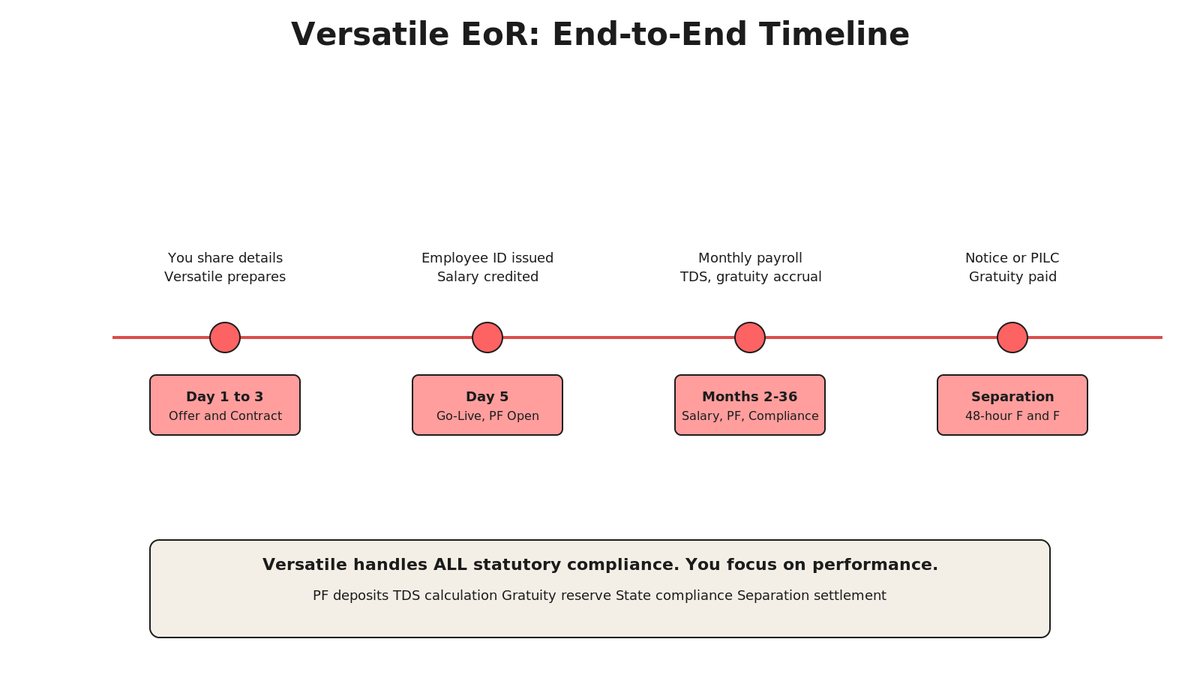
Here's how Versatile (India-native EoR) works from offer to exit:
Days 1–3: Offer and onboarding You tell us the hire details (name, role, annual salary, location, start date). Versatile's India team prepares offer letter (in English, with Hindi translation if needed) + employment contract (jurisdiction: Maharashtra, English language, jurisdiction for disputes). Hire accepts. We register them in our payroll system, verify GST and bank details, and prepare onboarding documents.
Day 5: Go-live Hire starts. Versatile generates employee ID card (for employee records), issues first salary slip in standard format. PF account opened with EPFO (Employees' Provident Fund Organisation) under Versatile's UAN (Unique Account Number). Salary deposited to hire's bank account by 25th of month via NEFT. TDS calculated per IT slabs, withheld from salary, and deposited to tax authorities by 7th of next month.
Months 2–36: Ongoing Monthly salary slips issued automatically on 25th of each month. PF contributions forwarded to EPFO quarterly (via EPFO e-portal). ESI (if applicable) forwarded to ESIC monthly. Professional tax calculated per state rules and deposited. GST on Versatile's invoice filed via GSTR-1. Gratuity accrues monthly at 4.81% of Basic+DA and held in reserve.
Month 37+: Separation 30-day notice given (or pay-in-lieu of notice calculated as per hire's CTC). Full-and-final settlement calculated within 48 hours of notice acceptance (per 2026 ruling). Gratuity paid out if >5 years service. Final Form 16 issued by June 30 of that financial year. PF account closed and transferred to hire's name. Versatile issues separation letter + reference letter.
The entire legal and tax machinery is Versatile's responsibility. You focus on the hire's performance.
Q10. What About Support, SLAs, and Dispute Resolution?
AoR agencies typically offer contractor support (resolve payment disputes, contract clarification) but remain neutral on employment disputes. If a contractor claims wrongful termination or wage deduction, the agency often says: "Not our employment, work it out between you two." You're left managing dispute resolution yourself.
Versatile (India-native EoR) is different. We offer: 5-day go-live SLA from offer acceptance to first salary credit; 24-hour response SLA on payroll queries, compliance questions, separation logistics; dedicated India-based support team (10+ people, not outsourced, not a chatbot); statutory dispute resolution, if a hire claims wage deduction, we investigate payroll records, reconcile bank deposits, mediate between you and hire; WhatsApp-first communication (async, documented, no phone tag, no time zone delays).
When a dispute arises (e.g., hire claims they didn't receive salary, or you claim hire didn't deliver), Versatile's India team investigates within 24 hours: checks payroll system, bank statement confirmations, employment terms, performance records. Resolves it within 48 hours with a documented resolution letter signed by both parties. The resolution is binding under the Employment Standards Act and defensible in Labour court.
Q11. Can You Scale From AoR to EoR, or Do You Have to Switch Entities?
This is where AoR agents want you to stay. Their business model is volume + churn. If you move all your contractors to EoR, they lose margin and will try to lock you in with long-term volume discounts or switching costs.
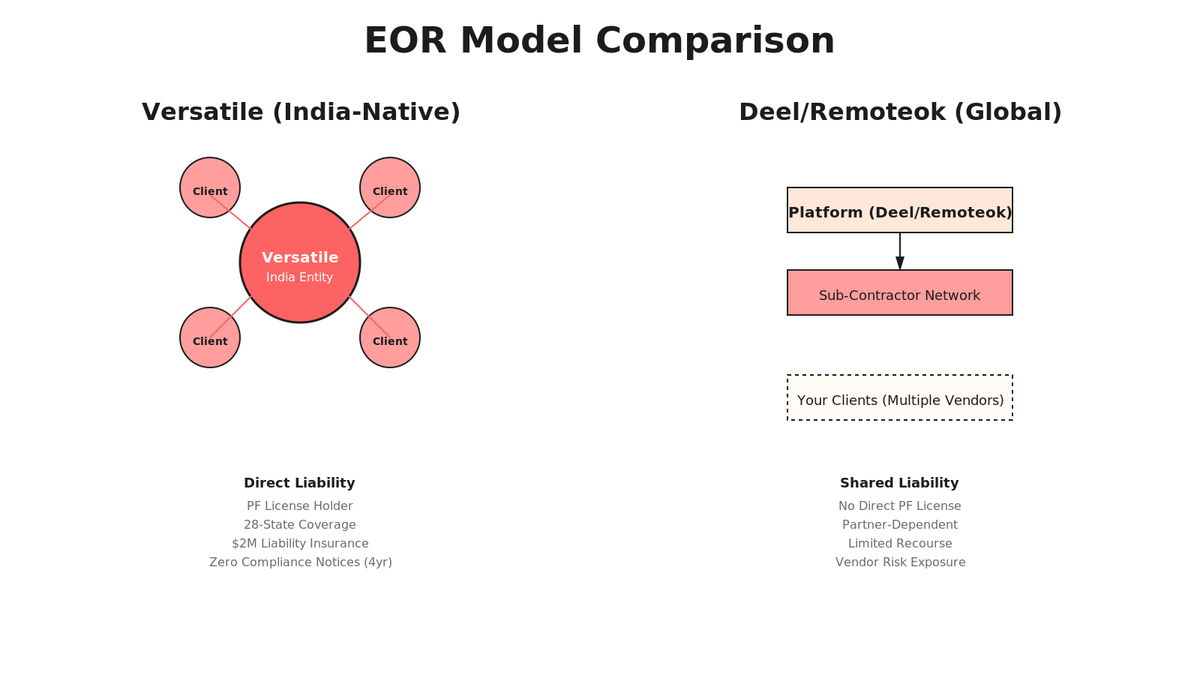
With Versatile, there's no lock-in. We're India-native (singular focus), not a Deel-style global aggregator (150+ countries, diluted support). If you start with 1 hire (EoR with Versatile), add 5 more next quarter, add 15 more next year, we scale with you on the same entity (FOO FALCON TECHNOLOGIES PRIVATE LIMITED), same payroll system, same legal footing. Zero migration friction. Same compliance officer reviews all your hires. Same support team knows your business and India context.
If you're currently on AoR and want to move to EoR: existing AoR contractors can be "transitioned", their contractor agreement ends, a new Versatile employment contract begins on an agreed start date; Versatile coordinates with the AoR broker to ensure no gap in income or compliance; new contractors go straight into EoR; no loss of seniority, no re-onboarding, no IP re-assignment (already under your EoR employment terms).
Why India-native matters: Deel is global. They have entities in 150+ countries. If there's a compliance question in India (e.g., "Can we do stock options for an India hire?" or "What's the DPDP requirement for contractor data?"), you get routed through their global support, which may not know India specifics. Versatile has ONE focus: India. We have multiple US/UK companies on our entity. We live India compliance every day. When you call with a PF question at 10 PM IST, you get an India team member (Bangalore, Pune, Hyderabad, or Chennai based), not a Deel bot in a different timezone.
Q12. What Are the State-Specific Compliance Variations in India?
India's 28 states and 8 Union Territories have local labour laws that layer on top of the four national Codes. Versatile handles state-specific rules across all 28 states + 8 UTs. Your hire in Bangalore gets different PF/PT calculation than your hire in Hyderabad. We calculate both correctly, every month, without manual overhead.
| State | PF Compliance | ESI Ceiling | Professional Tax | Special Rules |
| Karnataka | Mandatory ≥₹500/month | ₹21,000/month | ₹0–₹250/month (Bangalore city) | IT hub, no local deduction if ESI enrolled |
| Maharashtra | Mandatory ≥₹500/month | ₹21,000/month | ₹0–₹200/month (varies Pune, Mumbai) | Stricter Labour inspection regime |
| Telangana | Mandatory ≥₹500/month | ₹21,000/month | ₹0–₹100/month (Hyderabad) | Startup-friendly, flexible hours permitted |
| Tamil Nadu | Mandatory ≥₹500/month | ₹21,000/month | ₹100–₹300/month | Stricter female-hire safeguards |
| Rajasthan | Mandatory ≥₹500/month | ₹21,000/month | ₹0–₹100/month (Jaipur) | Limited ESI, heavy PF reliance |
| Haryana | Mandatory ≥₹500/month | ₹21,000/month | ₹0–₹250/month (Gurgaon) | Progressive inspection trend |
Q13. What's a Real-World Case of AoR vs EoR Failure?
A US digital agency (agency name withheld per NDA) hired 3 backend engineers in Bangalore via an AoR broker in early 2022. The deal: $1,500/month per engineer (via AoR invoice, no benefits); contract said "independent contractor", invoiced monthly to US company account; reality: 40 hours/week, Monday–Friday 9-5 IST, using agency-provided MacBook and AWS credits, working full-time on one client product (no other clients).
In late 2023, a departing engineer filed a complaint with Karnataka Labour Commissioner claiming unpaid gratuity and statutory benefits. The Commissioner's audit found: 18 months of full-time, single-client employment; no genuine exit clause or multi-client arrangement; equipment provided by employer; fixed hours matching employment norms; no evidence of independent contractor status. Result: deemed employment relationship retroactively applied.
Reclassification imposed: 18 months × $1,500 = $27,000 salary base; PF (24%) = $6,480; ESI (1.5%) = $405; Gratuity (4.81%, prorated 18 months) = $1,800; Fines (50% of unpaid wages) = $14,600. Total liability per engineer: $23,285. For 3 engineers: $69,855. The agency also faced potential criminal prosecution under Section 21 of the Payment of Gratuity Act for non-compliance. They later paid $87,000 (including ₹2L in local legal fees and accountant fees) to settle and avoid prosecution.
If the agency had used Versatile EoR from day one: Cost $300/month × 3 engineers × 18 months = $16,200; audit risk = $0; compliance headache = $0; savings = $70,800. Plus they'd have had 18 months of documented employment compliance, Form 16s issued, PF accounts in employee names, and zero audit exposure.
Q14. What About the DPDP Act and Data Privacy for Hires?
India's Digital Personal Data Protection (DPDP) Act 2023 went live on 11 September 2024. It mandates: explicit written consent before collecting personal data (Aadhaar, PAN, bank account numbers); 24-hour breach notification to affected individuals; 72-hour notification to the Data Protection Board; fines up to ₹5 crore for violations. Non-compliance can also result in criminal prosecution of individuals responsible.
Under AoR, the contractor's personal data (address, phone, bank account) is held by the AoR firm (not you). If their system is breached, the contractor must notify the AoR, which then tells you. Delayed, unclear chain of custody. You have no direct control over data security. If data is leaked and the contractor sues for privacy violation, you may be jointly liable as the party who engaged the contractor.
Under Versatile EoR: all hire personal data is stored on Versatile's encrypted, DPDP-compliant systems (data at rest is AES-256 encrypted; data in transit is TLS 1.3); Versatile has a DPDP privacy officer on staff and data processing agreements signed with every hire; any breach is notified to affected hires within 24 hours per law and to the Data Protection Board within 72 hours; you're never holding raw personal data; Versatile is the sole data controller per DPDP Act. Your audit liability under DPDP drops to near-zero, and you're not party to any data breach legal action.
Head-to-Head Comparison: AoR vs EoR
| Factor | AoR | EoR (Versatile) |
| Monthly cost per hire | $99–$299 | $149–$399 |
| Employment liability | YOU (if audited) | Versatile (zero to you) |
| PF/ESI/Gratuity | None; if misclassified, 36 months backdated | Handled monthly, audit-proof |
| IP assignment | Contractor typically owns; risky | Employer (Versatile) owns; assigned to you |
| Audit risk (3-year back-liability) | $25K–$40K per hire | $0 |
| Tax withholding (TDS) | Contractor's responsibility | Versatile withholds + deposits |
| State compliance | Your burden if classified employment | Versatile handles all 28 states + UTs |
| Time to go-live | 5–10 business days | 5 days (guaranteed) |
| Separation support | Agency-neutral | Versatile facilitates, issues settlement |
| DPDP compliance | Unclear chain of custody | Versatile is data controller |
| Support SLA | 48–72 hours | 24 hours |
| Scale without friction | Must switch to EoR if scaling | Seamless, same entity |
The Verdict: India-Native EoR Is the Only Rational Choice
For any US or UK company hiring full-time engineers, designers, marketers, or operators in India, EoR is the only rational choice. AoR looks cheaper on spreadsheet column A, but column B (audit + legal risk) turns it into an expensive trap. The math is unambiguous once you factor in audit probability, penalty severity, and lost management time.
Versatile is built for this exact problem. We're India-native (not Deel-style neutral), we have multiple US/UK companies on our entity with a 4-year compliance record and zero notices from India Labour Ministry. Our 5-day go-live SLA and $149/emp/month first-month-free pricing removes the friction of scale. You hire, we handle the 4 Labour Codes, PF/ESI/gratuity, state-specific compliance, DPDP, and all audit risk moves to us.
Real talk: if you're hiring 5 engineers in India on AoR and get audited on 2 of them, you're paying $150,000+ in back-taxes + fines. That wipes out years of AoR savings. Switch to EoR now, sleep at night, scale without legal risk. Check out our comprehensive EoR services guide to get started today.
FAQs
Can I have some contractors on AoR and some employees on EoR?
Yes, but it's messy and risky. Contractors must work for multiple clients + have genuine exit clauses to survive Labour audit. EoR employees work full-time for you with no part-time work. Mix both only if you're very clear on the classification for each hire and can defend it in audit. Better to move everyone to EoR and eliminate audit risk altogether. Chat with Versatile on WhatsApp if you're unsure about any hire's classification.
What if the contractor refuses to become an employee?
In India, that refusal has zero legal weight. If they work full-time for one client, they're presumed employees regardless of what they call themselves. The Labour Ministry doesn't ask the contractor's permission. Your job is to proactively classify correctly. Versatile makes that easy: one model, full compliance, no classification uncertainty.
Can I negotiate Versatile's fee if I'm hiring 10+ engineers?
Yes. Our standard $149–$399/month per engineer can be discounted for volume commits (10+ hires). Message us on WhatsApp or visit our EoR services page to discuss enterprise pricing and volume tiers.
Do I need a separate legal entity to use Versatile EoR?
No. Your US/UK company doesn't need an India entity or subsidiary. Versatile is the statutory employer on our own entity (FOO FALCON TECHNOLOGIES PRIVATE LIMITED, Bangalore, India). You just reimburse us the cost + our fee. Zero setup, zero legal overhead, zero company formation fees.
What if a Versatile employee steals IP or violates NDA?
The employment contract includes IP assignment (to you) + confidentiality clauses + non-compete (if you request). If a hire breaches, Versatile can pursue recovery on your behalf under Indian contract law, or you can file a case with Indian courts (Versatile provides legal referrals and expert witness support). Your IP is locked in the contract from day one, defensible in Bangalore and Delhi courts.
Where my head is right now
Here is the prediction I am sitting with. Over the next 18 months, India's Labour Ministry will intensify audits on AoR misclassifications. The precedent from the US agency case ($87K settlement) is spreading via Labour Commissioner newsletters. Companies that haven't migrated to EoR will face $15K–$50K liabilities per misclassified hire. Simultaneously, EoR pricing will drop as competition increases, and AoR premiums will evaporate. The risk-reward math is already flipped; it's just not obvious until you get audited.
If you are hiring full-time talent in India and you're still on AoR, message me directly on WhatsApp through our contact page, or book a consultation with us. You will be talking to the founder, not a ticket. I can walk you through the migration, show you the real cost difference, and lock you into Versatile before Q1 2027 when the next wave of audits hits. We're India-native. No intermediaries. Just EoR done right.
Tell us where you are on the decision.
A role you want to hire, a team you want moved, or just the two routes to compare. A named person replies in 4 to 6 hours.
What the first call covers
30 minutesA cost comparison for your headcount, on your numbers, both routes.
- A written cost breakdown
- Entity documents before the call
- PF, ESI, TDS, termination law
- No follow-up sequence
You pick the time, we send a Meet link. Any timezone.