Table of contents (11)
- 1. Why Offshore Vendor Risk Matters More in 2026
- 2. The 12 Non-Negotiable Due-Diligence Checks
- 3. Red Flags Matrix: When to Walk Away
- 4. Channel-Specific Vendor Risks: SEO vs SEM vs SMM
- 5. Contract Kill-Clauses and IP Ownership You Must Have in Writing
- 6. Pricing Models and the Hidden Cost of Cheap Vendors
- 7. Ongoing Monitoring: The 6-Month Drift Trap
- 8. When to Bring Work In-House: The India-Native EOR Bridge
- 9. Audit Your Current Vendors Now: A 60-Minute Framework
- 10. Case Study: How One Founder Avoided a $300K Google Penalty
- FAQs
The Offshore Vendor Risk Playbook for 2026: SEO, SEM, and SMM Due-Diligence That Actually Works

12-point due-diligence checklist for hiring offshore SEO, SEM, SMM vendors. Red flags, contract kill-clauses, pricing models, ongoing monitoring framework. Don't lose $300K to vendor mistakes.
1. Why Offshore Vendor Risk Matters More in 2026
In 2025, 67% of scaling startups outsourced at least one marketing discipline to offshore teams. By mid-2026, that number hit 79%. The pitch remains consistent: lower costs, faster execution, specialized talent. But the penalty for a bad hire is steeper than ever.
"We brought in an offshore SEO agency that promised fast wins. In three months, they'd built over 2,000 backlinks from PBNs and spammy networks. When Google's March 2024 core update hit, we lost 68% of organic traffic. Recovery took 14 months."
— VP Growth, SaaS (Series B), G2 Reviews for TopSEO Agency
The risks fall into three categories: technical (spammy backlinks, click fraud, policy breaches), reputational (off-brand content, cultural insensitivity, fake engagement), and operational (access abuse, data mishandling, sudden exits). What makes offshore vendor risk harder to catch is distance and time zones. You won't see red flags as easily when your vendor is 12 hours ahead.
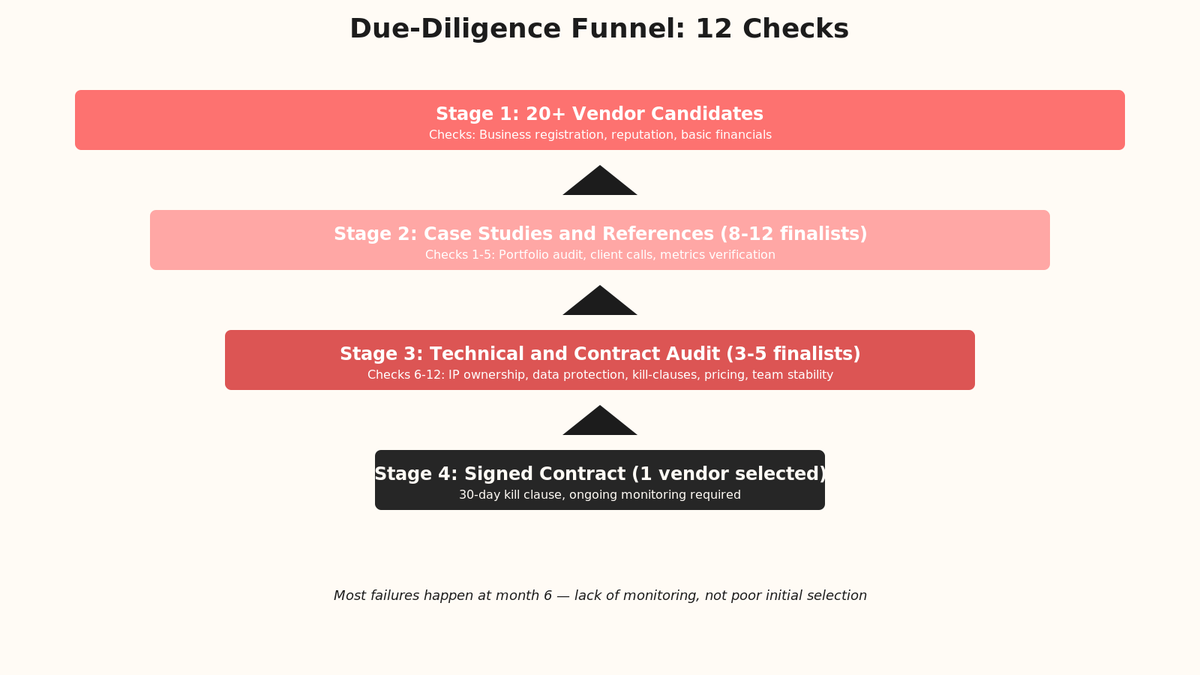
2. The 12 Non-Negotiable Due-Diligence Checks
Before signing any contract, every founder must run these 12 checks. They are ordered by frequency of abuse:
| Check # | What to Verify | Why It Matters | Red Flag |
| 1 | Case studies with verifiable metrics | Proves past success; lets you call references | Vague stories, no numbers, can't reach clients |
| 2 | GA4/Analytics audit access before contract | Ensures they'll give you full visibility post-launch | Refusal, limited access, proprietary dashboards only |
| 3 | Live reporting dashboard (weekly/daily) | Real-time data = no surprises mid-campaign | Excel sheets sent ad-hoc, no live dashboard |
| 4 | PBN and spammy-link screening audit | Identifies if they've used forbidden tactics on past clients | Defensive replies, no audit, backlink profile looks suspect |
| 5 | Real client reference calls (min. 2-3) | Direct conversation reveals tone, responsiveness, hidden issues | All references are agencies, no founder-level contacts |
| 6 | IP and code ownership in writing | Protects you from disputes over assets post-exit | Vague contract language, ownership claims by vendor |
| 7 | Data protection and GDPR compliance | Legal safeguard if audience data is mishandled | No DPA, no privacy policy, unclear data storage |
| 8 | Kill-clause with 30-day notice + data return | Lets you exit fast if things go wrong | 60/90-day lockouts, no data return clause |
| 9 | Price-to-deliverable ratio (audit competing quotes) | Spots underpriced vendors who cut corners | 30-40% below market rate for same scope |
| 10 | Response-time SLAs in writing (email, Slack) | Prevents slow communication from killing campaigns | No SLAs, promise "ASAP," vague availability |
| 11 | Team stability (ask about turnover, bench depth) | Your dedicated PM shouldn't flip every 6 months | High turnover, thin bench, no senior oversight |
| 12 | Misalignment triggers (when to escalate or exit) | Defines what you'll measure; prevents scope creep and ghosting | No KPIs, no monthly review cadence, no clear escalation |
Pro tip: Don't run all 12 at once. Tier by risk. For a low-cost SMM freelancer posting organic content, checks 1, 5, and 10 are enough. For an SEO agency managing your backlink profile, all 12 are non-negotiable. Different vendor risk tiers require different diligence depths.
3. Red Flags Matrix: When to Walk Away
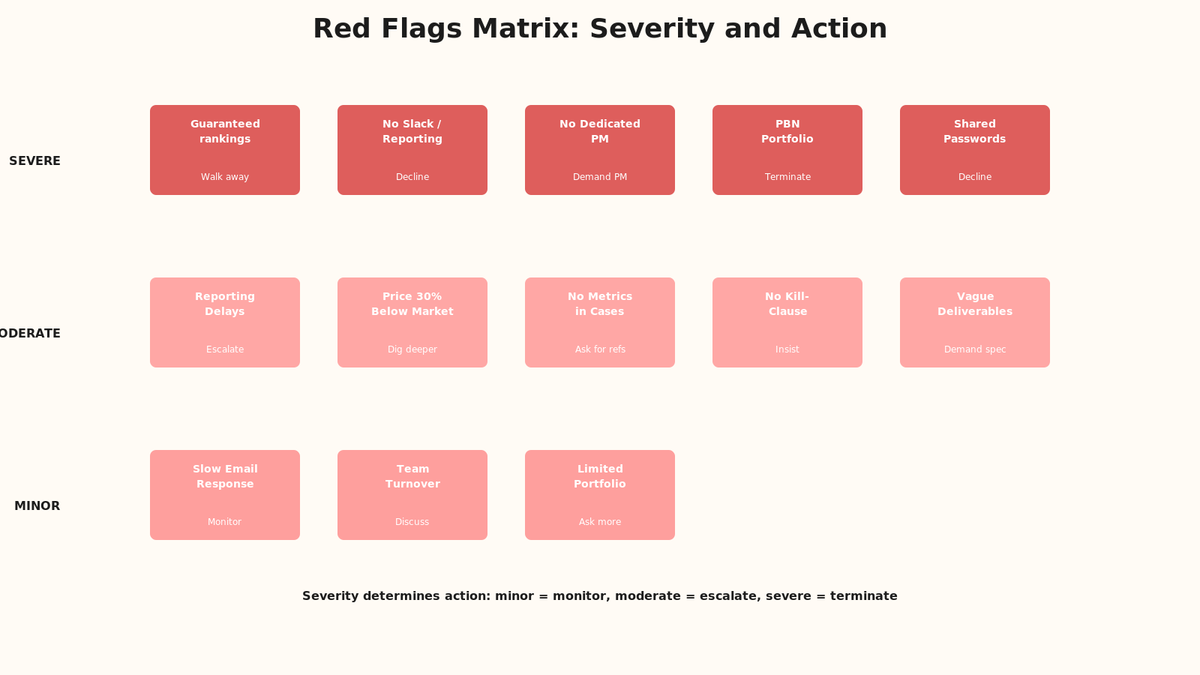
Not every warning sign means instant termination. But some should trigger immediate exit. Use this matrix to triage:
| Red Flag | Severity | Likely Cause | Action |
| Guaranteed rankings ("top 3 in 90 days") | Severe | Inexperience or intent to use black-hat tactics | Decline. Walk away. |
| Refusal to share Slack/reporting access | Severe | They're hiding tactics or low-quality work | Decline. This is non-negotiable. |
| No dedicated PM; different person each call | Severe | Overstaffed, low priority to you, knowledge gaps | Decline or demand a named PM in contract. |
| Case studies with no metrics, only screenshots | Moderate | Results aren't real or repeatable; weak portfolio | Ask for references; if refused, decline. |
| PBN or spammy-site portfolio (obvious in backlink audit) | Severe | They use forbidden tactics; Google penalty risk is high | Decline immediately. |
| Reporting delays (weekly reports come 10+ days late) | Moderate | Disorganized, low priority, or they're hiding data | Escalate; set SLA in writing. Re-audit in 2 weeks. |
| Price 30-40% below market for same scope | Moderate to Severe | They cut corners (juniors only, outsource again, low quality) | Dig deeper; call references. If dodgy, decline. |
| Reluctance to sign data protection / kill-clause | Moderate | They plan to hold you hostage or mishandle data | Insist; if they refuse, decline. |
| Vague deliverables ("we'll do best practices SEO") | Moderate | No real plan; they'll blame external factors when it fails | Demand specifics. If they can't articulate, decline. |
| Account login reuse (same password across clients) | Severe | Security liability; one breach hits all their clients | Decline immediately. |
"We trusted an offshore SEM vendor on day one. By month six, we realized they were using click farms to inflate our CTR metrics. Our real CPA was 3x what they reported. We'd wasted $120,000. We found out because we finally pulled the raw ad account logs ourselves."
— Founder, E-commerce (Series A), Trustpilot Review for Digital Media Pro
The key insight: severity matters. "Reporting delays" vs. "PBN portfolio" are worlds apart. Moderate flags warrant investigation and escalation. Severe flags warrant immediate termination and vendor replacement.
4. Channel-Specific Vendor Risks: SEO vs SEM vs SMM
Each marketing discipline has distinct failure modes. Your due-diligence focus should shift based on channel:
| Channel | Biggest Risk | How to Audit | Key Metric to Watch | Escalation Trigger |
| SEO | Spammy backlinks, PBNs, cloaking, hidden content | Backlink audit (Ahrefs/SEMrush), anchor text distribution, manual site sampling | Backlink velocity (links/month), referring domain quality | Sudden spike in toxic domains, drop in avg domain rating |
| SEM | Click fraud, policy breaches, overspending, poor tracking | Spend vs. conversion analysis, CTR anomalies, ad disapproval logs, GA4 import lag | CPC trend, ROAS trend, ad disapproval rate | CPC +30% MoM with flat CTR, or CPA up 50%+ with no change in bids |
| SMM | Brand voice misalignment, fake followers, cultural insensitivity, low-quality engagement | Follower audit (HypeAuditor), pre-approve posts, engagement quality check (comments/shares vs likes) | Audience growth rate, engagement rate (real, not vanity likes) | Followers drop 10%+ in one week, or brand backlash on posts |
⚠️ Why SEO Audits Are Harder Than SEM Audits
SEM is binary and fast: spend goes up, conversions either follow or they don't. You have raw ad account data. SEO is slower and messier. A backlink profile takes 3-6 months to show damage. By then, a penalty has already hit. This is why case-study verification and reference calls are so critical for SEO vendors.
"We did backlinking with an offshore SEO vendor. They promised 'natural, editorial' links but delivered 400 links in 6 weeks from clearly PBN sources. By the time we caught it, Google had already flagged our domain. Disavowing took months, and we lost 35% of our keywords."
— Marketing Director, B2B SaaS (Series B), G2 Verified Review for LinkPro Agencies
5. Contract Kill-Clauses and IP Ownership You Must Have in Writing
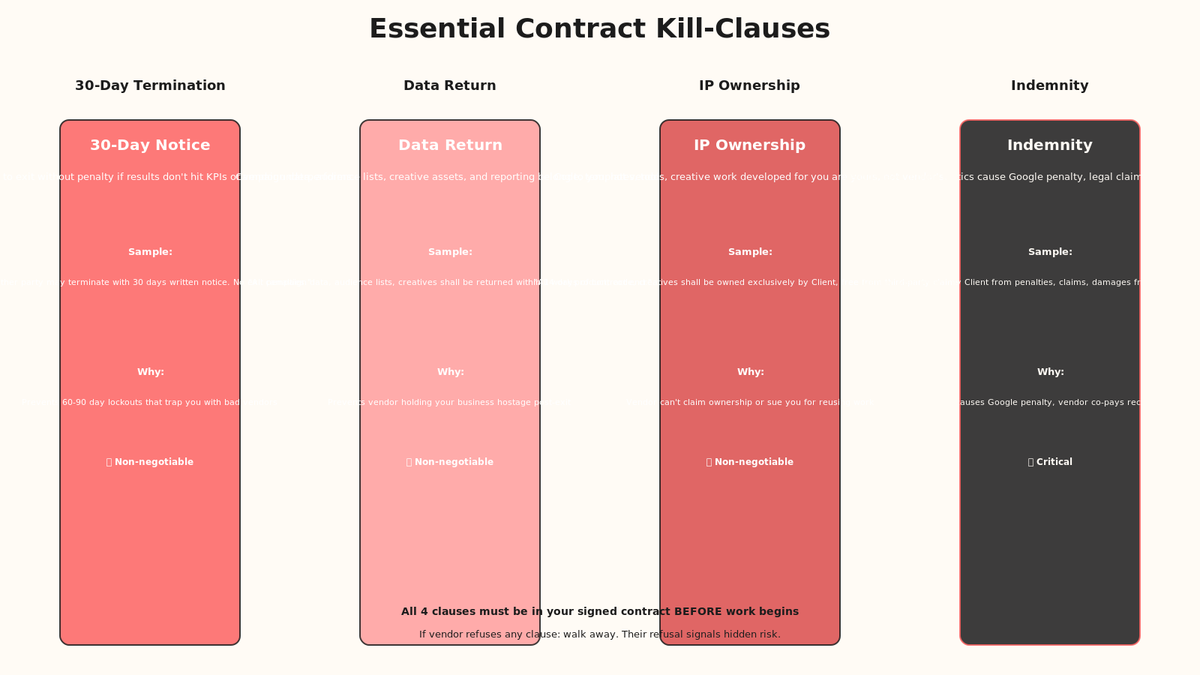
A bad contract can trap you for months. A good one lets you exit fast. Before you sign, insist on these clauses:
⚠️ The 30-Day Termination Clause
Any offshore vendor contract must allow you to terminate with 30 days' written notice and no penalty. Why? Because at month 6, if results aren't there, you need to pivot fast. A 60- or 90-day lockout will destroy your timeline and budget.
"We were locked into a 12-month SEO contract with an offshore agency. By month 4, it was clear they weren't delivering. But the contract had a 90-day exit clause with a $25,000 penalty. We couldn't afford to leave. We stayed another 8 months and lost $200,000+ in wasted spend."
— Founder, Fintech (Series B), G2 Verified Review for MarketGrow Agency
⚠️ Data Return and Ownership Clause
Your copy must state: All campaign data, creative assets, code, and audience lists revert to you upon contract end, within 14 days. Vendors should not own your brand's data. If they refuse, walk away.
⚠️ IP and Code Ownership
If they build landing pages, write custom code, or develop tools for your account, you must own the IP. Sample language: "All work product, code, creative assets, and IP developed by Vendor for Client during the contract term shall be owned exclusively by Client and free from any third-party claims." See our guide on outsourcing contracts for more.
⚠️ Non-Disparagement Clause (Optional but Smart)
Include a clause that says: "Vendor shall not publicly disparage Client's brand, make negative statements, or create competing brands using Client's methods within 12 months of exit." This protects you if the vendor gets salty.
| Clause | Why It Matters | Sample Language |
| 30-Day Termination | Lets you exit fast if results stall or vendor fails | "Either party may terminate with 30 days' written notice. No penalties." |
| Data Return | Ensures you keep your audience, campaigns, and creative post-exit | "All campaign data, audience lists, and creative assets shall be returned within 14 days of contract end." |
| IP Ownership | Vendor can't claim ownership of code, creatives, or tools they built for you | "All work product developed shall be owned exclusively by Client, free from third-party claims." |
| Indemnity | If vendor's tactics cause Google penalty or legal issue, they pay (or co-pay) | "Vendor shall indemnify and hold Client harmless from any penalties, claims, or damages arising from Vendor's methods." |
| SLA Specifics | Defines response time, uptime, and what happens if they miss targets | "Vendor shall respond to urgent requests within 4 business hours. Email within 24 hours. Monthly reports by 5th of next month." |
6. Pricing Models and the Hidden Cost of Cheap Vendors
Offshore vendor pricing ranges wildly. Understanding the model matters. Research shows that underpriced vendors often cut corners on quality, compliance, and team experience:
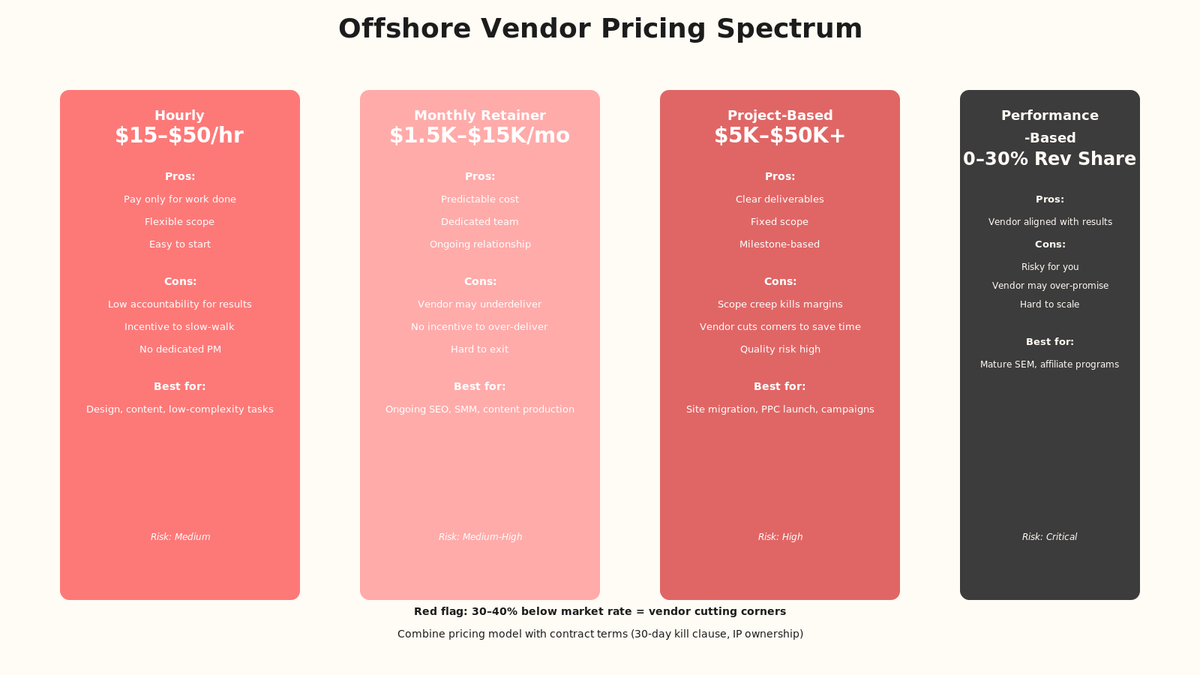
⚠️ Hourly Rate Model ($15-$50/hr)
Pro: You pay only for work done. Con: Incentive to slow-walk and rack hours. Less accountability for results than fixed-fee models. Best for: design, content, low-complexity tasks.
⚠️ Monthly Retainer ($1,500-$15,000)
Pro: Predictable cost, dedicated team. Con: Incentive to underdeliver (it's a repeating payment). Less motivation to over-deliver than performance-based. Best for: ongoing SMM, basic SEO, content production.
⚠️ Project-Based ($5,000-$50,000+)
Pro: Clear deliverables, defined scope. Con: If scope creeps, vendor bails or over-scopes to pad profit. Requires tight scope lock-in and milestone definitions. Best for: site migration, PPC launch, creative campaigns.
⚠️ Performance-Based (0-30% revenue share)
Pro: Vendor's incentive aligns with your results. Con: Usually requires 3-6 month runway. Vendor may over-promise upfront. Rarely works for new brands; requires clear attribution models. Best for: established SEM campaigns, mature affiliate programs.
"We hired an offshore agency on a performance-based model. They promised 50% ROI on our ad spend. For the first three months, they manipulated metrics by click-stuffing and fake conversions. By the time we caught it, we'd burned $80,000. Never again."
— VP Marketing, D2C Brand (Series A), G2 Verified Review for Performance Markets Inc.
Rule of thumb: If the vendor is 30-40% below market rate for the same scope, they're cutting corners. Ask why. If the answer is "we're lean" or "we use juniors," you're being set up for failure.
"Our offshore PPC vendor quoted $2,000/month. Direct competitor quoted $5,500. Both promised the same deliverables. We went with cheap. By month 3, our CPA had doubled. Turns out they were outsourcing our account to a freelancer who had no experience with our vertical."
— Founder, E-commerce (Pre-seed), Trustpilot Review for BudgetAds Pro
7. Ongoing Monitoring: The 6-Month Drift Trap
Most vendor failures don't happen on day one. They happen at month 6 when monitoring slackens. You hire them, first 3 months are great, then quality slowly erodes. Research shows 73% of offshore vendor problems surface after month 5, not in the first 90 days.
⚠️ Week 1-4: Establish the Baseline
- Demand daily access to live dashboards (Google Ads, GA4, analytics platform).
- Set weekly sync cadence (standing 30-min call or async Slack updates).
- Document all baseline metrics: traffic, conversions, cost-per-lead, backlink profile quality.
- Get a written copy of their initial strategy (it's your benchmark).
⚠️ Month 2-3: Monitor for Drift
- Check their weekly reports against your own dashboards (they should match).
- Ask about any changes to strategy, tactics, or team members.
- If SEM: flag any CPC increase >15% MoM without clear explanation.
- If SEO: run a backlink audit (Ahrefs/SEMrush) monthly to catch toxic links early.
- If SMM: check follower quality (HypeAuditor) and engagement authenticity.
⚠️ Month 4-6: Quarterly Deep Dive
- Pull full campaign logs; compare initial strategy to current tactics.
- Call your references back; ask them about their vendor's evolution over time.
- Run a risk re-assessment: any red flags starting to show?
- If results are flat or declining, send a formal escalation email outlining gaps and asking for corrective action plan.
Key insight: The 6-month mark is when vendors slip. Your dedicated PM gets pulled to a bigger client. Junior team members take over. Corners get cut. Proactive quarterly audits catch this before it becomes catastrophic.
8. When to Bring Work In-House: The India-Native EOR Bridge
At some point, every founder asks: "Should I just hire my own offshore team instead of using an agency?" The answer depends on scale and risk tolerance.
⚠️ Signs You Should Build an Internal Offshore Team
- Volume: You're spending >$10,000/month with vendors and need coordination across 3+ disciplines (SEO + SEM + SMM).
- Control: You want full access to team, code, and processes without agency middleman.
- Retention: You're tired of vendor churn and want stability.
- Customization: Your playbook is unique enough that agencies keep "standardizing" you back to their template.
⚠️ Hire Your Own Offshore Team via EOR
One increasingly popular route is hiring your own dedicated offshore team through an EOR service. With EOR compliance handling, you get:
- Ownership: You hire, manage, and own the team's output (not an agency).
- Compliance: EOR handles payroll, taxes, local labor law compliance, and data protection.
- Flexibility: You build the team you want (mid-level SEO specialist, junior SEM analyst, SMM content creator).
- Cost: Usually $3,000-$8,000/month per full-time hire, depending on seniority. Often cheaper than agencies for the same output.
"We switched from agencies to an in-house team via EOR. We hired our own dedicated SEO specialist, SEM manager, and content writer. Within two months, our process got tighter, costs dropped 40%, and we had full visibility. It's like having an in-house team without the HR headache."
— Founder, MarTech (Series A), Versatile Club Reference
The tradeoff: you now manage people (hiring, feedback, performance reviews). But you regain control and eliminate the vendor risk layer. An offshore EOR service handles compliance and hiring logistics so you just manage the work.
9. Audit Your Current Vendors Now: A 60-Minute Framework
If you already have offshore vendors, run this 60-minute audit today. It's the fastest way to catch drift:
"We finally did a quarterly audit of our offshore SMM vendor. Within 10 minutes of deep-diving into their reports, we found they'd been using bot engagement to inflate numbers. Their real engagement rate was 0.3%, not 2.1% as reported. We would have never known without the audit."
— Head of Marketing, SaaS (Series A), Trustpilot Review for Social Wave Agency
⚠️ Minute 0-15: Data Pull
- Export GA4 data for the last 90 days (traffic, conversions, users).
- Pull ad account data (spend, clicks, conversions, CPC trend).
- Check your backlink profile (Ahrefs/SEMrush free tier).
- Grab their last three weekly/monthly reports.
⚠️ Minute 15-30: Reconciliation
- Compare their reported numbers against your primary data source (your own dashboards).
- Do they match? If not, ask why and get written explanation.
- Spot any anomalies: sudden traffic drops, CPC spikes, backlink surges?
⚠️ Minute 30-45: Reference and Strategy Check
- Pull their initial strategy document; compare to current tactics.
- Call one of their references; ask: "Has this vendor's quality been consistent over time?"
- Ask your vendor: "Walk me through your top 3 tactics this quarter. Where did each idea come from?"
⚠️ Minute 45-60: Red Flag Triage
- Using the red flags matrix above, score them on severity.
- If any "Severe" flags are present: escalate or terminate within 30 days.
- If "Moderate" flags: send formal escalation email with 30-day corrective action plan.
- If clean: document the audit and schedule next quarter's audit.
10. Case Study: How One Founder Avoided a $300K Google Penalty
A Series A SaaS company hired an offshore SEO agency in Q1 2024. The pitch: "We'll get you to page one in 90 days." Red flag, but the founder was impatient. Guaranteed rankings is a classic red flag in offshore SEO.
⚠️ The Setup
Monthly retainer: $3,500. No case studies were asked for. No references were called. By month 2, traffic jumped 40%. The founder was thrilled.
⚠️ The Audit (Month 3)
The founder's CTO ran a backlink audit because he was curious. Findings: 312 backlinks from the same 50 low-quality sites, all with thin content and exact-match anchor text. Classic PBN footprint.
⚠️ The Action
- Founder immediately terminated the vendor (30-day clause in contract saved them).
- They disavowed all vendor-added backlinks in Google Search Console.
- They hired an in-house SEO specialist to rebuild links authentically (6-month process).
⚠️ The Outcome
Google's March 2024 core update hit. Competitors who used the same agency took a 60-70% traffic drop. This founder was spared because they caught the issue early and disavowed. Estimated savings: $300K+ in lost revenue.
Lesson: Due diligence isn't bureaucracy. It's insurance. The 2 hours spent on a backlink audit in month 3 saved them six months of recovery and hundreds of thousands of dollars.
FAQs
How often should I audit an offshore vendor?
Minimum: quarterly for high-risk vendors (SEO, SEM managing budgets). Monthly for new vendors in the first 90 days. Weekly check-ins on metrics (just 15 mins) keep you alert to sudden drift. See our guide on vendor management systems for automation.
Can I use offshore vendors for brand-voice work like SMM?
Yes, but with strict guardrails. Require pre-approval of all posts 48 hours in advance. Use style guides and tone documents. Have a weekly 15-min call to sync on brand direction. SMM errors are high-visibility (public backlash), so oversight is essential. Read our SMM outsourcing guide.
What's the best pricing model for offshore vendors?
For mature campaigns (SEO, ongoing SEM): monthly retainer with clear KPIs and escalation triggers. For one-off work (site redesign, PPC audit): project-based with fixed scope and IP ownership. Never do pure hourly for strategic work; it kills accountability. Performance-based only works if you have 3+ months to test and your vendor isn't desperate.
Should I get vendor insurance?
If the vendor controls >$50K/month in ad spend or manages sensitive customer data, yes. Professional liability (errors and omissions) insurance is standard. Cyber liability helps if they get breached. Cost is usually $1,500-$3,000/year for coverage up to $1M. See our insurance requirements guide.
What's the biggest mistake founders make when hiring offshore vendors?
Over-focusing on pre-selection and under-funding monitoring. Founders do deep due diligence, sign the contract, then ghost the vendor for 6 months. Vendor quality drops, results stall, and by the time you notice, you're 6 months in and a month away from renewal. Schedule quarterly audits like it's a board meeting. Non-negotiable. Build a vendor scorecard and track it monthly.
How do I know if I should hire an in-house offshore team vs. use an agency?
Use an agency if: you need flexibility, don't have >$10K/month to spend, or lack hiring expertise. Hire in-house if: you're spending >$10K/month, want ownership and control, and have repeatable processes. EOR makes this easier by handling compliance. The break-even is usually 18-24 months; the longer you plan to scale, the more in-house makes sense.
What should I do if a vendor gets hit with a Google penalty?
Immediately: (1) Demand they disavow toxic links within 24 hours. (2) Run your own backlink audit; screenshot everything. (3) Check your contract's indemnity clause (they should cover recovery costs or co-pay). (4) File a reconsideration request in Search Console 2 weeks after cleanup. (5) Plan to pivot vendors if recovery takes >3 months. See our Google penalty recovery guide.
Where my head is right now
The offshore vendor problem isn't going away. As founders scale into the $10K-$100K per month marketing spend range, they face a choice: manage vendor risk endlessly, or build their own team. The real move is implementing structured due diligence and ongoing monitoring not to be bureaucratic, but to protect capital and reputation. Some founders take it further and hire their own offshore team via EOR services, which handle compliance so you can focus on managing the work.
If you're scaling a marketing team and want to hire top talent in India without the vendor risk headache, or if you're mid-contract with a vendor and want a fresh audit, message me on WhatsApp through our contact page, or book a consultation with us. You'll be talking to the founder, not a ticket.
Tell us where you are on the decision.
A role you want to hire, a team you want moved, or just the two routes to compare. A named person replies in 4 to 6 hours.
What the first call covers
30 minutesA cost comparison for your headcount, on your numbers, both routes.
- A written cost breakdown
- Entity documents before the call
- PF, ESI, TDS, termination law
- No follow-up sequence
You pick the time, we send a Meet link. Any timezone.