Table of contents (11)
Overcoming Obstacles: A 2026 Field Manual for Product Designers

Every serious product designer I know has hit the same eight walls in their career. Not in the same order. Not with the same intensity. But the same walls. This guide is a field manual for climbing over them faster than the design lead beside you.
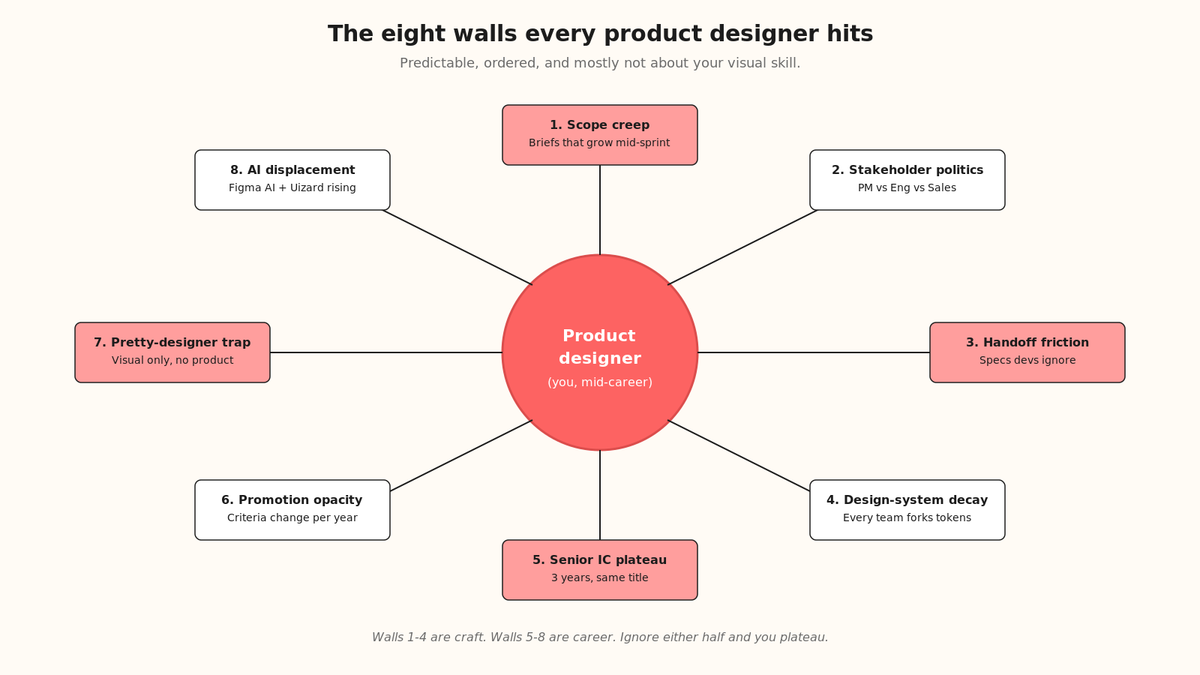
Q1. What are the eight predictable obstacles a product designer will face?
Nobody warns you about these when you graduate from a design bootcamp or your first junior role. They arrive year by year, look different at each level, and quietly stall careers when designers don't have language for what they're hitting.
- Scope creep on every project. The brief says one screen. Six weeks later you've designed eleven and rebuilt the information architecture twice.
- Unclear briefs. "Make our product feel modern." Three sentences, zero success metrics, and a launch date in four weeks.
- Stakeholder politics. The CEO wants pink. The CPO wants blue. The VP of Growth wants both. You want to keep your job.
- Engineering handoff friction. The Figma file is perfect. The build is unrecognisable. The engineers say "we didn't have time." The PM says "ship it anyway."
- Design-system decay. The design system was pristine in year one. In year three, there are 4 button primaries, 11 shades of grey, and 7 spacing scales.
- Career plateau at Senior IC. Five to seven years in, the promotions stop. Every role you look at is "Staff Designer" and you don't know what that means.
- Unclear promotion criteria. Your manager can't tell you what "senior" looks like. The rubric is 47 bullet points and nobody agrees on any of them.
- The "just make it pretty" trap. You get pigeonholed as the "visual designer." Product decisions happen without you. You're the last person in the room.
Q2. How do you deal with scope creep and unclear briefs?
These two obstacles are the same problem wearing different clothes. Both trace to the same root cause: the brief you were handed was not a brief. It was a wish. Your job as the designer is to convert the wish into a brief before you open Figma.
The tool that works is a one-page project charter written by you and signed by the PM before design starts. Four sections: What we're solving (in one sentence, tied to a user job), Who we're solving it for (specific persona with a real name), How we'll know we succeeded (one metric with a target), and What's out of scope (the three things you will not do).
The "out of scope" section is the single highest-leverage sentence you will write all quarter. It gives you the words to say no when the CEO drops in mid-project with a request that doubles the work.
"We adopted a project charter template across the design team in Q2 2024. Average project duration dropped from 9 weeks to 5.5 weeks, and PM satisfaction scores went up 22 points. The template is literally one Google Doc with four headings."
— Verified User in Software, Figma - G2 Verified Review
Q3. How do you handle stakeholder politics?
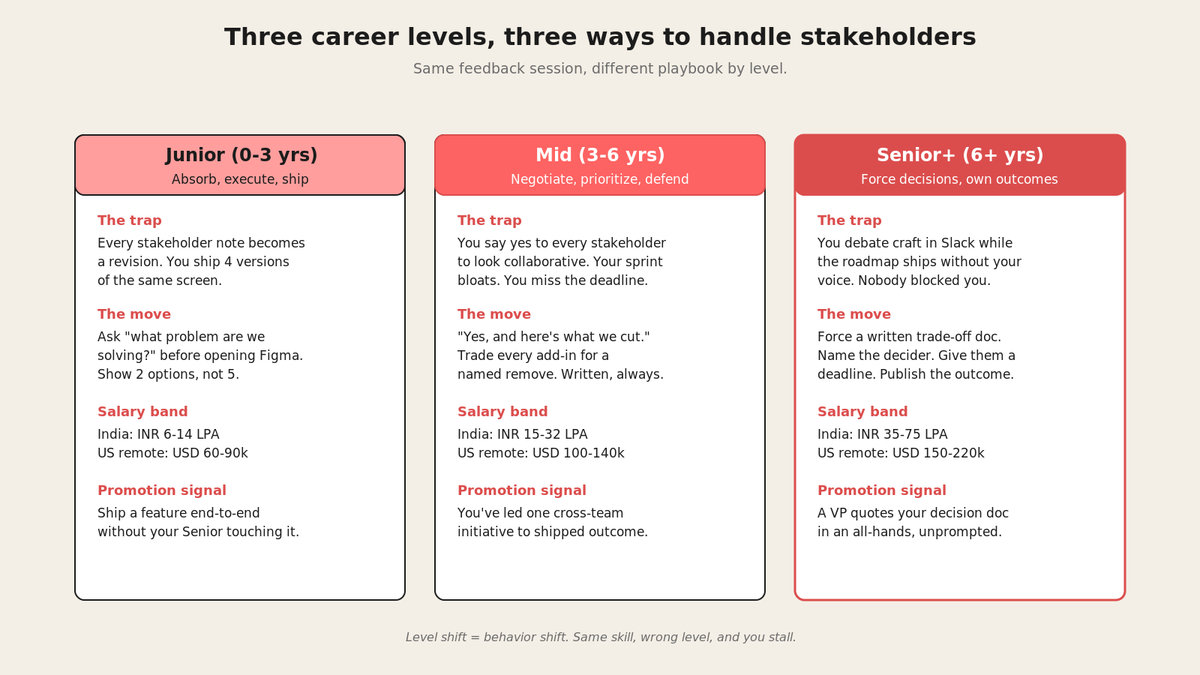
The mistake most designers make is treating stakeholder disagreement as a design problem to be solved by better mockups. It isn't. Stakeholder disagreement is a decision-making problem, and the design team's job is to make the decision faster, not to try to make every stakeholder happy.
Three moves that work:
Force explicit trade-offs. When the CEO wants X and the CPO wants Y, put both options in front of them side by side, with the cost of each named in weeks-of-engineering-time. Watch the argument change from "which is prettier" to "which is worth the money." Almost every executive picks the cheaper one.
Own the "designer's recommendation" moment. After you present two or three options, always end with your recommendation and your reasoning. Not "here are options, what do you think" but "here's what I recommend, here's why, and here's what would change my mind." That single sentence is what separates a Senior designer from a Junior.
Get the decision in writing. After the meeting, send a Slack message: "Confirming we chose Option B. Rationale: X. Rolling this into build." That message is your armour against re-litigation next Wednesday.
Q4. How do you fix engineering handoff friction?
The perfect Figma file dies on contact with the engineering ticket. This is not because engineers are lazy or don't respect design. It's because the handoff format was optimised for the designer's workflow, not the engineer's.
The fix is to write specs in the format your engineers actually use. On a React team, that means describing components in the vocabulary of props and states, not in the vocabulary of hover-and-active layers. On a native mobile team, that means describing layouts in terms of Auto Layout constraints, not in terms of "align this to that."
| Team type | What they need most | Common designer mistake |
| React / Vue front-end | Component structure + props + states named as code | Delivering static screens; skipping empty/loading states |
| iOS / Android native | Auto Layout constraints + platform component names | Custom components that fight the platform's design system |
| Backend-heavy full-stack | Error states + edge cases + copy for every scenario | Only designing the happy path |
| Design-system / platform team | Token references + Figma variables mapped to code tokens | Hardcoding colours instead of using system tokens |
Q5. How do you keep a design system from decaying?
Every design system dies the same way. Year one: pristine. Year two: two "temporary" components get merged in for a launch. Year three: eleven greys, four button primaries, seven spacing scales. Year four: nobody uses the system anymore because it doesn't reflect what the app actually looks like.
Design systems that survive treat themselves as products, with the other designers as their users. That means shipping releases, writing changelogs, deprecating on a schedule, and running usage analytics on which components actually get pulled from the library. It also means having one person whose job is the system, not a side project for someone who also has three other projects.
"Our design system went from 3 button primaries and 8 greys back to 1 button primary and 4 greys after we started running quarterly system audits. The audit takes one designer 3 days per quarter and has saved us 40+ hours of review cycles per sprint."
— Verified User in Consumer Goods, Figma - G2 Verified Review
Q6. What is the Senior IC plateau and how do you get past it?
Five to seven years in, the promotions stop. The next role above "Senior Product Designer" is "Staff Designer" or "Principal Designer" and no manager can tell you exactly what that means. This is the biggest career wall most designers hit, and the wall that kills the most careers when designers don't have a plan.
There are three real paths past it, and picking wrong wastes 2-3 years.
| Path | What it takes | 2026 India comp (INR LPA) |
| Staff / Principal IC | Cross-team influence, systems thinking, teaching others | 45 to 90 |
| Design manager (5-8 reports) | People management, org design, hiring, career coaching | 50 to 100 |
| Independent consultant | Direct client sales, contract closing, brand building | 60 to 200 (variable) |
The wrong path costs you two to three years and often a step backwards in title. Most designers I know who went manager-first without wanting to have quietly moved back to IC roles within 18 months.
Q7. How do you decode unclear promotion criteria?
Design career ladders are famously vague. "Ambiguity" appears on level 6 of a Google-style ladder and nobody agrees what it means. The move that works: stop reading the rubric and start reading who actually got promoted.
Look at the last three designers who got promoted to the level you want. What did they ship in the 12 months before promotion? Who did they present to? What cross-team projects did they lead? What was their manager's manager's public praise about? That pattern is your actual rubric. The written rubric is decorative.
"I stopped chasing the design ladder rubric and started interviewing the three people at my company who'd been promoted to Staff in the last year. Every one of them had led a cross-org initiative with a business metric attached. That was the actual bar."
— Verified User in Software, Figma - G2 Verified Review
Q8. How do you escape the "just make it pretty" trap?
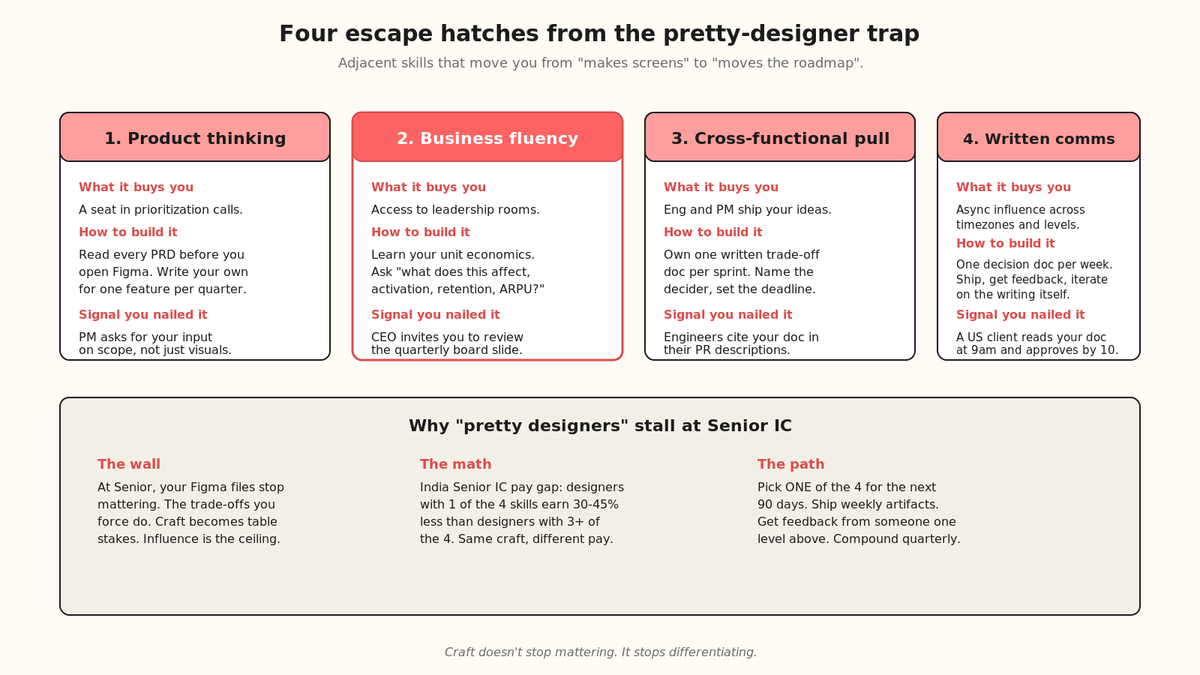
The pigeonhole most kills careers is being known as the "visual designer" on your team. Once that reputation locks in, product decisions happen without you, engineering scoping happens without you, and by the time you see the work it's a paint-by-numbers exercise.
The escape is deliberate cross-functional over-reach. Show up in product-planning meetings you weren't invited to. Write the roadmap draft nobody asked for. Draft the user-interview script before the researcher does. Send the PM a written product brief for their upcoming quarter with your recommendations attached. Nobody will stop you, and inside 6 months your reputation shifts.
Q9. How is the AI wave (Figma AI, v0, Framer AI) changing the job?
The tools got very good very fast. Figma AI drafts screens from prompts, v0 turns prompts into shippable React components, Framer AI builds live landing pages from a sentence. The "make it look nice" layer of product design is being compressed at exactly the speed engineers predicted.
What doesn't compress: taste, product thinking, cross-functional influence, and the ability to reason about tradeoffs in front of a room of executives. Designers whose value was mostly visual craft will feel this wave hardest. Designers whose value is product thinking will find AI tools accelerate them 2-3x.
The practical move for a designer in 2026: use the AI tools aggressively for early exploration and shippable prototypes, and reinvest the saved hours into product research, cross-functional presence, and writing clearer specs. The designers who resist the tools will spend 2028 wondering why they got laid off.
Q10. What is different about being an India-based product designer?
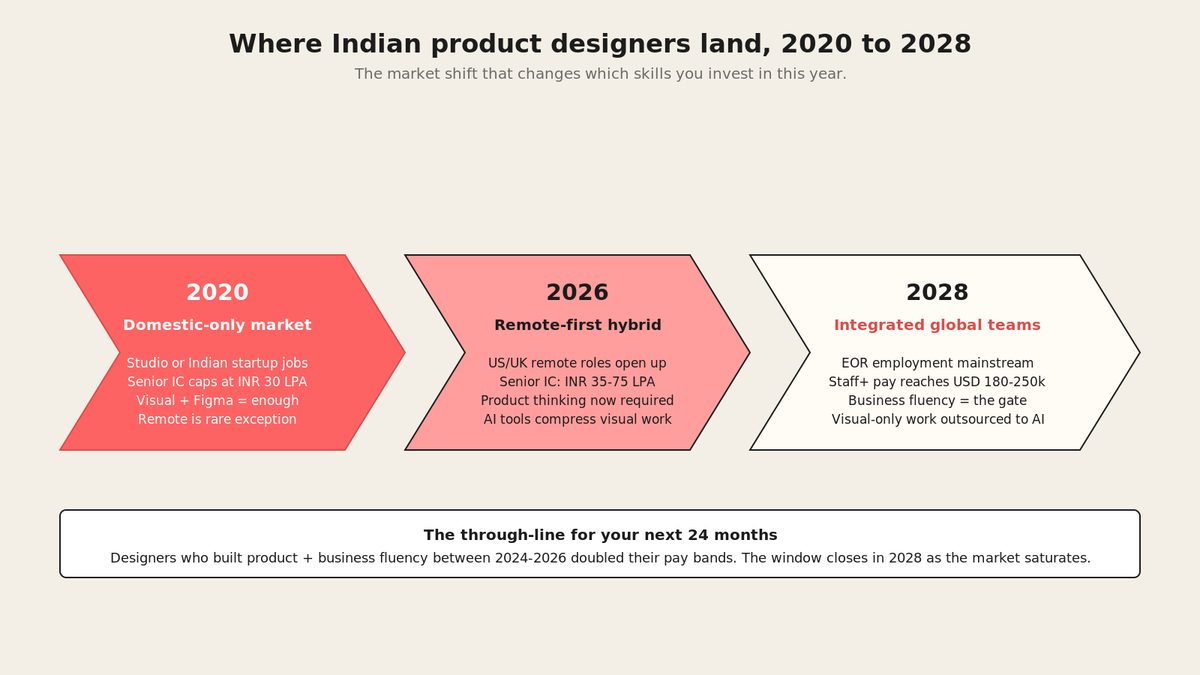
Two things are structurally different. The first is comp. Equivalent-level product designers in India earn 40-60 percent less than US or UK peers doing the same work. A Senior Product Designer at a US Series B startup makes USD 140,000. A Senior Product Designer at an equivalent Indian startup makes INR 30-40 lakhs (roughly USD 36,000 to 48,000). This is not because Indian designers are worse. It's because the domestic market clears at a lower price.
The second is a promotion ceiling at large product companies. Head of Design roles at India-HQ product companies are relatively few, and Head of Product / Head of Engineering titles almost never go to designers. This caps the career ladder in a way that doesn't cap in the US or Western Europe.
The path around both walls is the same: work directly with US, UK, or European product companies, either remote-first or through employer-of-record arrangements that make you a full employee of the overseas company while you sit in Bangalore or Gurgaon. That closes 30-50 percent of the pay gap and unlocks the career ladders that domestic hopping cannot.
FAQs
What's the single highest-leverage skill for a product designer?
Written communication. Designers who write clear one-page product briefs, sharp specs, and crisp Slack summaries ship 30-40 percent faster because they cut clarifying-question loops. This is undervalued in most design bootcamps and screamingly rewarded in most Series B+ product companies.
Should I become a manager if I hit the Senior IC plateau?
Only if you're excited about people work, not if you're just avoiding the plateau. Design management is a genuinely different job (5-8 reports, org design, hiring, career coaching) and if you don't actively want it, you'll be miserable inside a year and back on the IC track by month 18.
Are AI tools going to take my job?
Not if your job is product thinking, cross-functional influence, or design systems. Yes if your job was mostly visual polishing. The compression of the "make it pretty" layer is real and accelerating.
How do I get promoted to Staff Designer?
Lead a cross-organisation initiative with a business metric attached, and make sure your manager's manager (and their manager) sees the impact. Written case studies of your work, presented at company all-hands or design leadership forums, are the currency of Staff-level promotions.
Is portfolio still the most important thing for job hunting?
For Junior and Mid roles, yes. For Senior and above, the portfolio matters less than the written case study of one or two projects and the story of how you thought about tradeoffs. Referrals from ex-colleagues also carry disproportionate weight above the Senior level.
How do I find remote design roles with US or UK companies from India?
Three channels that actually work in 2026: Y Combinator's Work at a Startup platform (filter for remote-friendly), design-specific Slack communities (Designer Hangout, Product Design Newbies, Design Details listeners), and direct outbound to design leaders at Series A-C companies you admire. Cold outbound with a written work sample and a specific point of view about their product converts far higher than portfolio-first applications.
Where my head is right now
What I tell design leaders every week: the career walls above are predictable, and the tools to climb over them are learnable. What's harder to fix is the structural pay gap and the promotion ceiling for India-based designers. That's where the leverage of working with overseas product companies really compounds.
At Versatile we help US and UK-headquartered product companies hire senior designers, staff designers, and design leads in India as full employees on our entity. If you're a designer in India who has been talking to a US or UK company and they've said "we don't have an India entity so we can only do contract," that's exactly the problem we solve. We're an India-native EOR, so we become the legal employer for you in India while you work directly for the overseas company as a full-time employee, with proper PF, gratuity, and health benefits.
If you're navigating that conversation right now, or if you're a hiring manager overseas trying to figure out how to bring a Bangalore-based designer onto your team properly, book a 15-minute call at calendly.com/the_versatile_club/30min or fill this form and I'll reach out.
, Sagar Chainani, Founder, Versatile
Tell us where you are on the decision.
A role you want to hire, a team you want moved, or just the two routes to compare. A named person replies in 4 to 6 hours.
What the first call covers
30 minutesA cost comparison for your headcount, on your numbers, both routes.
- A written cost breakdown
- Entity documents before the call
- PF, ESI, TDS, termination law
- No follow-up sequence
You pick the time, we send a Meet link. Any timezone.