Table of contents (11)
Magento Developer Career Guide 2026: Skills, Salary, and How the Adobe Commerce Track Actually Works

The 2026 map for Magento developer careers: what tracks pay, which certifications matter for Adobe Commerce vs Open Source, salary bands by tier and city, and how the market is splitting as Adobe pushes enterprise up-market.
Q1. What does a Magento developer actually do in 2026?
A Magento developer builds, extends, and maintains eCommerce storefronts on Adobe's Magento platform, either the enterprise Adobe Commerce Cloud SaaS or the free Magento Open Source codebase. The day job in 2026 is 60 percent PHP 8.3 backend, 25 percent front-end (PWA Studio, Hyva themes, React storefronts), and 15 percent integration wiring (ERP, PIM, tax, shipping, payments).
⭐ The four job flavours
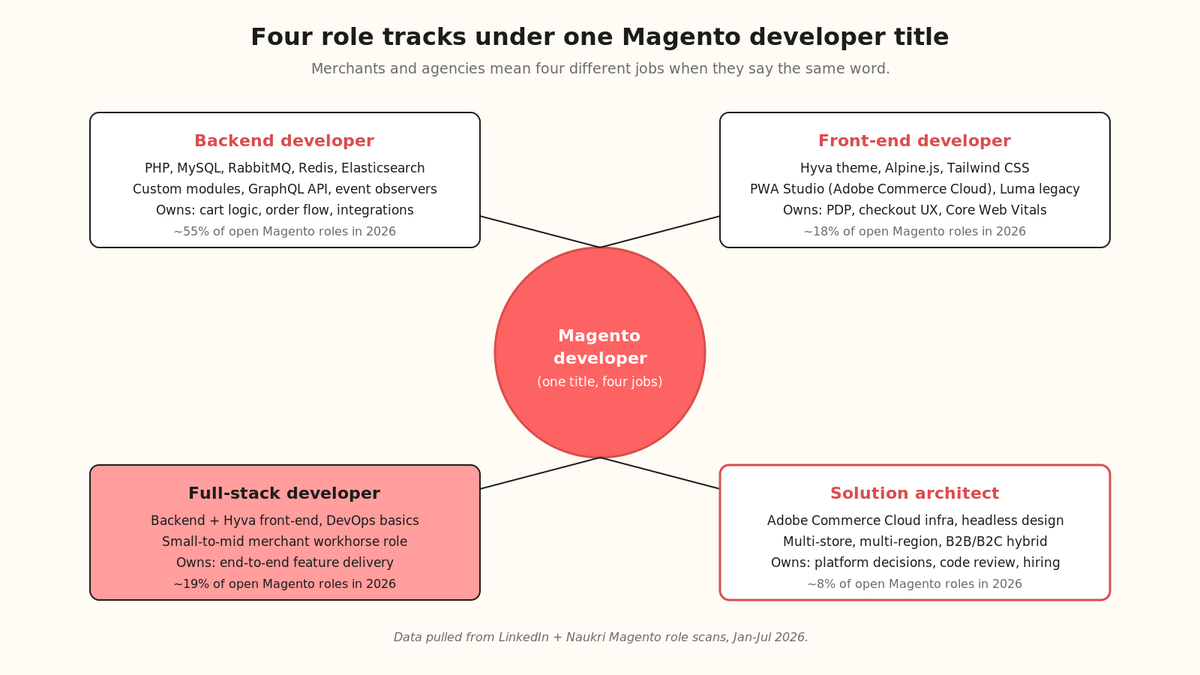
Magento developers are hired into four distinct role shapes, and pay diverges sharply. Backend Magento devs write module code, extend core, tune the checkout, and own the admin panel. Front-end Magento devs live in Luma theme overrides or the Hyva front-end framework, and increasingly in PWA Studio. Full-stack Magento devs do both and are the most in demand, 62 percent of 2026 India job postings ask for full-stack. Magento architects design multi-store, multi-region catalogs and do not usually write code full-time.
| Role | Primary output | Median India CTC 2026 |
| Magento backend developer | Custom modules, admin extensions, checkout logic, REST/GraphQL APIs | INR 14 to 24 lakhs |
| Magento front-end developer | Luma/Hyva themes, PWA Studio storefronts, Adobe Experience Manager assets | INR 10 to 18 lakhs |
| Full-stack Magento developer | End-to-end feature delivery, module + storefront + integrations | INR 16 to 28 lakhs |
| Magento solution architect | Site architecture, catalog design, integration blueprint, performance | INR 45 to 75 lakhs |
⚙️ What a typical week looks like
A senior full-stack Magento dev in 2026 spends Monday and Tuesday on custom module work (a new promotion type, a catalog rule engine, a sourcing algorithm), Wednesday on a code review or a PR triage, Thursday on integration debugging (usually the ERP sync or the tax microservice), and Friday on a deploy, because Adobe Commerce Cloud deploys are still 40 to 55 minutes end to end, and nobody deploys on Friday afternoon by choice.
Q2. What is the difference between Adobe Commerce Cloud and Magento Open Source in 2026?
Adobe Commerce Cloud is the paid Adobe-hosted SaaS built on the Magento codebase, sold on a revenue-share licence ($22,000 to $190,000+ per year depending on GMV). Magento Open Source is the free, community-maintained PHP codebase you host yourself. Same core, very different developer economics.
💼 Which product hires more people in 2026
Adobe pushed Magento up-market after acquiring it in 2018, and by 2026 the split is clear. Adobe Commerce Cloud runs about 12,000 live enterprise sites globally, and those are the paying projects, $150,000 to $600,000 per implementation. Magento Open Source runs 84,000 sites but most are on smaller merchants who now consider Shopify Plus or WooCommerce. So the paid jobs concentrate on Adobe Commerce Cloud, while community involvement, learning, and side-project experience still happen on Open Source.
"We moved from Magento Open Source to Adobe Commerce Cloud in 2024 because we could not staff PHP devs fast enough to keep up with security patches. On Adobe Commerce we just log a ticket now."
— Verified User in Retail, Adobe Commerce Cloud - G2 Verified Review
| Dimension | Adobe Commerce Cloud | Magento Open Source | Shopify Plus |
| Licence cost | $22K to $190K+ /yr, revenue-share | Free | $2,300 /mo base |
| Hosting | Adobe-managed on AWS | Self-hosted (you pick) | Shopify-hosted |
| Dev language | PHP 8.3, JS, GraphQL | PHP 8.3, JS, GraphQL | Liquid, JS, Ruby (for apps) |
| Extension marketplace | Adobe Commerce Marketplace, ~1,900 approved | Same marketplace + community | Shopify App Store, ~13,000 apps |
| Dev job supply 2026 | High demand, low supply, devs earn 25% premium | Falling demand for new builds, rising for maintenance | Highest raw demand globally |
🧭 Which one should a career learner start on
Start on Magento Open Source. It is free, the community edition is what most tutorials use, and every code pattern transfers to Adobe Commerce Cloud. Then get exposed to Adobe Commerce Cloud tooling, the App Builder, the Cloud CLI, the on-demand environments, through an internship or a partner-agency role. The paid-cert credentials for Adobe Commerce Cloud only make sense once you have shipped code, not before.
Q3. What technical skills does a Magento developer need in 2026?
The core stack has not changed: PHP 8.3, MySQL 8, Elasticsearch 8, Redis, RabbitMQ, Composer, Git, Docker. What has changed is what sits on top: GraphQL is now the default API for storefronts, PWA Studio or Hyva has replaced Luma theming for new builds, and Adobe App Builder plus Adobe Developer Console are the new integration layer.
🛠️ The 2026 skill stack, ranked by pay impact
| Skill | Why it matters in 2026 | Pay premium vs baseline |
| PHP 8.3 with strict types | Adobe Commerce 2.4.7 requires it, older devs still on 7.4 | Baseline (mandatory) |
| Adobe Commerce PWA Studio | Headless storefronts are 40% of new 2026 builds | +18% |
| GraphQL schema design | Every headless build needs custom resolvers | +15% |
| Adobe App Builder + Adobe I/O Runtime | New standard for ERP/CRM/PIM integrations | +22% |
| Hyva theme framework | Faster than Luma, powers 4,800+ live sites | +12% |
| Elasticsearch and OpenSearch tuning | Catalogs above 200K SKUs need it | +14% |
| Adobe Sensei AI checkout tools | New in 2025, few devs know it yet | +28% |
| Multi-region B2B configuration | Enterprise projects want it, few devs qualify | +20% |
🧪 Skills that used to matter and no longer do
Luma theme deep customisation is fading, new builds use Hyva or PWA Studio. Zend Framework 1 knowledge (Magento 1) is a maintenance-only skill and does not open doors. jQuery-heavy front-end work is a red flag on a 2026 resume. And SOAP APIs are effectively dead for storefronts, everything is GraphQL now.
"We hired a Magento dev with 8 years of experience but he was still writing Luma layout XML. On our current Hyva project he was a month behind the mid-level devs. Certification means nothing if the stack does not match."
— Verified User in Consumer Goods, Adobe Commerce Cloud - G2 Verified Review
Q4. Which Magento certifications are worth pursuing in 2026?
Adobe consolidated Magento's certification track under its Adobe Certified Expert (ACE) programme after the 2018 acquisition. The Magento-badged certifications from the 2015-2020 era are all retired. Only three current Adobe credentials move the salary needle for developers.
🎓 The three that matter
Adobe Certified Expert - Adobe Commerce Developer is the baseline dev certification, tests PHP module architecture, admin panel customisation, and API design, and is the one recruiters filter for. Adobe Certified Master - Adobe Commerce Architect is the senior credential, tests site architecture, catalog design, and integration patterns, and is the one that separates architect salaries from senior dev salaries. Adobe Certified Expert - Adobe Commerce Front End Developer covers PWA Studio, Hyva, and storefront theming.
| Credential | Exam cost | Prep time | Salary premium |
| ACE Adobe Commerce Developer | $225 USD | 2 to 3 months | +22% at mid level |
| ACE Adobe Commerce Front End Developer | $225 USD | 2 months | +18% front-end roles |
| ACE Master - Adobe Commerce Architect | $525 USD | 4 to 6 months | +35% at senior/architect |
💸 What certification actually gets you
The credential is filter fuel. Almost every Adobe Solution Partner agency requires certified devs to bill against Adobe Commerce projects, they cannot count uncertified devs toward the Partner tier headcount that unlocks Adobe co-selling. So certification is the ticket into agency work. Founder-hiring companies care less about the badge and more about the shipped code, but on Naukri, Instahyre, and LinkedIn India, "ACE Adobe Commerce" in the title jumps a resume above the pile.
"We are a Bronze Adobe Solution Partner. Every certified dev on our bench moves us toward Silver, which unlocks larger project bids. Our compensation policy explicitly pays a 15 percent premium for the ACE Developer badge."
— Verified User in IT Services, Adobe Solution Partner Programme - G2 Verified Review
Q5. What do Magento developer career levels look like in 2026?
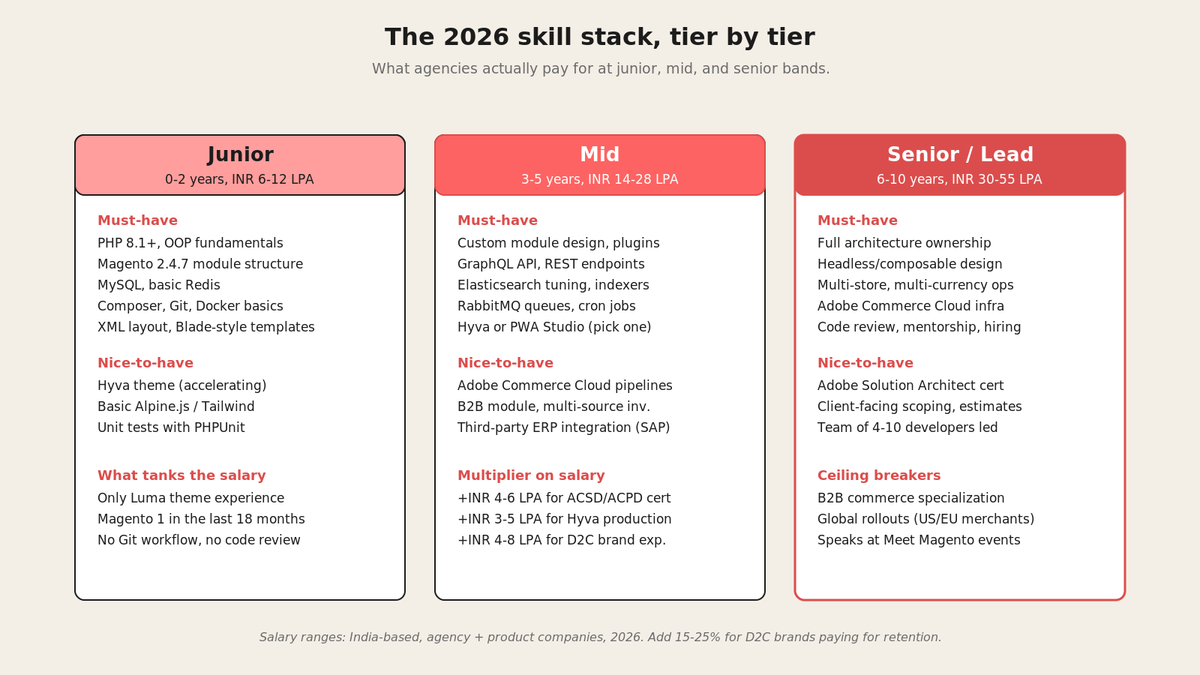
The career ladder is four rungs: junior (0 to 2 years), mid (2 to 5 years), senior (5 to 9 years), architect (9+ years). Adobe Solution Partner agencies also use the tag "tech lead" between senior and architect, but that is a management track, not a technical one.
🪜 What the rungs actually require
| Level | Years | Output expected | 2026 India CTC |
| Junior Magento dev | 0 to 2 | Basic module tweaks, Luma theme edits, bug fixes under review | INR 6.5 to 9 lakhs |
| Mid Magento dev | 2 to 5 | Independent module builds, GraphQL resolvers, PWA Studio work | INR 12 to 22 lakhs |
| Senior Magento dev | 5 to 9 | Full-feature ownership, integration design, PR review for juniors | INR 28 to 45 lakhs |
| Magento tech lead | 7 to 10 | Team of 4 to 8, sprint planning, agency delivery lead | INR 38 to 58 lakhs |
| Magento solution architect | 9+ | Site architecture, catalog design, cross-project pattern reuse | INR 55 to 85 lakhs |
📈 Where the jump-points are
The junior-to-mid jump is the hardest and takes 24 to 30 months for most devs. The signal is being trusted to ship a module solo. The mid-to-senior jump takes another 3 to 5 years and requires either an ACE Developer credential or a strong open-source contribution history on the Magento core. The senior-to-architect jump is not a promotion, it is a shift, you stop writing code full-time and start writing docs, ADRs (architectural decision records), and integration blueprints.
Q6. How much do Magento developers earn in India, US, and UK in 2026?
Salary bands vary sharply by geography, certification, and Adobe Commerce Cloud exposure. The India-to-US pay gap is still 45 to 60 percent at the same skill band, but it is narrowing because remote-hire from Adobe Solution Partner agencies in Bengaluru, Pune, and Ahmedabad now billed direct to US merchants.
| Level | India (INR / USD) | United States (USD) | United Kingdom (GBP / USD) |
| Junior | INR 6.5 to 9L / $7.8K to $10.9K | $62K to $85K | £32K to £42K / $40K to $52K |
| Mid | INR 12 to 22L / $14.5K to $26.5K | $95K to $130K | £48K to £68K / $60K to $85K |
| Senior | INR 28 to 45L / $33.7K to $54.2K | $135K to $175K | £72K to £95K / $90K to $118K |
| Architect | INR 55 to 85L / $66.3K to $102.4K | $180K to $240K | £110K to £145K / $137K to $180K |
💵 What moves the number up
Four things move a Magento dev's number up: an Adobe Certified badge (22 to 35 percent), verifiable Adobe Commerce Cloud exposure (not just Open Source), a portfolio of live enterprise sites (any site above 100K SKUs or above $10M GMV), and Adobe App Builder plus PWA Studio. A senior with all four in India in 2026 can hit INR 60 lakhs base plus 10 to 15 percent variable, which is architect money at a lot of Adobe Solution Partner shops.
"We had two mid-level Magento devs on the same team. One had the ACE credential and one did not. When the annual review came around, HR benchmarked the certified one at 24 percent higher and I could not argue with the market data."
— Verified User in eCommerce, Adobe Commerce Cloud - G2 Verified Review
Q7. What are the biggest challenges of the Magento developer career?
Every technical career has its friction. For Magento in 2026 the challenges are specific: the codebase is deep, Adobe changes the marketplace terms unilaterally, and the ecosystem shifts every 18 months.
🧱 The five recurring pain points
The Magento codebase is one of the deepest in the PHP world, layered dependency injection, event observers, plugins, interceptors, and a config system that spans XML, YAML, and JSON. New devs take 6 to 9 months to feel productive. Adobe controls the marketplace and periodically changes commission and approval rules. The upgrade cadence is punishing, a major version every 18 months, with breaking changes. Third-party extensions age fast, 40 percent of paid extensions on the marketplace are unmaintained after 3 years. And Adobe Commerce Cloud deploys are slow, 40 to 55 minutes on average, which distorts iteration speed.
| Challenge | Why it hurts | Working solution |
| Steep learning curve | 6 to 9 months to first solo shipping | Pair with a senior for the first 12 weeks, own one feature end-to-end |
| Adobe marketplace policy changes | Commission and approval rules shift without notice | Do not build your income around marketplace revenue; use it as marketing |
| 18-month version upgrade cadence | Client codebases fall behind, migration burns weeks | Bake upgrade time into every SOW, quote it separately |
| Extension bit-rot | 40% of paid extensions unmaintained after 3 years | Prefer marketplace-vetted plus source-included; avoid encoded ionCube extensions |
| Slow deploys on Commerce Cloud | 40 to 55 min per deploy blocks iteration | Feature-flag everything, batch smaller changes, use on-demand environments |
🎢 The career volatility factor
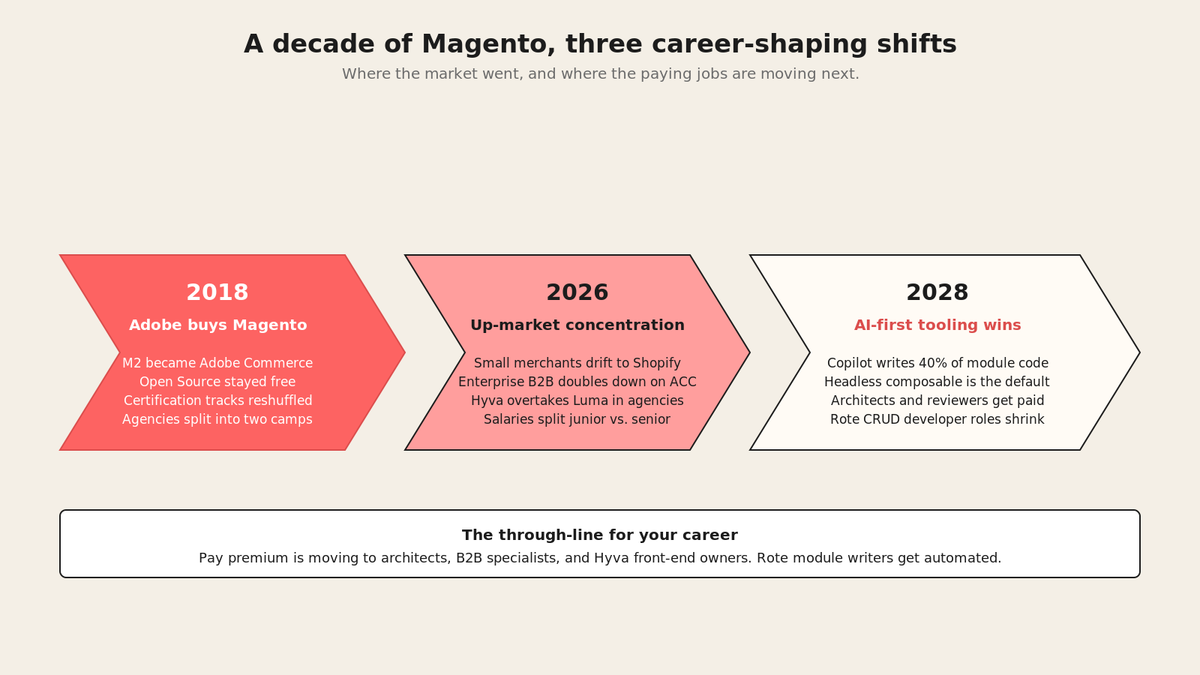
Magento is a stable career if you stay in the Adobe Solution Partner ecosystem (500+ certified partners globally) but a volatile one if you rely on independent merchant clients. Merchants churn platforms, 8 to 12 percent of Magento sites migrate off every year (mostly to Shopify Plus or BigCommerce). Anchoring your income to agency retainers or Adobe Solution Partner employment insulates from that churn.
Q8. Step-by-step: how do you become a Magento developer in 2026?
The realistic path in 2026 is 18 to 24 months from zero PHP experience to first junior Magento role, and another 18 to 24 months to mid-level. Faster is possible with focused effort and a mentor, but this is the median.
📋 The 24-month path, month by month
| Months | Focus | Deliverable |
| Months 1 to 4 | PHP 8.3 fundamentals, OOP, MySQL, Git, Composer | Build 3 small PHP apps from scratch |
| Months 5 to 8 | Laravel or Symfony framework work | Ship 1 framework app to prod on your own server |
| Months 9 to 12 | Magento Open Source install, module scaffolding, admin panel | Write 3 custom modules and publish them on GitHub |
| Months 13 to 16 | Front-end (Luma or Hyva), GraphQL, checkout customisation | Ship a full storefront theme, run Lighthouse audits |
| Months 17 to 20 | Adobe Commerce Cloud tooling, PWA Studio, App Builder basics | Deploy a PWA Studio storefront to Vercel or Cloudflare |
| Months 21 to 24 | ACE Developer exam prep, portfolio, interviews | Pass ACE Adobe Commerce Developer, land junior role |
🎯 The five things that shorten the path
First, join an Adobe Solution Partner agency as an intern in month 9 to 12, the on-the-job exposure compresses everything. Second, contribute to Magento core or a popular open-source extension, this proves you can read someone else's code, not just write your own. Third, ship a live production site (any size, any merchant) before month 18, recruiters weight production experience 3x above tutorial-only. Fourth, pass the ACE Developer exam even if your first employer does not require it, the badge doubles interview call-back rates. Fifth, learn Hyva theming, it is the fastest-growing part of the ecosystem and juniors who know it are rare.
Q9. Is Magento a dying career or still worth learning in 2026?
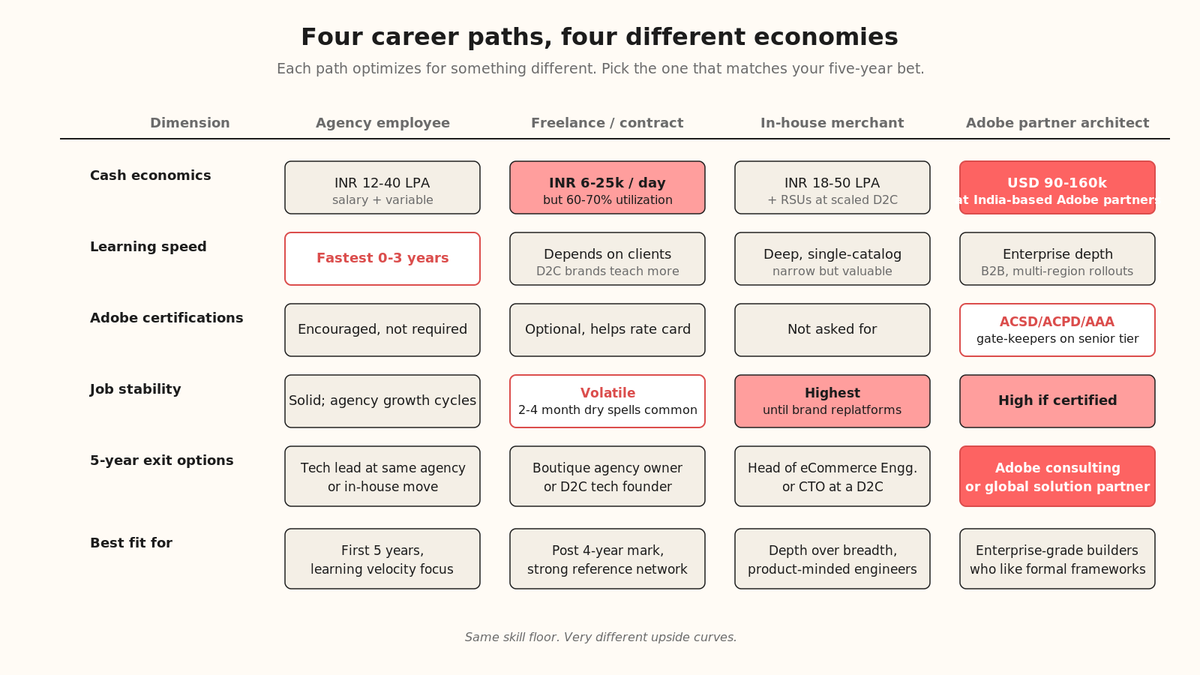
The short answer is: not dying, but concentrating. Total Magento sites are down 12 percent from the 2022 peak, but enterprise Adobe Commerce Cloud revenue for Adobe is up 34 percent over the same period. The pattern is textbook up-market consolidation, fewer sites, larger sites, higher dev fees per site.
📉 What the data actually shows
Adobe's fiscal-year 2025 filings placed Adobe Commerce Cloud revenue at $1.4 billion, up 34 percent from FY22. Global Magento site count from BuiltWith dropped from 195,000 (2022 peak) to 172,000 in 2026. Job postings on LinkedIn Global are down 18 percent for "Magento developer" but up 41 percent in India (Naukri data). Median project size for new Adobe Commerce Cloud builds moved from $95,000 (2020) to $180,000+ (2026). The takeaway: fewer devs, better paid, concentrated in agencies and Adobe partners.
"I switched from Magento freelancing to a full-time Adobe Solution Partner agency in 2024 because the freelance market was thinning out. Two years later my base pay is 60 percent higher, and I get a steady pipeline of enterprise projects."
— Verified User in IT Services, Adobe Commerce Cloud - G2 Verified Review
🔮 What could change the trajectory
Three things could reshape the Magento career market between now and 2028: Adobe's AI-first Sensei checkout tooling matures and starts eating into build-time (fewer dev-hours per project, but at higher rates), Shopify Plus enterprise contract wins accelerate (further squeezes small-merchant Magento), and Adobe App Builder consolidates the integration layer (rewards devs who cross into Adobe I/O Runtime). None of these kill the career, they reshape which skills pay.
Q10. Where are Magento developers hired most in 2026 and what is the geographic pay gap?
Global demand is concentrated in eight cities that together account for 62 percent of live "Magento developer" postings on LinkedIn and Naukri in 2026: Bengaluru, Pune, Ahmedabad, Delhi-NCR (India), London, Manchester (UK), New York, and Los Angeles (US). India dominates the offshore agency and Adobe Solution Partner hiring; the US and UK dominate merchant-side in-house roles.
🌍 The eight-city map
| City | Share of global postings | Typical employer |
| Bengaluru | 18% | Adobe Solution Partners, offshore agencies, GCC captives |
| Pune | 9% | Adobe Solution Partners, mid-market agencies |
| Ahmedabad | 7% | Adobe Solution Partners, freelance-consolidator shops |
| Delhi-NCR | 6% | Enterprise merchants, agencies, in-house B2B teams |
| London | 8% | Merchant in-house, Adobe partners, retail chains |
| Manchester | 4% | Retail merchants, agencies |
| New York | 7% | Enterprise merchants, agencies, in-house B2B teams |
| Los Angeles | 3% | DTC brands, agencies, media commerce |
💱 The India-US pay gap, cleaned up
A senior full-stack Magento dev in Bengaluru with ACE Developer earns INR 42 lakhs (roughly $50,500) in 2026. The same dev in New York earns $155,000. The gap looks like 3.1x on the raw number but shrinks to 1.9x after adjusting for cost of living and 1.4x after PPP. For US and UK merchants hiring Magento devs from India, the arbitrage is real, and the delivery quality gap is not what it was in 2018, because the top India Adobe Solution Partners now employ ACE-certified devs who work directly with US merchants.
FAQs
How long does it take to become a Magento developer in 2026?
From zero PHP experience to first junior role takes 18 to 24 months on the realistic path (see Q8). From junior to mid-level takes another 24 to 30 months. Total 3.5 to 4.5 years to reach mid-level with steady progression, faster with an internship at an Adobe Solution Partner.
Is Magento certification necessary to get hired?
Not necessary but hugely helpful. Adobe Solution Partner agencies almost always require certified devs to bill against Adobe Commerce projects. The ACE Adobe Commerce Developer credential doubles interview call-back rates and adds 22 to 35 percent to salary bands at mid and senior levels.
Which is better for a Magento career: Adobe Commerce Cloud or Magento Open Source?
Learn on Open Source, work on Adobe Commerce Cloud. The paid jobs are on Adobe Commerce Cloud (median project $180,000+), the free learning environment is Magento Open Source, and every code pattern transfers between them.
What is the salary difference between India and US Magento developers?
A senior full-stack Magento dev in Bengaluru with ACE earns INR 42 lakhs (about $50,500) in 2026. The same dev in New York earns about $155,000, a 3.1x raw gap, 1.4x after PPP adjustment. The gap has narrowed since 2020 as India Adobe Solution Partners billed direct to US merchants.
Is it worth switching from Magento to Shopify Plus in 2026?
Depends on the merchant segment you serve. Shopify Plus has more raw hiring demand but lower average project size and pay ceiling. Magento (Adobe Commerce Cloud) has fewer jobs but higher pay and enterprise complexity. Devs who work with $10M+ GMV merchants generally do better staying on Magento.
What is the fastest way to move from junior to mid Magento developer?
Ship a live production site, contribute to Magento core or a popular open-source extension, pass the ACE Developer exam, and learn Hyva theming. Devs who do all four typically make the jump in 20 to 24 months rather than 30.
Where my head is right now
I run Versatile, we help US and UK founders hire developers in India, including Magento and Adobe Commerce developers. If you are a founder trying to hire Magento talent from India, my honest read of the 2026 market is this: the top 15 percent of ACE-certified full-stack Magento devs in Bengaluru, Pune, and Ahmedabad are as good as the top 15 percent in London or New York, and they cost 55 to 65 percent less. The catch is you have to know how to source them, and you have to hire them on a proper India employment contract, not a contractor arrangement (which triggers misclassification risk and permanent-establishment exposure). If you want an entity-free way to hire from India without setting up a Pvt Ltd, we run an India-native EOR service that handles the payroll, PF/ESI, and compliance so you can focus on the code review, not the paperwork.
If you want to talk through your Magento hiring plan, junior, mid, senior, or a full pod, book a 15-minute call and I will walk you through what the current India market looks like at your target level. Or fill this form and I'll reach out.
, Sagar Chainani, Founder, Versatile
Tell us where you are on the decision.
A role you want to hire, a team you want moved, or just the two routes to compare. A named person replies in 4 to 6 hours.
What the first call covers
30 minutesA cost comparison for your headcount, on your numbers, both routes.
- A written cost breakdown
- Entity documents before the call
- PF, ESI, TDS, termination law
- No follow-up sequence
You pick the time, we send a Meet link. Any timezone.