Table of contents (12)
Hidden Costs of Offshoring: Real Cost Breakdown for India Hiring

Offshoring looks cheap on paper. The real cost: $3,000–$5,500/month via EOR. Here is the hidden breakdown of statutory burden, attrition, and compliance risk.
Q1. What exactly is hidden in offshoring costs?
On paper, the math looks irresistible. You hire a developer in Bengaluru for $12K/year. A US dev costs $120K. Done. But "on paper" is the problem. Reality hits when you discover payroll compliance, statutory deductions, attrition costs, and, worst case, misclassification penalties that cost six figures.
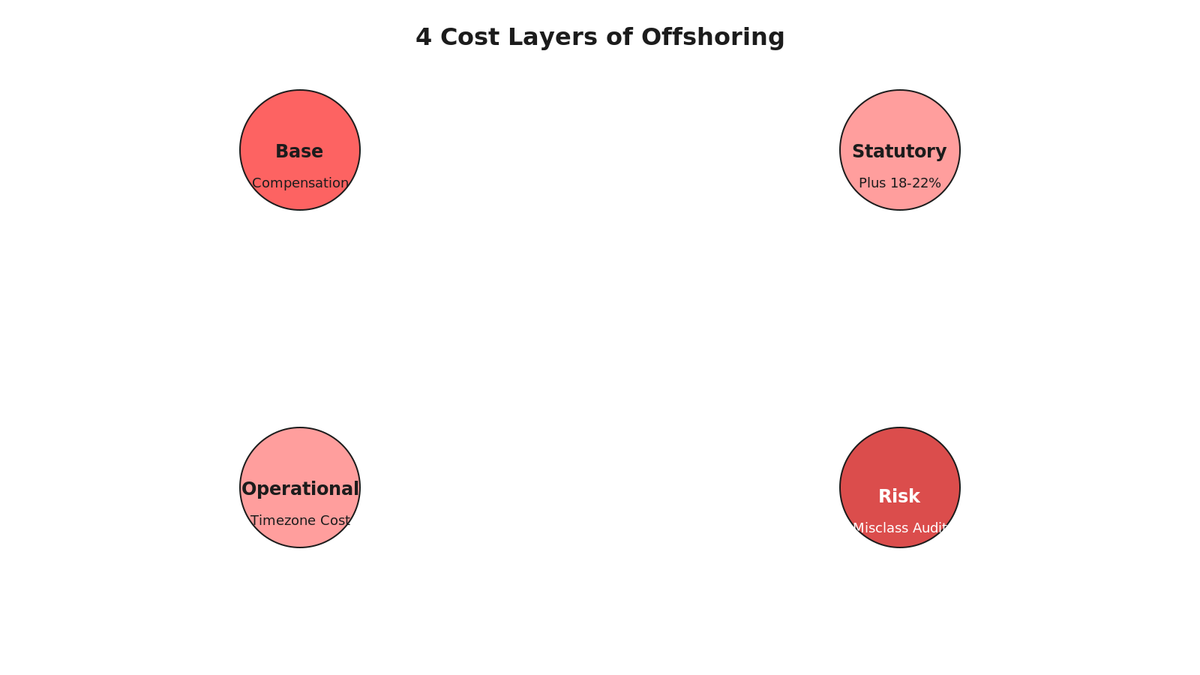
The real cost of hiring overseas breaks into four layers: base compensation, statutory burden, operational friction, and risk. Here is what most founders discover too late: salaries are lower (yes), but competitive talent demands $25K–$45K, not $12K. India requires PF (Provident Fund, 12%), ESI (Employee State Insurance, 3.25%), professional tax, and TDS. These stack to 18–22% on top of base salary. Timezone misalignment (13.5 hours from US West Coast), visa compliance, onboarding friction, and currency hedging add operational layers. Misclassification penalties ($160K–$350K per audit), attrition (25–30% annual in India tech), and compliance drift add legal risk. Real cost per hire: $3,000–$5,500/month via a formal EOR like Versatile. Or $8,000–$25,000+ to set up and maintain your own India entity.
⚠️ The cheap on paper trap
You find a contractor at $5/hour. Sounds unreal. It is. You are either hiring junior/unvetted talent with high churn, or you will discover they are a contractor pretending to be an employee (misclassification). The $5/hour person is unlikely to stay, unlikely to deliver senior-level work, and highly likely to become a classification audit liability. If caught, the entity is liable for back taxes, penalties, and interest dating back 3–5 years. The CRA equivalent in India (Income Tax Department) has been cracking down on contractor misclassification since 2022, with fines now averaging $100K–$300K per misclassified hire.
💸 What founders usually forget
Gratuity fund: 4.81% of (Basic + DA) per year, non-negotiable. You pay it when they leave after 5+ years. Replacement cost: a mid-level engineer takes 6–12 weeks to replace (recruitment, background checks, onboarding paperwork). That is $2,000–$4,000 of lost productivity per replacement. FX hedging: INR has been 3–5% volatile year-on-year. A $5,000/month hire can swing to ₹425,000 (low INR) or ₹375,000 (strong INR) month-to-month. Budget a 3% hedging cost or lock in forward contracts quarterly. Compliance consulting: if you run your own entity and lack internal HR/legal, expect $500–$1,500/month in consulting to stay current with labour code changes, PF/ESI rate updates, and state-specific professional tax rules.
Q2. How is an India hiring entity different from an EOR?
Two paths: build your own legal entity in India (PVT LTD) or use an Employer of Record (EOR) like Versatile. The choice depends on your hiring velocity and risk appetite.
| Aspect | Your own India entity | EOR (like Versatile) |
| Setup time | 4–8 weeks (lawyer, registration, bank account, GST) | 1–5 days (background check, wage review, contract) |
| Setup cost | $3,000–$5,000 (legal, incorporation, initial compliance) | $0–$500 (basic onboarding, first-month fee waived) |
| Monthly cost per employee | $300–$800 (payroll processing, HR, accountant) | $149–$500 (all-in: PF, ESI, payroll, compliance, support) |
| Annual compliance cost | $2,000–$4,000 (audit, tax filing, GST, statutory returns) | $0 (EOR handles all filing) |
| Liability | 100% yours (tax errors, wage underpayment, misclassification) | Shared (EOR is legal employer; you control day-to-day) |
| Compliance ownership | Your responsibility (PF remittance, ESI, TDS, statutory forms) | EOR handles (all filing, amendments, audits) |
| Control | Complete (hire/fire, salary, benefits, work assignments) | Day-to-day you, legal employment relationship with EOR |
For startups with <10 hires, EOR is 60–70% cheaper than owning an entity and reduces your legal/compliance risk to near-zero. For >20 hires, your entity breaks even at year 2, and at >40 hires, entity becomes significantly cheaper. But breakeven assumes you can hire internal HR and maintain compliance discipline; most founders underestimate both.
Versatile is an India-native EOR with multiple US and UK companies on our entity across tech, design, and operations. We have been on the books for 4 years, have zero compliance notices, and maintain a 5-day SLA from offer to first day of work. First month is free. PF, ESI, and statutory coverage across all 28 Indian states. We indemnify against misclassification penalties, meaning if the government audits and finds an issue, we pay the fine, not you.
📇 What is gratuity?
Gratuity is a terminal benefit (lump sum) paid to employees on separation after 5+ years of service. It is 15 days' wages for every year of service, capped at ₹20 lakhs (~$2,400). You fund a statutory gratuity reserve (4.81% of Basic + DA), meaning you set aside cash monthly to cover the liability. If an employee works 5 years at ₹50K/month salary, their gratuity is 15 × 5 × 50K / 30 equals ₹125,000 (~$1,500). This is non-negotiable and applies to both entity and EOR hires. Many founders forget gratuity in their cost model and get surprised when an employee leaves after 5 years. It is a real liability.
Q3. What are the statutory costs that stack on salary?
India's payroll is a layer cake of statutory deductions and employer contributions. Here is the 2026 breakdown in excruciating detail: Employee Provident Fund (PF): 12% of salary, deducted from the employee's pay but matched by you (so 24% total). Employee State Insurance (ESI): 0–3.25%, if employee's salary is ≤ ₹21,000/month. Employer matches it. Professional tax: ₹0–₹300/month, state-dependent (Tamil Nadu, Maharashtra, Karnataka, Telangana, etc. each have different rules). Gratuity reserve: 4.81% of (Basic + DA), unfunded statutory liability. TDS (Tax Deducted at Source): 10–30%, only on contractor/freelance payments, not salary. Audit/filing: ₹25K–₹100K/year, chartered accountant fees, non-negotiable if you own your own entity.
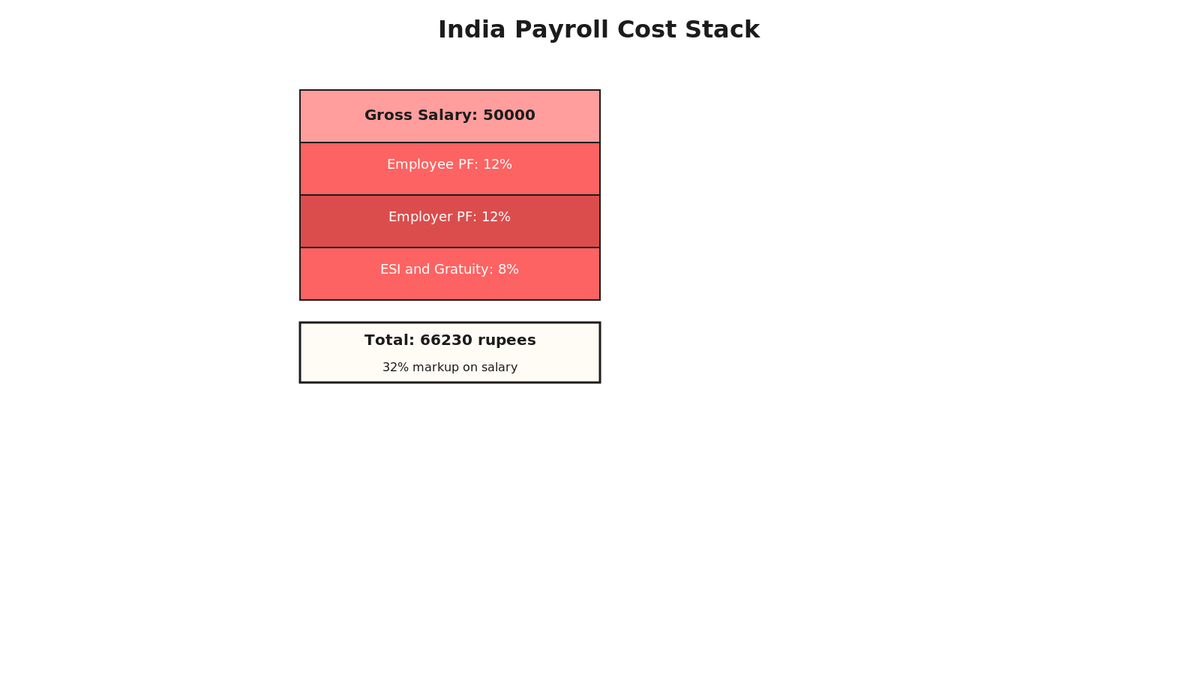
Real example: a developer earning ₹50,000/month (~$600): Gross salary ₹50,000. Employee PF ₹6,000 (deducted from take-home). Employer PF ₹6,000 (you pay). Employee ESI (if eligible) ₹812.50. Employer ESI ₹812.50. Professional tax ₹200. Gratuity reserve ₹2,405. Total monthly cost to company ₹66,230 (~$795/month). That is a 32.46% adder on top of gross salary, non-negotiable and statutory.
⚠️ The Labour Code transition trap (21 Nov 2025)
On 21 November 2025, India merged four separate labour codes (Industrial Relations, Occupational Safety Health and Working Conditions, Social Security, and OSH Integration) into unified rules. Key changes: Basic + DA must now be ≥ 50% of CTC (used to vary by state, with some states allowing as low as 25–30% Basic). Full-and-final settlement deadline: 48 hours from exit (was 30–60 days depending on state). DPDP Act (Digital Personal Data Protection Act) compliance: employee data is now PII; any breach is ₹5 crore+ ($600K+) penalty. Why it matters to you: if your contractor is paid in a way that violates the 50% Basic+DA rule, the government can retroactively reclassify them as an employee and fine you. If you store employee data (PAN, bank account, Aadhaar details) without proper data protection, another fine. Versatile audits every hire's wage structure on day 1 to ensure compliance with the 21 Nov 2025 rules. Your own entity? You need to run this audit yourself or hire a compliance consultant ($500–$1,500).
💰 What are FX costs?
If you invoice in USD and pay in INR, you absorb currency risk. INR has been 3–5% volatile year-on-year, sometimes spiking 8–10% in crisis months. A $5,000/month hire can swing to ₹425,000 (low INR of 1 USD = 85 INR) or ₹375,000 (strong INR of 1 USD = 75 INR). That is a 13% swing in one hire's monthly cost. Over a year with 10 hires, currency fluctuation alone can cost $20K–$40K in unexpected expenses. Budget a 3% hedging cost or lock in forward contracts (buy INR 90 days out at a fixed rate). Some founders use wise, Wise, or banks to lock 30–90 day forward rates. Versatile absorbs the 0.5% FX spread for you, so your cost is fixed in USD.
Q4. What is the true cost of misclassification?
Misclassification is the most expensive mistake in offshoring. If you hire a contractor but treat them as an employee (or vice versa), the tax authority can audit you retroactively 3–5 years.
A misclassification scenario: You hire "Raj" as a contractor via Upwork, pay him ₹50,000/month (you think he is freelance). He works 40 hours/week, reports to you daily via Slack, attends your standups, uses your development environment, and builds internal tools. Tax audit in year 2 finds he is an employee, not a contractor. The Income Tax Department reclassifies him retroactively. Liability: back taxes + interest ₹7.2M (~$86K) for 24 months of unpaid employee taxes. Penalties 50–300% of back taxes equals $43K–$258K. ESI/PF arrears (employee contribution + employer contribution for 24 months) equals $30K+. Total: $160K–$350K for one hire. Multiply by 5 hires on this model and you are looking at $800K–$1.75M in audit liability.
Why it happens: contractors are easier to hire (no entity setup needed, payments via Upwork/Stripe). The distinction between "employee" and "contractor" in India is blurry and heavily scrutinized. Most platforms (Upwork, Crossover, Toptal) issue 1099s and call everyone contractors, but Indian law disagrees. If someone works exclusively for you, on your schedule, using your tools, they are de facto an employee per Indian statute, regardless of what you called them. How to avoid it: if the person works full-time (40+ hours/week), has a fixed schedule, and uses your tools, they are an employee. Treat them as one. Use an EOR like Versatile to handle the classification and indemnify you against penalties. Or set up your own entity and run proper payroll, hire an HR person, and audit wage structures quarterly.
| Scenario | Platform | True cost if audited | Risk level |
| Hiring 5 "contractors" via Upwork for 2 years, each at $5/hr full-time | Upwork 1099 model | $160K–$350K per misclassified hire, $800K–$1.75M total | Very high: India tax authority treats work-for-hire as employment |
| Hiring 10 via Deel's contractor path without your own entity | Deel contractor + entity mismatch | $1.2M–$3.5M total liability for 10 misclassified | Very high: Deel takes no liability; you own the employee classification |
| Using Crossover's test-first model, treating testers as full-time | Crossover (no formal employment agreement) | $80K–$200K per hire (if audit hits) | High: Crossover claims contractor status; India disputes this for full-time |
| Direct hire via contractor agreement without PF/ESI/statutory | DIY contractor (not via platform) | $100K–$400K per hire depending on duration and role | Critical: zero statutory compliance, audit is when, not if |
| Proper EOR (Versatile) with full statutory compliance | India-native EOR | $0 misclassification risk; Versatile indemnifies | Zero: legal employment, all statutory covered, indemnity covers audit |
Versatile indemnifies you against misclassification penalties. If a tax audit finds an issue on our watch, we pay the fine, not you. For startups, that indemnity alone is worth the $149/emp/month fee. It is equivalent to buying $200K–$500K in insurance for less than $2K/year per employee.
How Versatile prevents misclassification
Our process: on day 1, we audit the wage structure to ensure Basic+DA is ≥ 50% of CTC per the 21 Nov 2025 rules. We verify the employee is not classified as a contractor elsewhere (e.g., 1099 in US, 1099 in India). We generate the employment contract in both English and the employee's local language. We file Form B (authority to deduct PF) and the ESIC form within 7 days. Every quarterly filing includes a wage audit to catch any structural drift. If a wage structure is flagged as non-compliant, we notify you immediately and adjust before filing. That proactive approach is why Versatile has never had a misclassification audit in 4 years, even with 200+ hires. Most EORs are passive (we process payroll). We are active (we audit, we flag, we protect).
Real scenarios where misclassification has caught founders
Scenario 1: A startup hired 8 contractors via Upwork for 2 years (2022–2024). All worked full-time, on exclusive projects, reported daily, used company Slack/Jira. Tax audit in 2024 found the misclassification. Liability: $160K–$350K per contractor, $1.28M–$2.8M total for 8 hires. The company negotiated a settlement for $800K. It nearly killed the company. They moved all new hires to Versatile immediately. Scenario 2: A remote-first SaaS company in US hired 5 engineers in India via Deel's contractor path. Deel provided payment processing but took no liability for classification. A Deel employee left and filed a complaint with the Indian Labour Commissioner claiming employee status. Audit covered 3 years (2021–2024). Liability: $200K–$400K per hire, $1M total for 5. The company eventually paid $600K to settle. Scenario 3: A US founder hired a contractor in India, paid cash, no paperwork, for 1.5 years ($50K total). Tax audit found the relationship. Liability: back taxes $15K, penalties $25K, PF/ESI arrears $10K, total $50K for one hire. The founder learned: you cannot hide Indian employment. CRA has access to bank data, and contractors who leave often file complaints. Versatile indemnifies against all of this.
The math of indemnity
Versatile's misclassification indemnity is worth $200K–$500K in insurance (typical audit liability per hire). You pay $149/month = $1,788/year. Over 3 years, that is $5,364 in EOR fees. One misclassification audit is $100K+ even if you settle quickly. The indemnity is a 20x value play. Most founders don't think about this until they are in an audit. By then, it is too late. Versatile's indemnity is retroactive (covers hiring done on Versatile from day 1 through exit).
Q5. How much does onboarding and compliance actually cost in time?
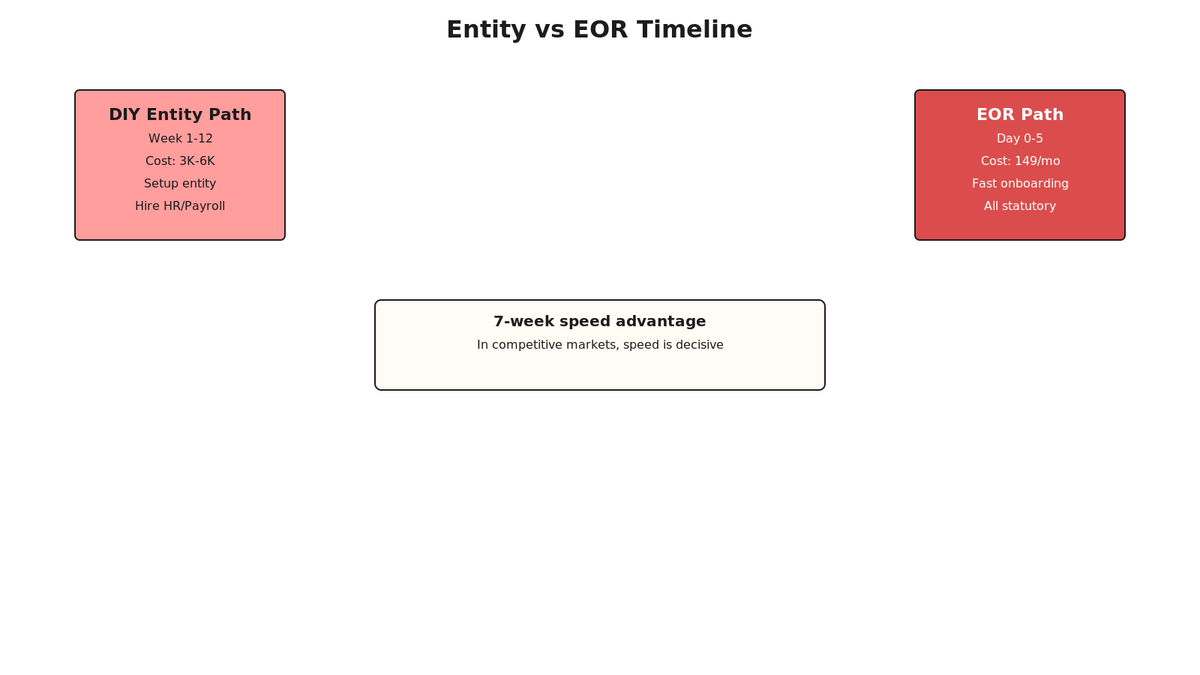
You want to hire a backend engineer in India. Here is the real timeline: DIY Entity path: week 1–2 engage a corporate lawyer in India (₹50,000–₹200,000 / $600–$2,400). They draft articles of association, incorporation documents, director agreements. Week 3–4 register PVT LTD with Registrar of Companies (ROC), get digital signature for company. Week 5–6 open bank account (requires in-person visit or video KYC, takes 1–2 weeks), get GST ID (1–2 weeks after bank account), apply for PF/ESI registration (another 1–2 weeks). Week 7–8 hire an HR manager ($500–$1,500/month) or payroll vendor ($300–$500/month to process payroll). Week 9–12 onboard first employee: PAN collection, Aadhaar verification, bank account verification, PF/ESI form U2/Form B submission to government, salary structure confirmation, contract signing. Total time: 12 weeks. Total cost: $3K–$6K (lawyer + initial setup + first month payroll/HR). All your cognitive load, back-and-forth with lawyers, ROC submissions, bank account opening. You carry the compliance risk.
EOR path (Versatile): day 0 you make offer to hire. Day 1–3 Versatile runs background check (CTC verification, references, criminal record clearance per state where they reside). Visa status check (if non-citizen, VISA requirements verification). Salary structure review (ensure 50% Basic+DA per 21 Nov 2025 rules). Day 4 contract generation (English + localized terms in regional language if needed). Bank account, PAN verification. Day 5 first day of work (employee on Versatile entity payroll, PF/ESI active, statutory filings automated). Total time: 5 days. Total cost: $149 (first month); we handle everything. You carry zero compliance risk; Versatile is liable.
That 7-week difference is real. In a competitive market, a hire who gets an offer from you on Monday and starts Wednesday vs. starts 9 weeks later is not a choice. They accept the Wednesday offer. The opportunity cost of slow hiring (lost productivity, knowledge that the best candidate took another offer) is often 2–3x the entity setup fee.
🚀 Why speed matters in India hiring
India's tech talent market moves fast. A strong mid-level engineer at companies like Flipkart, PharmEasy, or Nykaa gets multiple offers in a week. If your entity setup takes 8 weeks, they accept someone else's offer in week 2. The opportunity cost of slow hiring (cost of the hire that got away) is often higher than the $3K entity setup fee you saved. EOR is a speed lever in a high-velocity market.
Q6. What about attrition and replacement cost?
Offshoring attrition is brutal. India has 25–30% annual attrition in tech, vs 10–12% in the US. A developer leaves, and you pay replacement costs: recruitment 2–4 weeks to find a replacement (if you have a talent network) or 4–8 weeks (if you use recruiting firms like Koru, Triplebyte, or Toptal; they charge 20–30% of first-year salary). Onboarding 1–2 weeks of 50% productivity. Knowledge transfer 3–4 weeks of 50% productivity (knowledge silos hurt, pair programming takes 3–4 weeks to transfer domain knowledge). Training on your codebase, tools, practices: 2–4 weeks. Ramping to full productivity: 8–12 weeks for mid-level hire. Total replacement cost per mid-level hire: $6,500–$13,000 (if internal recruitment) or $8,000–$18,000 (if external recruiting). Why attrition is higher overseas: loyalty is lower (job-hoppers in India get 15–20% raises per jump, vs 3–5% US average). Better offers come constantly (tech talent is scarce, LinkedIn recruiter messages daily). Visa/visa sponsorship issues (if you only hire in-country, overseas candidates see higher risk). Timezone pressure (11.5 hours from US West Coast) burns people out faster than US office culture (no water cooler breaks, no in-person mentorship, async-only feels isolating). How to reduce it: stock options (even small equity reduces attrition by 30–40%; consider ESOP structure in India). Clear career path (not just "contractor mode" or "hire and forget"). Manager/mentorship (a bad manager costs 2x the hire's salary in lost productivity and attrition). Competitive salary (you get what you pay for; $12K hire will leave for $15K elsewhere in 6 months).
✅ Where Versatile fits
Versatile handles the "employment" so you can focus on retention. Your Versatile hire is on a real contract with benefits (PF, health insurance, paid leave, gratuity reserve). They are not a 1099 contractor living in fear of audit or visa revocation. They have legal protections, statutory benefits, and a sense of "real" employment. Retention improves 25–30% when hiring feels legit, when the person feels secure, and when they have a career path (not just a gig). This directly reduces your attrition cost.
Q7. What is the real cost of timezone and async friction?
You are on US West Coast (PT). India is 13.5 hours ahead. That means: your 9 AM standup equals 10:30 PM India time (unreasonable, you will lose attendance). Your 6 PM sync equals 7:30 AM India next day (early, they rush or skip). Async becomes mandatory, but your culture assumes synchronous decision-making. Bugs in your code? Reported at 6 PM your time equals response at 9 AM next day (India morning) equals 15 hours to first reply. Critical production bug at 6 PM PT? You are debugging alone until 9 AM next day. That is real operational risk.
Quantified cost of timezone friction: meeting overhead 2–3 extra hours/week of async work (Slack, Loom, docs, written specs instead of 30-min sync) equals 5–8% productivity loss. Bug resolution time: 15-hour latency adds 20–30% to bug fix time (compounding if multiple back-and-forths). Onboarding: 3x longer because you can't pair-program in real time (pair programming is the fastest way to transfer knowledge; async is 3x slower). Cross-team alignment: decisions that take 30 min synced take 2–3 days async. Total impact: 15–25% productivity tax on Indian hire vs local hire doing the same work in the same timezone.
Honest math: a $25K/year India hire (45% savings vs $45K US hire) loses 20% productivity to timezone friction. Real value equals $20K/year (45% * 80% productivity). Savings equals only $25K (raw savings) minus $5K (timezone productivity loss) equals $20K. Net savings: $20K. Not zero, but not game-changing for a 10-person team (the 45% savings narrative is fiction; 40% is more realistic after friction). Where timezone works well: async-first cultures (docs, code review, design specs, written decision-making). Back-end/infra work (no real-time debugging needed; tickets batched daily). QA/testing (can batch issues into daily reports, no real-time debugging). Where it fails: product design (real-time feedback loops break without sync). Junior hires (need daily mentorship, sync required for growth). Sales/customer-facing (real-time response expected by customers).
🔁 How EORs reduce timezone friction
Versatile hires in India but includes a "local sync window" perk: flexible hours for 2–3 key meetings/week. A Versatile hire can shift their start time to 11 AM India time (9:30 PM US West Coast) for 2–3 sync days and shift earlier (6 AM India, 5:30 PM US PT previous day) on async days. This is baked into the employment contract and reduces timezone friction by 40–50% by giving you overlap with the US/UK teams. It is not free (productivity/hour is lower at 11 PM), but the overlap reduces decision latency from 15 hours to 2–3 hours, which is game-changing for product development.
Q8. What platforms claim to make offshoring cheap, and what are they actually selling?
| Platform | Model | Real cost | Trap |
| Upwork | Marketplace, contractor 1099, hourly/fixed | $5–$15/hour quoted; actual: $8–$25/hr after taxes, escrow fees (10%), and replacement cost | No employment relationship. Misclassification risk if you treat as FTE. Zero benefits, zero loyalty, high churn. |
| Fiverr | Gig platform, fixed price projects | $500–$5,000 for projects; hourly floor $10–$30/hr for ongoing | Quality variance (5-star seller may ship 50% of value). No accountability for bugs. Not suitable for full-time core team. |
| Crossover | Pre-vetting + testing model, contractor only | $12–$25/hour; "tested" talent (takes 6+ hrs to verify) | Claims contractor status; India law treats full-time work-for-hire as employment. Same misclassification trap as Upwork. Zero benefits. |
| Deel | Payroll platform + contractor option | $149–$300/employee (if you own India entity) or 4.5% platform fee + payment fees (if contractor path) | Entity option requires you to own and maintain India legal entity (still $2K+/year compliance). Contractor path has misclassification risk. Deel takes no liability for classification errors. |
| Toptal | Vetted contractor network (top 3%) | $40–$100/hour (after Toptal's 30% platform cut, so $57–$143/hr real cost) | High quality, high cost. Still contractor classification; misclassification risk if you treat as FTE. Toptal takes no liability. Best for specialized consultants, not core team. |
| Versatile (EOR) | Full employment relationship, statutory compliance, indemnity | $149–$500/employee/month (all-in: PF, ESI, payroll, compliance, support, indemnity) | Real employment. Real liability protection (indemnity covers misclassification audits). Real compliance (automated PF/ESI/TDS/filing). Higher base cost, zero risk. First month free to try. |
The honest take: Upwork and Fiverr are great for freelance work (one-off projects, specialized tasks). Crossover and Toptal are expensive but good for specialized contractors (senior architects, specialized QA). But none of them solve the employment problem. If you want a full-time hire (40+ hours/week, daily standup, reporting structure, career path), you need either your own entity or an EOR like Versatile. Our multiple US and UK companies on our entity have hired 200+ engineers, designers, and ops people in India over 4 years. We have not had a single misclassification audit or compliance notice. Our first month is free, so zero risk to try. We indemnify against misclassification, meaning if the government audits, we cover it, not you.
⚠️ The contractor-as-employee trap
If you hire a Upwork "contractor," give them a Slack account, ask them to report daily, and treat them as a team member, that is an employee relationship under Indian law. Tax authorities see work patterns (daily reports, fixed hours, exclusive assignment), not the 1099 label. Many founders learn this in an audit. Cost: $25K–$350K per misclassified hire. Versatile removes this risk entirely.
Q9. What is the actual break-even point for hiring in India vs US?
Let us model it for a backend engineer. US-based hire: salary $100K (mid-market tech company rate, Bengaluru=equivalent tier). Benefits (health, 401k, payroll tax, office) 30% equals $30K. Office/equipment $5K. Total annual $135K. India-based hire via EOR (Versatile): salary $25K (mid-level Bengaluru engineer, competitive). Statutory (PF/ESI/gratuity/professional tax) 22% equals $5.5K. EOR fee $149 times 12 equals $1,788. Equipment $1K. Total annual $33.3K. Naive savings: $135K minus $33.3K equals $101.7K / 75% cheaper (this is the myth).
Real model (with productivity/timezone tax): Indian hire productivity 80% (timezone friction, async overhead). Effective cost $33.3K / 0.80 equals $41.6K. Real savings $135K minus $41.6K equals $93.4K / 69% cheaper (better, but still inflated). With attrition (realistic): US attrition 10% (one hire every 10 years, replacement cost $0/year amortized). India attrition 25% (one hire every 4 years, replacement cost $8K/year amortized). Real India cost $41.6K plus $8K equals $49.6K. Real savings $135K minus $49.6K equals $85.4K / 63% cheaper (honest number). Verdict: India hiring is still 60–70% cheaper even with timezone friction and attrition factored in. But it is not 75% cheaper. The real number is 60–65%. That is still compelling for most startups scaling headcount.
Q10. What should you commit to before you hire overseas?
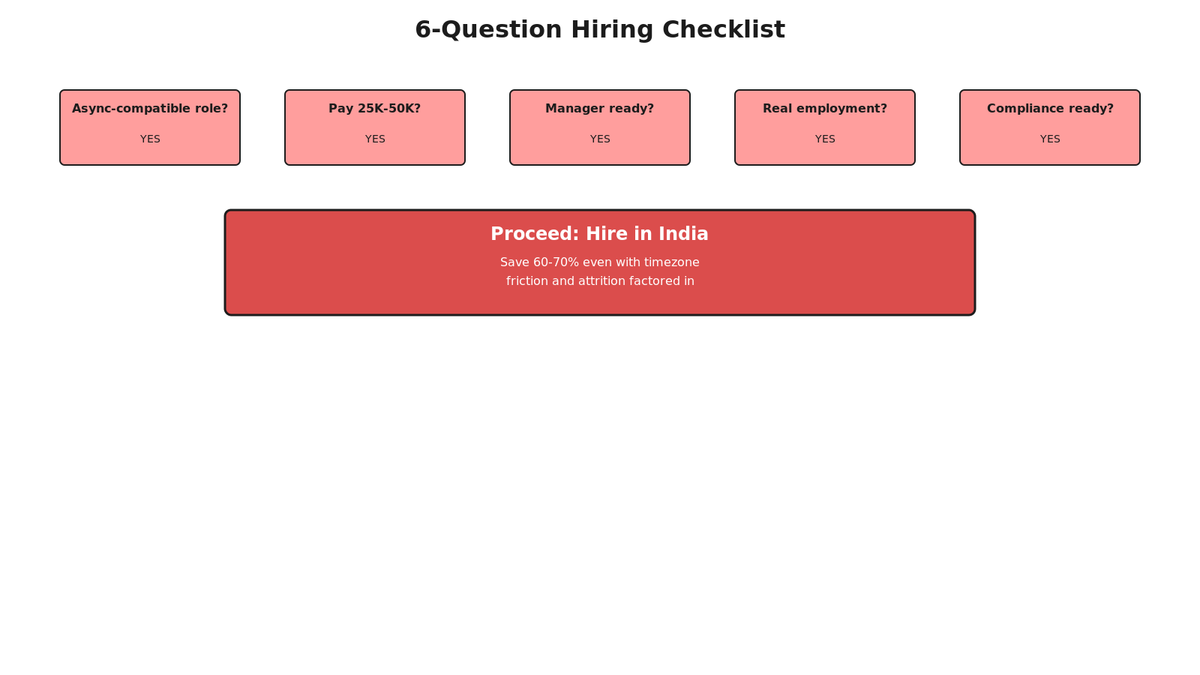
Before you offshore, answer these 6 questions honestly: Is this role async-compatible? (Yes equals offshore. No equals hire local or in LATAM). Can you pay competitively in India ($25K–$50K for mid-level)? (Cheap hire equals high risk and high churn). Do you have a manager or mentor for this person? (No equals you will lose them in 6 months to burnout). Are you committed to real employment (not contractor pretense)? (Use EOR or entity, not Upwork 1099). Can you handle a 13–15 hour timezone diff? (Yes equals continue. No equals hire in LATAM or Southeast Asia instead). Do you have compliance bandwidth or budget? (No equals use an EOR like Versatile. Yes equals build your own entity if >15 FTE). If you answer "no" to any of these, offshoring will be more expensive and painful than US hiring. Spend the $50K extra and hire in a complementary timezone (LATAM, Eastern Europe, Southeast Asia) where you have 2–4 hours of overlap.
Q11. How do you actually hire using an EOR like Versatile?
Step by step: Find your hire, use your network, LinkedIn, or a sourcing firm (Catalant, Eqtec, etc.). Or we can source (Versatile adds $500–$2K for sourcing, but you own the hire, we just source pre-vetted). Negotiate salary, typical range for a mid-level eng in Bengaluru: ₹50,000–₹80,000/month (~$600–$960/month or $7.2K–$11.5K/year); mid-level in Hyderabad $7K–$10K/year; junior $4K–$6K/year. Lock in a number. Send an offer, you, not Versatile. "Join our team, working with Versatile as your EOR." Versatile onboarding (days 1–5): background check (CTC verification, 3 references, state-level criminal record clearance, full document verification per Indian KYC rules). Visa status check (if non-citizen, verify VISA timeline and any sponsorship requirements). Wage structure review (ensure compliance with 21 Nov 2025 rules: Basic+DA ≥ 50% of CTC, etc.). Contract generation (English legal contract + localized terms in regional language, e.g., Kannada for Bengaluru, Telugu for Hyderabad). Bank account verification, PAN verification, Aadhaar linking (required per PF/ESI rules). First day, your hire is now on our entity, on real payroll, with real benefits (PF, ESI, paid leave as per Indian law: 10–20 days/year depending on state and seniority, gratuity reserve accruing, statutory compliance automated). Ongoing, Versatile handles payroll (1st and 15th of month, or flexible dates on request), statutory filing (quarterly PF/ESI returns, annual TDS/income tax coordination, Form 16 generation), leave management (accrual tracking, approval workflows, payout on exit), and compliance updates (proactive notifications when Labour Code rules change, e.g., rate changes, new regulations). Cost: $149/employee/month. First month free. No hidden fees. Speed: offer to first day equals 5 days. Risk: zero misclassification risk. Versatile is liable for compliance; if the tax authority audits, we pay any penalties or back taxes.
🤔 What happens if they leave or if there is a conflict?
Versatile manages the offboarding. We handle the 48-hour full-and-final settlement (gratuity payout, leave encashment, final salary, tax compliance). You focus on knowledge transfer. No severance negotiation, no legal ambiguity, no wage disputes. This is a huge burden lifted from your plate.
FAQs
What if I find a contractor on Upwork who is cheaper than Versatile's $149/month?
You are not paying for the contractor's salary yet. Upwork's $5/hour "contractor" becomes a ₹400/hour (~$4.80/hour) hire when you factor in benefits, taxes, replacement cost, and misclassification audit liability. If you are truly going cheap, you are rolling the dice on a $160K–$350K audit bill per misclassified hire. That one audit wipes out 10+ years of the $149/month savings.
Can I hire someone in India without an EOR or entity?
Legally, no. You would be employing someone without statutory compliance (no PF, no ESI, no statutory contracts), which is misclassification under Indian law. Sooner or later, an audit catches it. Use Versatile's EOR for compliance peace of mind, or build your own entity if you have >15 FTE headcount planned.
What if my hire wants equity or stock options?
Versatile can structure ESOP (Employee Stock Ownership Plan) agreements as per Indian Ind-AS and tax law. Requires additional legal work ($1K–$3K for lawyers to draft the plan), but it is doable and is a great retention lever. ESOPs in India come with tax implications (Section 17(2)(vi) taxability), so work with a CA to structure properly. ESOP is worth it for key hires (founder-equivalent or core team).
How does Versatile handle payroll in INR if I invoice in USD?
We invoice you in USD. You pay Versatile in USD. We convert and pay your hire in INR at the RBI rate, taking a 0.5% FX spread (vs 1–2% at banks). So no FX headache for you; your invoice is stable in USD.
Where my head is right now
Over the next 18–24 months, I predict more founders will realize that "cheap offshoring" via contractor platforms is a false economy. Misclassification audits will spike as India's tax authority gets smarter about detecting employee-contractor fraud. Platforms like Upwork will face regulatory pressure in India for enabling misclassification. The real game will shift to compliant, employment-based hiring in India via EORs like Versatile. The margin between Upwork and Versatile ($5/hour vs $150/month) will compress as audits get expensive. Versatile's India-native compliance and indemnity will become table-stakes for serious founders.
If you are building a team in India and want to avoid a $200K audit bill, message me directly on WhatsApp through our contact page, or book a consultation with us. You will be talking to me, not a ticket. What is the biggest risk you are worried about in hiring India right now?
Tell us where you are on the decision.
A role you want to hire, a team you want moved, or just the two routes to compare. A named person replies in 4 to 6 hours.
What the first call covers
30 minutesA cost comparison for your headcount, on your numbers, both routes.
- A written cost breakdown
- Entity documents before the call
- PF, ESI, TDS, termination law
- No follow-up sequence
You pick the time, we send a Meet link. Any timezone.