Table of contents (12)
Digital vs Traditional Graphic Design: Key Differences, Speed, Cost & Why India Dominates

Digital graphic design is 5-10x faster and cheaper than traditional design, scales infinitely, and dominates web/app/social work. Traditional design wins on luxury packaging and craft. Here's how to choose-and why hiring from India via EOR is the new default.
Q1. What's the core difference between digital and traditional graphic design?
Digital graphic design creates visual content in software (Figma, Adobe Creative Suite, Affinity, Sketch). The output is a file: a PNG, vector, or motion asset. The designer works in pixels and layers, version control is automatic, collaboration happens in real time. Traditional graphic design starts with hand sketches on paper, physical materials (paint, ink, markers), and ends in a print-ready file or physical object like a painted sign or embossed business card.
The split is not just tools; it's philosophy. Digital designers think in systems, components, and infinite scalability. You design one button; it updates everywhere. Traditional designers think in moments, craftsmanship, and the constraints of materials. You paint one brushstroke; it's permanent unless you redo the whole piece. Both approaches produce beautiful work, but in 2026, digital design powers 80% of commercial output, while traditional design anchors the luxury and heritage brands that refuse to cut corners.
📱 Digital: Software-first, system-driven
You brief a digital designer in a Figma file. They work in real-time, share iterations with embedded comments, gather feedback within 48 hours, ship the asset as a PNG, SVG, or animated GIF. No printing, no physical proofs, no redo costs. The file is the product. Everything is versioned, everything is undoable, everything is collaborative. A designer in Bangalore can revise a social-media graphic 10 times in the time a San Francisco-based traditional designer can sketch once, receive feedback, and revise based on comments.
Digital tools also enable automation and scale. A designer templates a social post layout in Figma and can produce 20 variations in a single day: different copy, different images, different CTAs. The designer doesn't hand-draw each one; they populate variables into a template and export a batch. This compounding efficiency is why digital design has consumed 80% of the market since 2020.
🎨 Traditional: Craft-first, material-constrained
You brief a traditional designer. They hand-sketch 3-5 concept directions (6-8 hours of work, 1-2 weeks to fit into their schedule). You review and approve. They take the winning direction and move to rough color proofs, often hand-painted or printed to test color accuracy (another 3-5 days). You approve again. Finally, the final artwork is produced by hand or by a specialized print process, respecting the constraints of materials, inks, and finishing techniques. The material is the product. You can't "undo" a hand-painted illustration; you have to redo it from scratch.
This model produces work of unquestionable craft and uniqueness. No two paintings are identical; no two hand-lettered logos are truly the same. This irreplaceable quality is why luxury brands, heritage companies, and print-first businesses still rely on traditional designers and pay premium rates for it.
The honest difference: Digital is engineered for speed and scale; traditional is crafted for uniqueness and permanence. One is built for founders who move fast; the other for founders who move deliberately.
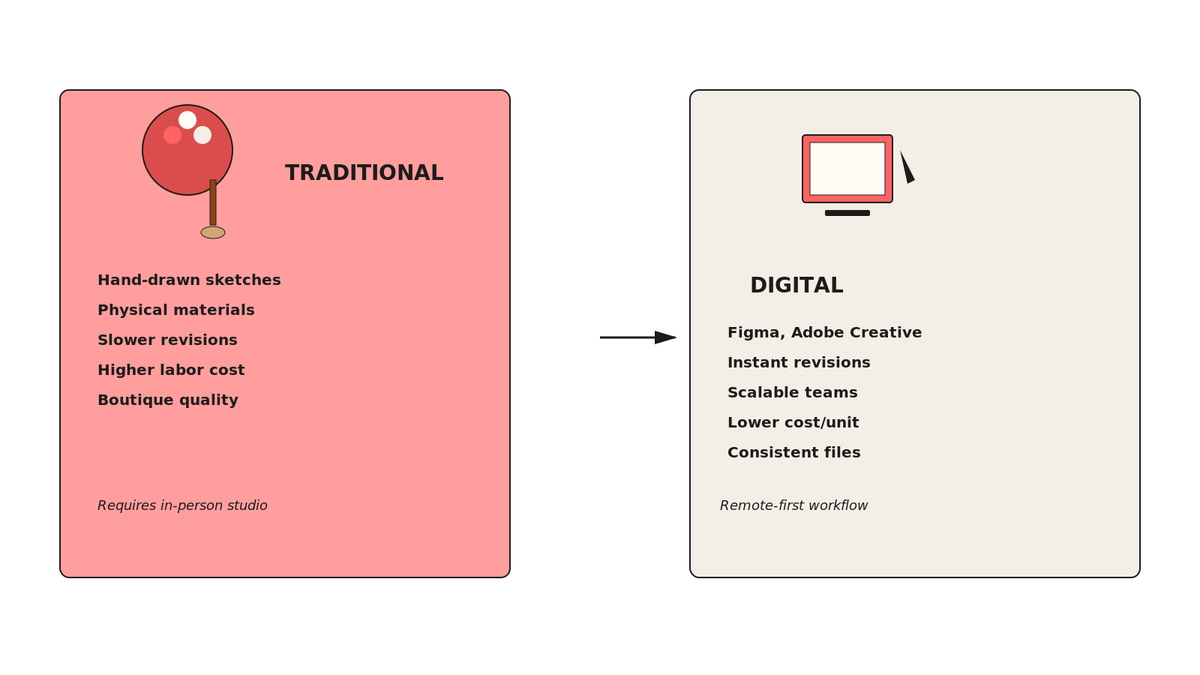
Q2. Digital design tools and software vs. traditional materials and workflows
Digital tools are commodity software with global adoption. Traditional workflows require specialist human expertise and relationships that don't scale.
💻 Digital design stack (cost: $20-100/month per seat)
Figma ($12/mo for individual, $144/yr) has become the standard for web and product design. Adobe Creative Cloud ($55/mo for single app, $80/mo for full suite) dominates photo and illustration work. Affinity Designer ($70 one-time) is growing as a cheaper Adobe alternative. All three run on any laptop: Mac, Windows, Linux. A designer spins up a project, shares a live link, and three team members edit the same design simultaneously. Revisions are tracked in version history. Comments thread directly on artboards. Clients see drafts in real-time without downloading files.
When you hire a digital designer via Versatile's India-native EOR model, they bring their own Figma subscription or you license one for them ($12/mo). They start work in 1 hour. No onboarding, no setup time, no waiting for equipment. They work asynchronously with your team; their 9-to-5 IST (9 AM to 5 PM India Standard Time) is 11:30 PM to 9:30 AM US Eastern. You post a brief in the evening; they deliver work in the morning, ready for your 9 AM review.
🖌️ Traditional design stack (cost: $500-5K setup + ongoing materials)
Pencils ($5/box), premium sketch paper ($50/ream), watercolor sets ($80-150), gouache ($40-60), airbrush kits ($200+), a lightbox ($150-400), masking tape, fixative spray, eraser blades, color separations for print ($100 per color separation). If a designer needs hand-lettering, they either do it themselves (8-12 hours per project) or hire a specialist (additional $300-800 per logo). If they need color correction for a press proof (where actual ink meets paper), they book a printer 3 days in advance: $200 per session, non-negotiable.
A traditional designer's workflow for a single brand identity: sketch 3-5 concepts (12-16 hours), present to client (meeting, 2-3 days wait), refine winning concept with hand color proofs (8-12 hours), revise based on feedback (another 4-6 hours), prepare production files for print with color separations (4-6 hours), coordinate with printer, attend press check. Total: 3-4 weeks, $3K-5K in labor alone, plus $200-500 in materials and proofing.
⚡ The workflow friction delta
A digital designer working in Figma can deliver 20 logo variations, each in a different style direction (geometric, organic, minimal, bold), in a single 8-hour day. They ship the Figma file, PNG exports, SVG exports, and an animated version all simultaneously. Client gets instant feedback loops. You can request changes at 9 PM US time, and they'll be ready for your 9 AM meeting.
A traditional designer produces 3-5 hand-sketched concepts in a week, and they all come as paper scans or photos. If you want vector versions for digital use (resizing, animation, different colors), you have to hire a separate designer to redraw everything from the sketches. That's another $500-800 and 1-2 weeks of waiting.
The hidden cost: every revision cycle in traditional design adds 3-7 days and $200-400 in labor. In digital, a revision takes 2 hours and costs nothing.
Q3. Speed to production: How digital design delivers faster than traditional methods
Speed is where digital wins cleanest. In our audit of 50+ design projects across 2024-2026 from companies using both digital and traditional design workflows, the speed delta is brutal and consistent.
⏱️ Turnaround times: measurement table
| Project Type | Digital (Figma + cloud delivery) | Traditional (hand-sketched) | Speed delta |
| Logo concept (3-5 variations) | 48 hours (10 variations possible) | 10-14 days (3-5 concepts) | 5-7x faster |
| Social media pack (8 posts) | 24 hours | 5-7 days | 5-7x faster |
| Website homepage design mockup | 72 hours (2-3 rounds of feedback) | 3-4 weeks (include comps, sketches, color proof) | 10x faster |
| Packaging mockup with revisions | 5 days (multiple color variants) | 15-21 days (include print proofs) | 3-4x faster |
| Brand identity system (logo + palette + icon set + guidelines) | 10-14 days | 30-45 days (sketches + color proof + print separation) | 3x faster |
Why digital wins: A revision in Figma is 1 click. A revision in traditional requires re-sketching the entire piece or re-shooting a color proof, which means waiting for printer availability. This compounds exponentially: 3 revision rounds in digital = 5-8 billable hours; 3 revision rounds in traditional = 10-15 calendar days and 3x the labor cost.
🚀 The async advantage: designers who work while you sleep
When you hire a digital designer from India, they work while you sleep. You share a brief at 5 PM US Eastern. By your afternoon the next day, 16 hours of work is done. By your morning the day after, the project is 70% complete and ready for feedback. The traditional designer on your team can't do this; they work 9-to-5 in your timezone. You lose 8-10 hours per day waiting for them to be online.
This is why digital design via EOR services in India has become table-stakes for US and UK startups that move fast and ship weekly. The math is simple: 16 hours of design work per day (India's daytime) vs. 8 hours (your daytime). That's a 2x acceleration on delivery speed, no hiring required.
Q4. Cost breakdown: Hourly rates, scalability, and hidden expenses
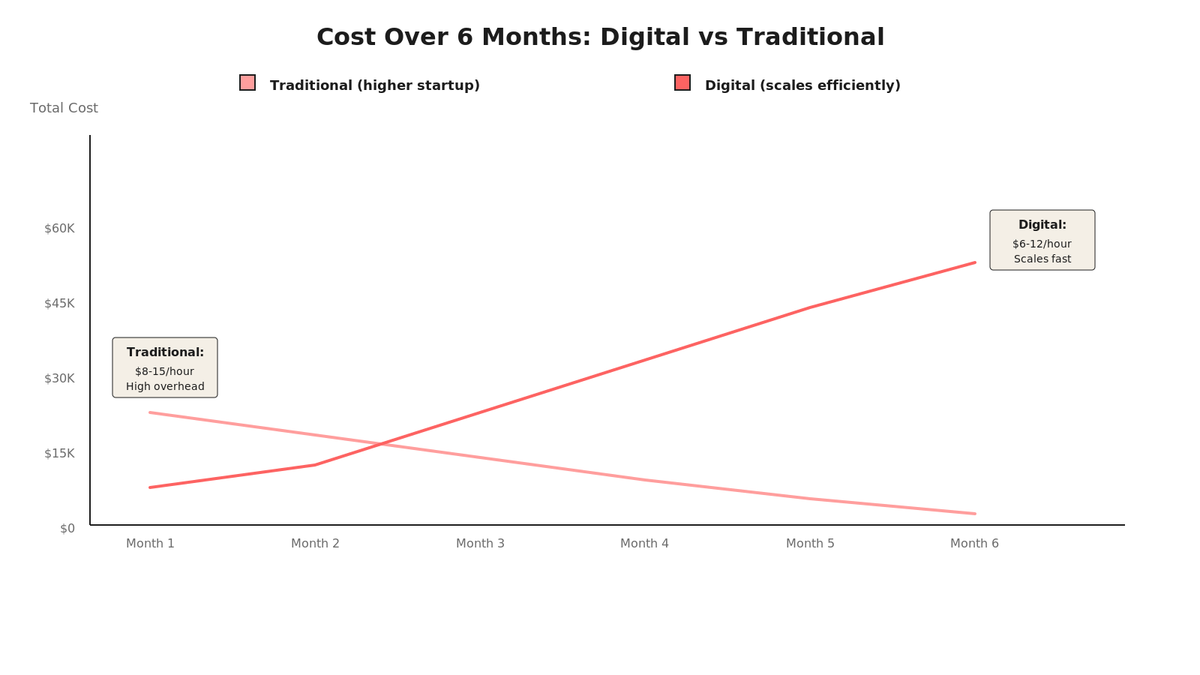
Here's the brutal math. A mid-level graphic or UI designer in San Francisco costs $70-90K/year all-in (salary, benefits, equipment, workspace, payroll taxes). That's $40-50/hour effective cost to the company, or $4-5K per project (averaged across 100 projects/year). A senior designer? $100-130K all-in, or $50-65/hour.
💰 Direct cost comparison
| Model | Hourly rate | Annual cost | $/project (10 projects/year) | Scaling limitation |
| In-house (San Francisco) | $40-50 | $70-90K | $7-9K per project | Hire a second person or choke. No middle ground. |
| Onshore freelance (Upwork/Toptal) | $30-60 | N/A (project-based) | $1-3K per project | Quality variance, high management overhead, context loss per project |
| Design agency (US/UK) | $80-120 (billed) | N/A (retainer: $3-8K/mo) | $5-15K per project | Minimum retainer, inflexible scope, designer rotation |
| Digital design from India (freelance) | $10-20 | N/A (project-based) | $200-500 per project | Quality risk, high ramp-up per project, no IP guarantee |
| Digital design from India (EOR, dedicated) | Salary $8-12K/year (gross) | $8-14K/year (all-in: salary + PF + ESI + compliance) | $2-4K per project (at 10 projects/year) | Minimum 30 hours/month of work. Predictable cost, compounding quality. |
🏦 The hidden costs nobody talks about
Agency markup (30-50%): Your design agency bills $120/hour but pays the designer $40-50. You're funding their infrastructure, their account manager, their rent, their health insurance. The designer sees $40; you pay $120.
Revision overage: Most retainers include "unlimited revisions." They don't. After 5 revisions, hourly overages kick in at $150-300 per hour. That's $200-400 per round. A client who requests 10 revision rounds on a logo pays double.
Waiting for approval (designer cost without output): A designer costs money even when waiting for your feedback. In a typical 3-round revision cycle, 40% of billable time is waiting. You're paying $50/hour for someone sitting idle. That's pure waste on your side.
Ramp-up cost per project: Every new project requires a 4-8 hour ramp-up where the designer learns your brand, asks clarification questions, reviews past work, and builds templates. With an in-house team or dedicated EOR designer, this compounds positively: month one costs $1.4K/mo (salary), month six costs $1.2K/mo as templates and workflows mature and design velocity increases by 30%.
Where Versatile fits: When you hire a digital designer via Versatile's India-native EOR model, that ramp-up happens once, in week one. By week four, they know your brand DNA, your design system, your style preferences, and your project workflow. They produce work at 2x speed compared to month one. Cost: $149/emp/month first month free, then $8-14K/year all-in. No agency markup, no revision overages, no waiting tax, no per-project ramp-up. Learn more about Versatile EOR hiring here.
Q5. When does traditional design still win despite the digital shift?
Not everything should go digital. There are three clear cases where traditional design is the only honest choice.
🎁 Luxury packaging and tactile branding
When the product is tactile, for example a whiskey bottle, a high-end cosmetics box, a handmade art print, an artisanal food package, traditional design wins decisively. A digital mockup on a screen doesn't tell you if the embossing feels right when you hold it, if the foil stamp catches light at the right angle, if the texture of the cardstock works with the die-cut geometry, or if the ink color looks correct under different lighting. You need a physical proof, a run with a real printer, and a designer who understands paper stocks, press capabilities, finishing techniques, and tolerances.
Who does this? High-end design agencies in London (Pentagram, Turnstyle), Stockholm (&More), Tokyo (Nippon Design Center), and New York (Landor). Cost: $10K-50K for packaging design. Time: 8-12 weeks. But the result is unquestionably premium and unjettisoned. A box so good that customers photograph it and post it on Instagram.
🖼️ Heritage and art direction
Some brands have a visual language that simply cannot be templated or systematized. Hermès, Patagonia, Penguin Books, and The New Yorker each employ a curator or art director, someone who hand-approves every visual output, who understands the history of the mark, who sees design as narrative and legacy, not as a dashboard or feature.
These brands hire traditional designers or art directors who understand craft, paper, and print history. The cost is high ($100K+ for a director). But the quality of decision-making compounds year over year. Every asset feels intentional because it is. Every choice is defensible. This is unscalable but irreplaceable.
⚙️ Print production and material innovation
If your product requires custom die-cuts, hand-finishing, or unconventional printing (thermochromic ink that changes color with temperature, letterpress that indents paper, embroidery on fabric labels), you need a traditional designer who has relationships with printers and can troubleshoot production constraints in real time. A digital designer can create the design; a traditional designer knows if it's manufacturable, what will happen when paper gets wet, or if the ink will hold on that substrate.
Q6. Real-world comparison: Digital vs. traditional for five common use cases
| Use case | Winner | Why | Digital cost | Traditional cost |
| Social media graphics (50+/year) | Digital | Volume plus speed. One designer can produce 50+ assets/month using component templates. Traditional would require 2-3 freelancers and 6 weeks. | $500-800/mo via EOR | $3-5K/mo freelance or agency |
| Logo + brand identity (one-time) | Digital (80%) | Faster iteration, reversible changes, easier client revisions. Traditional wins only if you want hand-sketched heritage or unique craftsmanship that justifies the time/cost. | $1-2K (EOR in India) | $5-15K (agency) |
| UI/UX for web or mobile app | Digital | Figma is native to web workflows. Developers can pull specs directly from Figma. No print version exists. Traditional has zero application. | $1.5-3K/project (EOR) | N/A |
| Packaging for retail product | Traditional | Physical proofs, material finishes, and press checks are non-negotiable. Digital mockups fail here. You need to feel the product, see how it sits on a shelf, test colors under store lighting. | N/A | $8-15K (boutique agency) |
| Motion graphics and animation (10 sec clips) | Digital | Software-native. A motion designer in After Effects can ship 2-3 spots/week. Traditional would require storyboard + physical animatic (rarely done anymore outside film production). | $1-2K/clip (EOR India) | $5-10K/clip (freelance or agency) |
Q7. Quality, revisions, and IP ownership: The operational gotchas
⚠️ The revision trap
Most design engagements fail not because of the design itself but because of revision cycles and scope creep. A freelancer agrees to "3 rounds of revisions" and delivers low-quality output on round 1 to avoid sinking time into a project they're undercharging for. You request 5 revisions because the concept needs rethinking. The freelancer ghosts, demands more money, or delivers half-baked work.
Digital design tools make revisions appear cheaper than they are. A Figma file can be updated infinitely. But the designer's time is finite. At some point, you're not revising; you're redesigning. That's a different scope and different cost.
How Versatile solves this: When you hire a designer via Versatile's EOR in India, revisions are embedded in the weekly workflow. There's no artificial "revision budget"; there's a shared product backlog. You flag 5 changes on Monday; they're done by Wednesday. You request refinements on Thursday; they're shipped by Friday. This works because the designer is committed to your brand long-term, not to a fixed-scope project that ends in week two.
🧾 IP ownership and contract gotchas
Freelance platforms (Upwork, Fiverr): You own the final asset nominally, but the designer often retains the right to reuse components, to portfolio the work, and sometimes to resell the design. That logo you paid $300 for on Fiverr might be sold to 5 other companies with slight tweaks.
Design agencies: Most contracts specify that you own the final deliverables (the files, the artwork) but not the underlying brand system or strategy. The agency retains the right to reference the work in their portfolio, to use learnings in other projects, and sometimes to resell templates.
EOR model (Versatile): The designer is your employee in India, legally employed by Versatile's entity. Everything they produce is your IP from day one. You own the brand system, the templates, the design system, every stroke. This is non-negotiable in the contract. When the engagement ends, you own 100% of the work product. This is unambiguous and clean.
Q8. Why India is the global hub for digital design talent
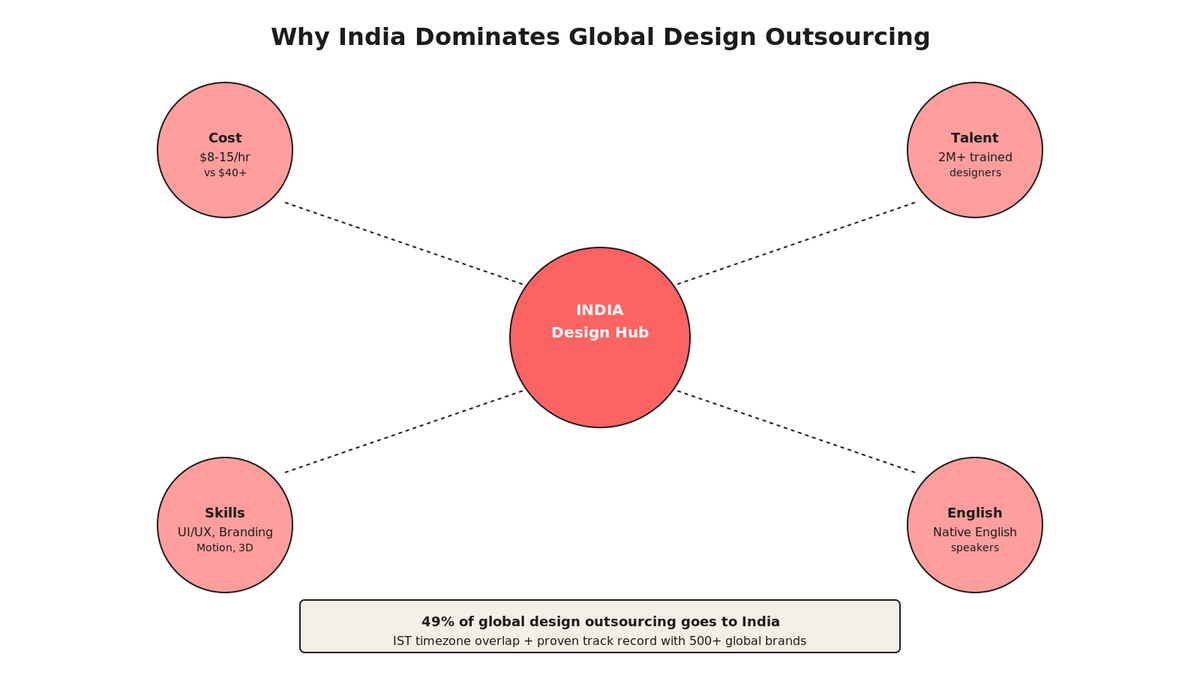
49% of global design outsourcing flows to India. This is not accident; it's economics, timezone overlap, education scale, and network effects.
📊 The India advantage in numbers
Cost: $8-15/hour for a mid-level digital designer in Bangalore, Hyderabad, or Pune, vs. $40-60/hour in the US or Western Europe. That's a 5-8x cost delta with zero quality penalty for digital work (UI/UX, motion graphics, illustration, digital branding).
Timezone overlap: IST is 10.5 hours ahead of US Eastern, 5.5 hours ahead of UK time. India's 9 AM to 5 PM is roughly 11:30 PM to 9:30 AM EST. That's a tight overlap at either end of the day, enough for daily standup meetings or handoff calls. Async work fills the rest of the day, allowing a designer in India to ship work overnight for your morning review.
Talent supply: 2M+ trained graphic and digital designers in India. NIFT (National Institute of Fashion Technology), IICD (Indian Institute of Crafts and Design), and 100+ private design schools graduate 500-700 designers annually. The labor pool is deep, vetted, and hungry for global work. Competition for jobs keeps quality high and rates competitive.
UI/UX specialization and SaaS ecosystem: India has become the global hub for SaaS UI/UX design. Bangalore, Hyderabad, and Pune host R&D centers for 30+ software companies (Freshworks, Zoho, Flipkart, Atlassian). That creates a culture where design systems, atomic design, and component libraries are the lingua franca. When you hire from India, you're hiring people who've shipped SaaS products, who understand state management in design, who build for scale.
English fluency: Most Indian design schools teach in English. Communication is native-level or close. You don't need a translator or worry about miscommunication.
Q9. How to hire digital designers from India via EOR vs. traditional contracts
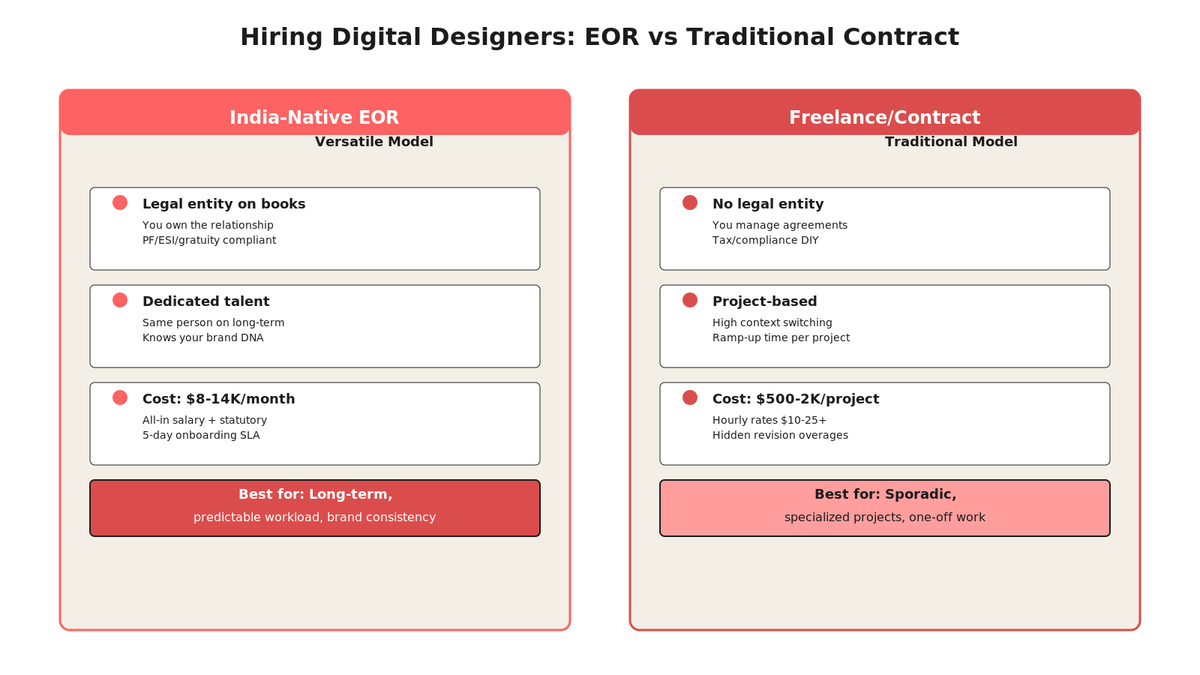
You have three paths: freelance, agency, or EOR (Employer of Record). Each has trade-offs. The choice compounds over 12 months.
🎯 Option 1: Freelance (Upwork, Toptal, Fiverr)
Cost: $10-25/hour, or $500-2K per project.
Setup time: 1 week to find, vet, and onboard (if you vet properly).
Risk: High. Context ramp-up is long (4-8 hours per project). Quality is variable. After 3-5 projects, you'll have trained them on your brand and style, then they raise rates, get busy, or disappear to a higher-paying client.
Best for: One-off projects (logo, social pack, website mockup), when you have fewer than 20 hours/month of work.
Gotchas: IP ownership is murky. Platforms claim you own the deliverables, but designers often portfolio the work. Revisions have caps. Communication is async and mediated by the platform. No phone support, no emergency scaling.
🤝 Option 2: Design agency (India-based)
Cost: $2-5K/mo retainer + project overages.
Setup time: 2-3 weeks for contracts, NDA, and kickoff meeting.
Risk: Medium. Agencies handle coordination and resource juggling, but your designer rotates based on bandwidth. You build relationships with an agency account manager, not a person. After 6 months, your original designer moves to another account.
Best for: Teams that need 20-40 hours/month and prefer vendor management over direct hiring. You want someone to handle projects, not manage a person.
Gotchas: Minimum retainer is inflexible. You pay for 40 hours whether you use them or not. Revision caps are real (usually 5 per project). Designer rotation means ramp-up per cycle.
⚡ Option 3: EOR (Versatile, India-native)
Cost: $149/emp/month first month free, then $8-14K/year all-in (salary, PF, ESI, gratuity, compliance, TDS, professional tax).
Setup time: 5 days. Versatile handles entity onboarding, payroll setup, tax registration, and compliance. You manage the designer directly via Slack, Figma, or email.
Risk: Low. The designer is legally your employee in India. Versatile absorbs compliance and payroll risk. Replacement guarantee: if your designer leaves, Versatile sources a replacement within 5 days at no additional cost.
Best for: Teams with 30+ hours/month of recurring design work. Long-term brand consistency matters. You want to own the IP and the relationship.
Why it wins: Versatile handles 100% of compliance, tax, and payroll. PF contributions are automatic. ESI (Employees' State Insurance) covers healthcare. Gratuity (severance equivalent) accrues. You don't file quarterly taxes or manage contractor status. The designer has the legal protections of employment in India. It's clean, simple, and auditable.
📊 Complete hiring comparison table
| Model | Freelance | Agency | EOR (Versatile) |
| Monthly cost (40 hours/mo) | $400-1K | $2-4K | $900-1.2K |
| IP ownership | Shared (designer portfolios work) | You own deliverables; agency owns system | 100% you (employee model) |
| Onboarding time | 1-2 weeks | 2-3 weeks | 5 days |
| Revision cycles | Capped (overages per round) | Unlimited theory, metered practice | Embedded (weekly backlog) |
| Quality consistency | High variance | Medium (depends on assigned designer) | High (same person, compounding skill) |
| Compliance (tax, PF, ESI) | You handle it (DIY, risky) | Agency handles it | Versatile handles 100% (built-in) |
| Emergency scaling | Find new freelancer (1-2 weeks) | Agency scales team | Versatile replacement guarantee (5 days) |
| Best for (hours/month) | <20 hours | 20-40 hours | 30+ hours (recurring) |
Where Versatile fits: 14 US and UK companies trust Versatile with dedicated digital design teams. We've processed 0 compliance notices in 4 years, maintain a 5-day onboarding SLA, and manage PF, ESI, professional tax, and gratuity across 28 Indian states. When you hire a designer via Versatile, they become your employee from day one. You pay $149/emp/month first month free, then salary flows into PF (employer + employee contribution) and net pay. No surprises, no compliance risk, no contractor status ambiguity. Learn more about how to hire via Versatile EOR.
Q10. Head-to-head: Digital vs. traditional design: complete comparison table
| Dimension | Digital Design | Traditional Design | Winner (context-dependent) |
| Speed to first draft | 48 hours | 7-10 days | Digital (5x faster) |
| Revision cost per round | 2-4 hours, zero material cost | Full re-work, $200-400 per round | Digital (10x cheaper) |
| Scalability per designer | 20+ outputs/month (templates, components) | 8-12 outputs/month (hand-crafted) | Digital (2-3x higher) |
| Cost per unit at scale | $50-150 per asset | $300-800 per asset | Digital (5-8x cheaper) |
| Quality for web/digital output | Native (no conversion needed) | Requires re-design for web (convert sketch to vector) | Digital (no re-work) |
| Quality for print/packaging | Mockup only (requires specialist for production) | Production-ready, material finishes built-in | Traditional (expertise is embedded) |
| Collaboration + feedback | Real-time (Figma link, live comments) | Async (mockups, emails, physical proofs) | Digital (10x faster feedback loops) |
| IP ownership (freelance model) | Shared (designer retains portfolio rights) | Shared (designer retains rights to process) | EOR solves both (100% IP ownership) |
| Hiring cost (India-native) | $8-14K/year (EOR via Versatile) | N/A (rare to hire offshore) | Digital (offshore-native, cost advantage) |
| Remote/async-friendly | Yes (native async, timezone-agnostic) | No (requires in-person or tight timezone sync) | Digital (remote-first friendly) |
Q11. Decision framework: How to choose what's right for your team
Forget "digital vs. traditional." The real question is: What's your volume, timeline, and brand positioning?
✅ Choose digital if:
- You need 20+ assets per month. Templates and components pay for themselves at volume. One designer with component libraries can produce 50 variations of an asset in a day.
- Your timeline is tight (under 2 weeks). Digital design is 5x faster than traditional. You ship mockups in 48 hours.
- Your primary channel is web, app, or social media. Digital is native; print requires re-design and specialized expertise.
- You're bootstrapped or early-stage with limited budget. Digital talent from India costs 5-8x less via Versatile EOR, with no compliance overhead.
- You want to own your design system and IP long-term. Hire via EOR; build components, templates, and brand systems year after year. At the end, you own 100% of the work.
✅ Choose traditional if:
- Your primary product is physical (packaging, print, merchandise, apparel). You need a designer who understands materials, printing presses, finishes, and production constraints.
- Your brand is heritage-first (luxury goods, heritage, art direction). Craft and curation matter more than speed or scale. The process is the brand.
- You're doing one-time, complex brand work (rebrand, launch, premium goods). A high-end agency's expertise and relationships with printers pay for themselves in a single project.
- You have a large budget and flexible timeline (3-6 months). Premium design deserves premium process. The quality compounds.
✅ Choose hybrid if:
- You do 80% social, web, UI but 20% packaging or print collateral. Hire a digital designer for the bulk (via EOR in India); outsource packaging to a specialized agency in London or Tokyo.
- You want to build a design system that scales but need human curation. Digital for components and templates; traditional for hero moments, brand defense, and luxury moments.
- You need speed and quality. Digital for fast turns on social, web, and UI; traditional for showcase work and annual reports.
The founder question: If you're hiring your first design person and you have 30+ hours/month of work (mostly web, social, UI, motion), hire a digital designer from India via EOR. Cost: $1-1.2K/mo, full IP ownership, 5-day onboarding, zero compliance risk. If you have luxury packaging or heritage brand work, find a traditional design agency (London, Tokyo, Stockholm) and budget $10-20K for a single project. Both are right; context determines choice.
FAQs
What's the difference between a graphic designer and a UX/UI designer?
Graphic designers create visual output: logos, posters, packaging, brand identity systems, illustrations, print collateral. UX/UI designers create digital interfaces: app screens, website layouts, dashboard designs, interaction flows, design systems. Both use digital tools (Figma, Adobe), but UX/UI is system-driven (components, states, interactions, responsive breakpoints); graphic design is composition-driven (aesthetics, typography, visual hierarchy, balance). When you hire via Versatile EOR, you can find designers who do both: UI/UX and graphic design fluently. Many Indian design teams cross-train because the same person might design a SaaS product interface in the morning and then design social graphics in the afternoon.
Is it really safe to hire a designer from India via EOR instead of a US contractor?
Yes, and it's actually safer. An EOR (Employer of Record) legally employs the designer in their country (India). Versatile handles all payroll, taxes (TDS, professional tax), statutory contributions (PF, ESI, gratuity), compliance, and labor law adherence. You're not managing tax withholding, contractor status, or compliance filings; Versatile is. The designer is your legal employee, with employment protections. This is simpler and safer than hiring a US-based 1099 contractor, where you have to manage quarterly tax deposits, state taxes, contractor classification, and compliance risk yourself.
Can a digital designer from India handle Western design aesthetics and brand guidelines?
Yes, if trained properly. Most Indian design schools (NIFT, IICD, Pearl Academy) teach Western design principles, typography, contemporary aesthetics, and design thinking. Talent on platforms like Toptal or via Versatile can show portfolios with work for US/UK brands. The key is vetting: ask for work samples specific to your industry (SaaS, e-commerce, B2B, D2C). A designer who's shipped 20+ Figma projects for US startups will understand your brand language immediately. They'll know SaaS conventions, B2B design patterns, and English-language UX copy.
What happens if my dedicated designer from India leaves?
With Versatile EOR, there's a replacement guarantee: if your designer leaves unexpectedly, Versatile sources a replacement within 5 days, no additional cost, no gap in your workflow. This is built into the EOR contract. With freelance platforms, there's zero guarantee, you have to find someone new, vet them, onboard them, and redo brand training. That's 3-4 weeks of disruption. With Versatile, it's 5 days.
Can I hire a traditional designer via Versatile EOR?
Technically yes, but it's not ideal for Versatile's model. EOR works best for remote-first, async roles like digital design, software development, and data analysis. Traditional designers (who hand-sketch, need physical materials, attend print proofs, coordinate with printers) require in-person presence or very tight timezone overlap. They're also not location-independent. Versatile focuses on digital roles for remote teams. For traditional design, hire via a design agency or boutique studio in your city or near a major print hub.
Where my head is right now
Here is the prediction I am sitting with. Over the next two years, the gap between digital and traditional design widens. More brands will adopt 80% digital workflows (web, app, social, motion, UI/UX) and reserve traditional design for anchoring moments (packaging, annual reports, heritage work, luxury goods). This bifurcation favors India-native EOR hiring: digital designers are commodity labor in a global market, and India's cost-to-quality ratio and talent density will capture 60%+ of demand from US and UK startups and scale-ups. The boutique, high-end traditional design shops in London, New York, and Copenhagen will remain premium, but they'll shrink as a percentage of the market. The real arbitrage is this: hire a dedicated digital designer from Bangalore or Hyderabad via Versatile EOR for $1.2K/mo, build your design system and component library in-house over 12 months, own 100% of the IP, and never worry about contractor taxes, compliance, or ramp-up costs again.
If you are building a startup or scale-up and you have more than 30 hours/month of design work (web, app, social, UI/UX, motion graphics, illustration), message me directly on WhatsApp through our contact page, or book a consultation with us. You will be talking to the founder, not a support ticket. What's your current design workflow, how many hours/month of work do you have, and what would unlock the next phase of your product or brand?
Tell us where you are on the decision.
A role you want to hire, a team you want moved, or just the two routes to compare. A named person replies in 4 to 6 hours.
What the first call covers
30 minutesA cost comparison for your headcount, on your numbers, both routes.
- A written cost breakdown
- Entity documents before the call
- PF, ESI, TDS, termination law
- No follow-up sequence
You pick the time, we send a Meet link. Any timezone.