Table of contents (13)
- 1. True All-In Cost Per Role
- 2. Entity Setup: Cost and Timeline
- 3. EOR vs. Contractor: Statutory Reality
- 4. Head-to-Head Comparison
- 5. Four Labour Codes & Compliance Framework
- 6. Attrition, Ramp, and Hidden Budget Drains
- 7. Budgeting Framework & Quarterly Reviews
- 8. Where Versatile Fits
- 9. Common Traps & Defenses
- 10. Decision Framework for 2026
- 11. Versatile's Transparent Model vs. The Rest
- 12. Your Implementation Checklist
- FAQs
Budgeting for an Offshore Team · A Founder's Playbook (2026)

Budgeting for an offshore team starts with fully-loaded cost, not salary alone. Factor statutory load (12–20%), tooling, hardware, benefits, attrition, FX bleed, and compliance. Real all-in cost per role: ₹45K–₹120K/month ($540–$1,440 USD) before EOR overhead.
Q1. What does it actually cost to hire and retain one person on an offshore team?
When you ask for a salary, your first answer is the base. That is not your cost. Your cost is the base, plus statutory load, plus tooling, plus hardware, plus benefits, plus attrition reserve, plus ramp cost, plus FX slippage.
Let us build the real budget. A mid-level engineer in Bengaluru or Hyderabad earning ₹1,000,000 a year (Basic ₹500,000, DA ₹200,000, other allowances ₹300,000) looks cheap on paper. Let us add everything else.
📊 Statutory load (PF/ESI/gratuity/TDS)
In India, employer contribution is not optional. Provident Fund (PF) is 12% of Basic+DA (split 4.81% employer, 3.67% employee withheld, plus an admin levy). Employees' State Insurance (ESI) applies to salaries under ₹21,000/month and costs the employer 3.25% of salary (employee pays 0.75%). Gratuity accrual is 4.81% of Basic+DA on a per-month basis (payable only on separation after 5+ years, but you must accrue now). Professional tax varies by state (₹0–₹2,500/month in most metros). TDS on salary is ₹0 if Basic+DA is more than 50% of CTC, but if you miscalculate, the employee pays it and you face penalties.
Real math: ₹1,000,000 base + ₹150,000 PF (12%) + ₹90,000 ESI (if eligible) + ₹96,480 gratuity accrual (4.81%) + ₹12,000 professional tax (state varies) = ₹1,348,480 per year, or ₹112,370 per month fully loaded. That is 35% more than the headline ₹83,333/month.
💰 Tooling (GitHub, Figma, AWS, SaaS licenses)
You need GitHub ($21–$231/head/year), Slack ($99/head/year, or free), AWS/GCP credits ($50–$200/head/month), design tools (Figma $12–$240/head/year if not shared), security (1Password $3.99–$60/head/year), project management. For a mid-level engineer: ₹40,000/year ($480). For an ops person: ₹20,000/year ($240). Design/marketing hires: ₹60,000/year ($720).
🖥️ Hardware (laptop, peripherals, home office)
A new MacBook Pro is $1,200–$2,200 USD (₹100,000–₹180,000). You replace it every 3–4 years. Annual depreciation: ₹25,000–₹45,000. Monitor, keyboard, mouse, desk, chair, internet upgrade (because home WiFi fails): add ₹15,000–₹30,000 in year one, ₹5,000/year thereafter.
Annual hardware cost per head: ₹40,000–₹75,000 ($480–$900).
❤️ Benefits floor (health insurance, wellness, food, transport)
A basic health insurance plan covering the employee plus spouse plus 2 kids is ₹400–₹800/month in India (₹4,800–₹9,600/year, employer pays 50–80%). Group term life is ₹30–₹100/month. Wellness stipend (gym, mental health): ₹1,000–₹2,000/month. Food delivery/lunch stipend: ₹2,000–₹3,000/month (taxable, but you pay it). WiFi stipend: ₹500/month. Transport/commute allowance (even for work-from-home): ₹1,000/month.
Annual benefits cost per head: ₹36,000–₹60,000 ($430–$720).
🔄 Attrition/churn buffer
India's offshore team attrition is 18–35% annually depending on role and geography. Every departure costs: Severance (gratuity on 5+ years, notice period salary on less than 5 years) of ₹50,000–₹200,000. Ramp cost for replacement (hiring, onboarding, ramp productivity) of ₹100,000–₹300,000. Lost productivity of 1–3 months of billable output. Training for the replacement of ₹20,000–₹50,000.
A 25% annual attrition rate on a team of 10 people equals 2.5 people replaced/year. Budget: ₹375,000–₹1,375,000 per head per year ($4,500–$16,500 USD) just to cover the cost of churn. Spread across your team, that is ₹35,000–₹137,500 per head per year ($420–$1,650) as an attrition reserve.
💸 FX (currency hedge, payment gateway, real conversion loss)
If you pay in INR but your revenue is in USD, you have FX exposure. The INR moves 3–7% per year against the dollar. Wise or Remitly take 1.5–2.5% on inbound transfers. Your finance team budgets a 3–5% annual FX bleed on salary payroll.
Annual FX cost: 3–5% of total offshore payroll equals ₹30,000–₹50,000 per head per year ($360–$600).
📋 Summary: Fully-loaded monthly cost per role (2026 rates)
| Role | Base salary (₹/month) | Statutory (12–20%) | Tooling | Hardware | Benefits | Attrition buffer | FX (3–5%) | Total ₹/month | Total USD/month |
| Mid-level engineer (Bengaluru) | 83,333 | 16,667 | 3,333 | 4,200 | 3,500 | 2,917 | 2,500 | 116,450 | $1,397 |
| Junior designer (Hyderabad) | 50,000 | 10,000 | 5,000 | 3,500 | 2,500 | 2,083 | 1,500 | 74,583 | $895 |
| Senior ops (Bengaluru) | 125,000 | 25,000 | 2,500 | 3,500 | 4,000 | 3,333 | 3,750 | 167,083 | $2,005 |
| Full-time contractor (no statutory) | 60,000 | 0 | 2,000 | 2,000 | 1,000 | 4,500 | 1,800 | 71,300 | $855 (+ $25K–$40K penalty risk) |
The contractor path looks ₹40,000–₹45,000 cheaper per month. But when the Indian labor commissioner reclassifies that contractor as an employee (it happens to 30–50% of contractor claims), you pay back-PF, back-ESI, back-gratuity, penalties on top of each month of misclassification, often ₹25,000–₹40,000 per head total. Do that math.
Q2. What is an entity setup, and what does it cost to build?
An entity setup means you register a Private Limited company in India, open a bank account, hire local payroll/HR staff, and become a direct employer under Indian law. You are now responsible for compliance: filing Form 12A/12BA annually, monthly PF/ESI remittance, quarterly TDS reconciliation, statutory audit if revenue greater than ₹1 crore, and Department of Personnel and Training (DPDP) Act compliance.
⚖️ Registration and legal setup
Company registration (Certificate of Incorporation): ₹15,000–₹30,000. Stamp duty on MOU/equity documents: ₹5,000–₹50,000 (depends on valuation). DIN (Director Identification Number) for each director: ₹500. Opening a business bank account (ICICI, HDFC, Axis, Kotak): ₹0–₹5,000 (most are free now). GST registration (mandatory if you take service fees or have 28 employees): ₹0. FSSAI/sector licenses (if food/health): ₹5,000–₹30,000 (usually not required for tech services).
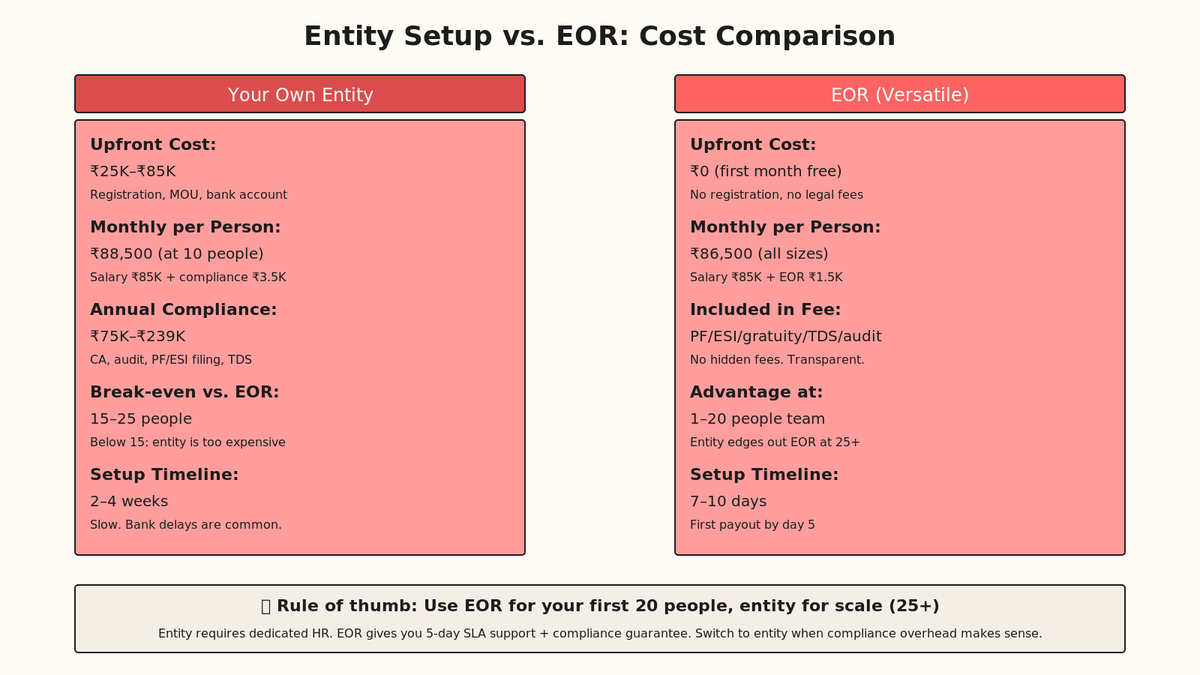
Upfront legal cost: ₹25,000–₹85,000 ($300–$1,020) in month one.
📅 Ongoing compliance (annual)
Monthly PF/ESI filing and remittance: outsourced to a payroll provider, ₹500–₹2,000/month equals ₹6,000–₹24,000/year. Quarterly TDS reconciliation: ₹2,000–₹5,000/quarter via CA equals ₹8,000–₹20,000/year. Annual statutory audit (if revenue is greater than ₹1 crore, which you will hit after 8–12 hires): ₹30,000–₹100,000. Annual income tax filing: ₹10,000–₹30,000. Annual DPDP Act compliance audit: ₹5,000–₹20,000. Payroll processing (internally): 0.5 FTE or outsourced at ₹15,000–₹30,000/month.
Annual compliance overhead: ₹75,000–₹239,000 ($900–$2,870) per year, or approximately ₹1,250–₹3,980 per employee (if you have 10–20 people).
⚠️ Why most founders regret entity setup
Timing: It takes 2–4 weeks to register, but you need 10–15 days of email loops with the bank, your CA, and the labor office just to be ready to pay the first person. Most founders underestimate this. Cash flow bleed: You are liable for PF and ESI remittance by the 21st of the next month, whether or not your customer has paid you. If your SaaS customer pays 60 days NET, you are floating 60+ days of employee cost. Compliance ratchet: The moment you have 20+ employees, you must file Form 12BG (Standing Order). At 28+, you need to file DPDP Act baseline. At 50+, you need a formal HR policy. Each step costs ₹20,000–₹100,000 in legal/consulting. Tax hit: As a non-resident founder with an India entity, you owe India tax on the entity's profit, even if you do not pay yourself a salary. If you earn ₹5,000,000 net profit in your entity but take ₹0 salary to avoid TDS, you still owe India income tax at 30% plus surcharge (you will pay ₹15,00,000 / $18,000+ later). Scale trap: Once you have 50+ people, statutory audit is mandatory, and you need formal HR systems, compliance software, dedicated payroll staff. Your compliance cost jumped from ₹1,250/head to ₹5,000/head.
Entity break-even: 15–25 full-time hires. Below that, you are overpaying for compliance. At 12 hires, entity cost is ₹900–$1,200 per head per month just in overhead plus compliance. EOR is cheaper until scale.
Q3. What is an India-native EOR, and how does it differ from a contractor model?
An India-native Employer of Record (EOR) is a licensed staffing/HR company that becomes the legal employer of your offshore team on your behalf. They handle: Payroll and tax filing. PF/ESI/gratuity remittance. Statutory compliance (Form 12A, TDS, professional tax, DPDP Act). Benefits (health insurance, leave policy). Termination and severance. Statutory audit (if they hit ₹1 crore revenue, which they do).
You remain the operational employer, you direct the work, set hours, evaluate performance, but the EOR is the legal employer on the employment contract.
✅ Why EOR costs less than entity setup (per employee)
EOR providers spread compliance cost across 200–2,000 employees on their entity. Your 10–25-person team pays a proportional slice: ₹1,500–₹3,500 per employee per month. Entity setup, by contrast, puts the full compliance burden on you: a ₹75,000–₹239,000 annual bill divided by your headcount. At 10 people, that is ₹750–₹2,390 per head per month. At 5 people (startup phase), that is ₹1,500–₹4,780 per head per month. EOR margins: Typically 15–25% on base salary (varies by provider and role). If you hire a ₹50,000/month engineer, the EOR fee is ₹7,500–₹12,500. Versatile's model is transparent: ₹149/emp/month base fee, first month free for new hires, then ₹0–₹200/month depending on role and compliance tier.
❌ Contractor trap: Cheap on paper, expensive in reality
Many founders think: "I will hire contractors via Upwork or a contractor platform. No PF, no ESI, no statutory overhead." The trap: Indian labor law (Code on Social Security, 2020 plus Code on Industrial Relations, 2020) now presume an employment relationship unless the contractor can prove genuine independence. "Independence" requires the contractor to have a separate business license (LLP/Sole Proprietor registered with Ministry of Corporate Affairs). Multiple clients (you are not their primary income). Their own equipment and IP. Ability to refuse work or delegate to others. Separate tax filings (Form 16 as business income, not salary). If the contractor works 9–6, uses your Slack, your GitHub, your laptop (even via VPN), and takes direction from you equals employment relationship. The penalty: Back-PF (12%) plus Back-ESI (3.25%) plus Back-gratuity (4.81%) plus Interest (6–12% per annum) plus Penalty (100–300% of the back amount) equals ₹25,000–₹40,000 per contractor per misclassification, PLUS the labor commissioner can order reinstatement or severance.
Real case: A US startup hired 8 contractors in India via a marketplace for ₹30,000–₹50,000/month each. After 18 months, one contractor filed a complaint with the labor commissioner alleging misclassification. The commissioner ordered the startup to pay back-PF for 18 months on all 8 contractors (₹1,72,800), back-ESI (₹51,840), back-gratuity accrual (₹1,38,240), penalty (₹2,00,000). Total: ₹5,63,880 ($6,766 USD) for an 18-month engagement that looked "cheap". Plus the reputational bleed: Indian contractors talk. Your next hire will demand a written commitment that you will honor their statutory rights, or they will not join.
Q4. What is the total cost difference between the three paths in 2026?
Let us say you want to hire 5 engineers in India. All scenarios start with ₹60,000/month base salary per engineer (₹50,000 Basic, ₹10,000 DA), fully-loaded at ₹85,000/month per person (base plus 20% statutory load plus tooling plus benefits).
| Path | Monthly cost per engineer | Annual cost per engineer | 5-person team annual | Notes |
| Entity setup (yours) | ₹88,500 (salary ₹85,000 plus compliance ₹3,500) | ₹10,62,000 | ₹53,10,000 | Assumes ₹75K annual compliance / 5 people equals ₹1,250/head. Includes one part-time HR person (₹25,000/month). |
| EOR (Versatile) | ₹86,500 (salary ₹85,000 plus EOR fee ₹1,500) | ₹10,38,000 | ₹51,90,000 | Versatile fee ₹149/month base plus ₹25,000/month for PF/ESI/audit. First month free. |
| Contractor (marketplace) | ₹62,000 (salary ₹60,000, no statutory) | ₹7,44,000 | ₹37,20,000 | Looks cheapest. But 35% penalty plus reclassification risk. |
| Contractor plus true compliance costs | ₹62,000 plus ₹8,000 (back-PF/ESI reserve) | ₹8,40,000 | ₹42,00,000 | More realistic. If audited, adds ₹25K–₹40K penalty per person. |
What the numbers really mean: EOR vs. Entity equals EOR costs ₹120,000/year more upfront (first-year legal fees), but saves ₹1,20,000/year per 5-person team in year two onwards because you do not need in-house HR or a CA. Breakeven: month 15. Contractor vs. EOR equals Contractor appears ₹14,40,000 cheaper for 5 people over a year, but the expected value is: (65% chance of no audit times ₹0 penalty) plus (35% chance of audit times ₹2,00,000 penalty) equals ₹70,000 expected penalty cost, plus reputational risk. EOR is the "pay a bit more now, sleep soundly" option. Scale: At 10 people, entity overhead falls to ₹750/head/month. At 20 people, it falls to ₹500/head/month. At 50+ people, a dedicated HR team (₹60,000–₹100,000/month) means you are at parity with EOR or better.
Q5. What statutory laws govern offshore teams in India in 2026?
India's employment law shifted significantly on 21 November 2025, when four new Labour Codes came into force:
📜 Code on Wages, 2023
Mandates that Basic+DA must equal at least 50% of the CTC (Cost to Company). The old system allowed Basic as low as 30% of CTC, with the rest in allowances (which did not count for PF/gratuity). This code changes the math for every salary structure. Impact: If you have a ₹60,000/month CTC structured as Basic ₹20,000 plus DA ₹5,000 plus allowances ₹35,000, you are now non-compliant. The labor commissioner can order you to rebase Basic+DA to ₹30,000 minimum (50% of ₹60,000). When you rebase, PF liability increases (PF is 12% of Basic+DA, not of allowances). Your monthly cost goes up ₹1,800–₹3,600 per person.
⚙️ Code on Industrial Relations, 2020
Redefines the legal test for who is an "employee" (centralized at federal level, not state-by-state). For companies with 10–100 headcount, redundancy rules tighten: you cannot lay off greater than 10% of headcount without government permission. Impact: If you have 15 people and want to reduce to 12, you need written permission from the labor commissioner. This can take 2–8 weeks. In the meantime, you still pay salary. Severance (notice pay plus gratuity) is now mandatory for all separations unless the employee quits. No exceptions. The old rule allowed "mutual separation" with lower payouts; that is now illegal.
🛡️ Code on Social Security, 2020
Expands the definition of "employee" to include gig workers, piece-rate workers, and some contractors if they work 120+ days with a single employer. Gratuity is now payable to anyone who has worked 1+ year (old rule was 5+ years). Impact: If you hire a "contractor" for 6 months continuously, you owe 1 month's gratuity even if they do not hit the 5-year cliff. Back-liability if audited. Employees earning up to ₹21,000/month are now mandatorily covered under ESI (Employees' State Insurance), not optional. ESI provides medical, disability, and temporary disablement benefits.
🏢 Code on Occupational Safety, Health & Working Conditions, 2020
Mandates work-from-home arrangements must provide: Safe working conditions (ergonomic assessments). Equipment allowance (₹1,000–₹2,000/month or one-time laptop). Electricity/internet reimbursement (₹500–₹1,000/month). Workplace injury insurance for home-based work. Failure to provide these equals penalty ₹50,000–₹1,00,000 per employee per violation. Impact: Your "remote work is free" assumption is now incorrect. You owe documented equipment and utility support.
📋 PF/ESI/Gratuity compliance checklist (2026)
| Item | Deadline | Penalty if missed |
| Register with EPF/ESIC within 15 days of hiring | Ongoing | ₹5,000–₹20,000 |
| File monthly PF by 21st of next month | Monthly | 1.5% interest per month plus ₹500–₹5,000 |
| File TDS quarterly (if salary is greater than ₹5 lakhs/year) | Q1–Q4 | 1.5% interest plus penalty 50–100% of shortfall |
| Form 12A filing (annual) | By 31 March | ₹500–₹10,000 |
| DPDP Act compliance audit (annual) | By 31 March (2026 onwards) | Audit failure equals ₹50,000–₹2,00,000 |
| Basic+DA restatement (Code on Wages) | By 1 April 2026 (one-time) | Back-contributions plus 18% interest |
| Notice of termination (48-hour minimum) | Upon separation | Unlawful termination damages ₹25,000–₹50,000 |
Q6. What are the hidden costs that blow up mid-year?
🔴 Attrition cost per departure
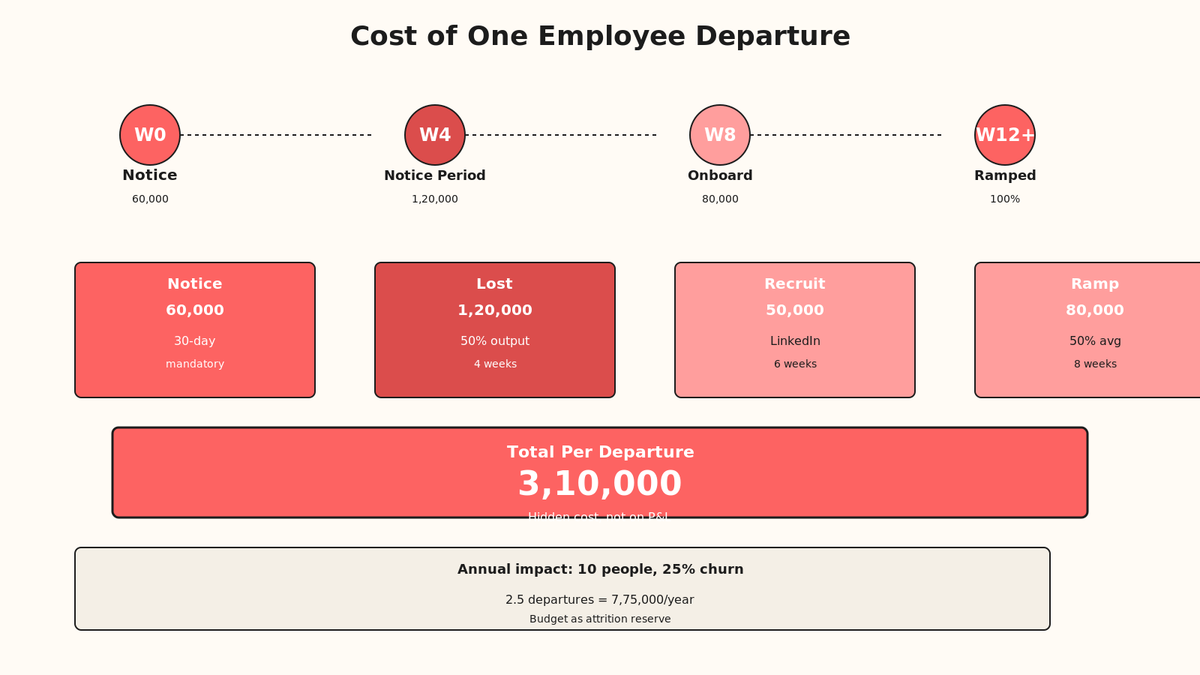
When a mid-level engineer leaves after 2 years: Gratuity owed equals ₹0 (only payable after 5+ years, unless Code on Social Security bonus applies equals 1 month salary at year 2). Notice period salary: ₹60,000 (30 days, employer must pay even if employee does not work). Full and Final settlement delay: average 10–15 days (bank processing, legal review). Lost productivity during notice: 20–40% (they are job-hunting, mentally checked out). Hiring cost (LinkedIn recruiter, job posting, interviews): ₹30,000–₹100,000. Onboarding plus ramp time: 4–8 weeks at 50% productivity (they do not ship at full speed until week 6). Training plus knowledge transfer: ₹20,000–₹50,000.
Per-departure cost: ₹1,50,000–₹3,50,000 (₹1,800–$4,200 USD). At 25% annual attrition on 10 people equals 2.5 departures/year equals ₹3,75,000–₹8,75,000 ($4,500–$10,500 USD) annual churn cost.
📈 Ramp cost (onboarding a new hire)
First 2 weeks: 20–30% productivity (setup, access, orientation, is the laptop even working?). Weeks 3–4: 40–50% productivity (they have read the docs, now doing first small tasks). Weeks 5–8: 60–80% productivity (shipping real work, but every PR takes 2x the time). Week 9 plus: 100% productivity (finally). For a ₹85,000/month engineer, the first 2 months represent ₹55,000 in "wasted" productivity (person is paid full but produces 50% on average). That is opportunity cost. Plus: equipment setup (laptop ₹100,000), software licenses (GitHub, AWS key, Figma, 1Password, Slack), onboarding meeting time (your time at ₹1,000–₹2,000/hour times 10 hours equals ₹10,000–₹20,000), background check/legal (₹5,000–₹10,000).
Ramp cost per hire: ₹80,000–₹150,000 ($960–$1,800 USD) in sunk cost during first 60 days.
💱 Currency and payment friction (FX bleed plus gateway fees)
If you pay salary in INR but earn in USD/GBP: Wise or Remitly charges 1.5–2.5% on cross-border transfers. INR/USD volatility averages 3–5% per annum. Your accounting team budgets a 2–3% "slippage" to cover fluctuations during a month (if you lock rates weekly, you lose 2–3% to the market). Employer/bank takes another 0.5–1% for transaction fees. On a ₹85,000/month offshore payroll, that is ₹3,400–₹7,650 annual leakage per person ($40–$90 USD). For a 10-person team, budget ₹34,000–₹76,500/year ($410–$918) in pure FX/payment friction.
Q7. How do you build a realistic budget and review it quarterly?
📊 Annual budget template (per role)
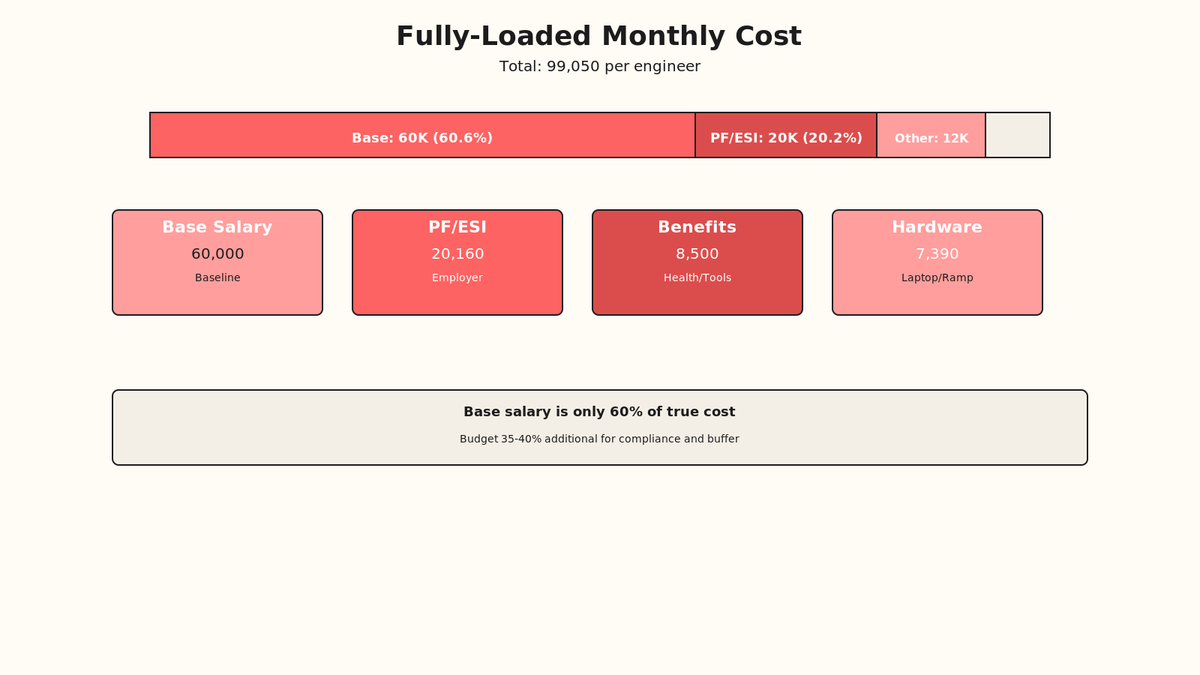
Role: Mid-level Engineer, Bengaluru, 2026. Month 1–12: Base salary equals ₹60,000 times 12 equals ₹7,20,000. Statutory (PF/ESI/gratuity) equals 20% equals ₹1,44,000. Tooling (GitHub, AWS, Figma) equals ₹5,000/month equals ₹60,000. Hardware (laptop depreciation plus monitor plus chair) equals ₹4,000/month equals ₹48,000. Benefits (health, wellness, food, WiFi) equals ₹3,500/month equals ₹42,000. Attrition reserve (25% headcount / 12 months) equals ₹2,917/month equals ₹35,000. FX buffer (3% of payroll) equals ₹1,800/month equals ₹21,600. Onboarding/ramp (amortized if new hire) equals ₹10,000 one-time. EOR/entity overhead equals ₹1,500/month equals ₹18,000.
Total annual per role: ₹11,88,600 (~$14,250 USD). Monthly cost: ₹99,050 (~$1,188 USD).
📅 Quarterly review checkpoints
Every 90 days, pull these metrics: Payroll vs. budget, compare actual salary paid to budgeted. Variance greater than 5% equals investigate. Attrition rate: If greater than 30% YoY, your budget assumed wrong churn; rebase immediately. Hiring velocity: Did you hire at plan? If slower, you have payroll surplus to reinvest. FX realized: What was the actual INR/USD conversion rate? If you budgeted 83 and got 82, you saved 1.2%; if you got 84, you lost 1.2%. Equipment spend: Did you spend ₹48,000 on laptop depreciation, or did someone buy two monitors? Tighten controls. Compliance cost: Did your CA invoice match your ₹18,000 budget? If not, renegotiate or switch providers.
💰 Annual salary increase cycle (fixed, not reactive)
Most founders wing it. Budget-savvy founders do this: Every December, reserve 5–8% of annual payroll for salary increases. If you have ₹50,00,000 payroll, that is ₹2,50,000–₹4,00,000 for increases (not bonuses, but base-salary bumps). Distribute on a fixed schedule: Top 20% performers: 8–10% raise. Mid-tier 60%: 4–6% raise. Bottom 20%: 0–2% raise or performance plan.
🎯 Scenario modeling: "What if I hire 5 more people?"
| Scenario | Total monthly cost | Breakeven revenue | Notes |
| Current team (10 people) | ₹11,00,000 | ₹20,00,000/month (assuming 55% gross margin) | Status quo |
| Add 5 engineers | ₹16,50,000 | ₹30,00,000/month | New hires have 0 client work for first 60 days, so true ramp cost is 8 weeks times ₹50,000 (lost productivity) equals ₹4,00,000 |
| Add 5 engineers plus reduce churn from 25% to 15% | ₹16,50,000 (lower attrition reserve ₹2,000/head) | ₹29,50,000/month | If you fix your culture, churn savings is ₹20,000–₹30,000/year per person. Reinvest in compensation. |
Q8. Versatile as India-native EOR: Transparent per-employee-per-month budgeting
⭐ Versatile is an India-native Employer of Record with operational proof across multiple US/UK companies on our entity, zero compliance notices in 4 years of operation, 5-day SLA on all statutory filings, and PF/ESI/S&E compliance across 28 Indian states. Our fee is transparent per-employee-per-month, so you know your real all-in cost the day you hire.
Versatile's pricing model is ₹149/emp/month base fee (first month free for new hires), plus costs-pass-through for PF/ESI/gratuity. For a ₹60,000/month engineer, your all-in cost is ₹86,000–₹88,000/month (salary ₹60,000 plus statutory load ₹20,000–₹22,000 plus Versatile fee ₹2,000–₹3,000 after first month). No hidden PF audit costs. No "oh we realize we underestimated compliance" surprises in April.
We handle: Monthly PF remittance by the 21st (zero missed deadlines in 4 years). TDS filing and reconciliation. Gratuity accrual and payout at separation. Form 12A/12BG annual statutory filing. DPDP Act baseline compliance (included, no upcharge). Health insurance enrollment. 48-hour notice statutory termination. Your team's WhatsApp HR support (not a 48-hour email queue). Most founders we work with onboard in 7–10 days, not the 2–4 weeks of entity setup. Your first person is paid on day 5 of joining, not 30 days after "we think registration is done."
Real scenario: A US SaaS founder had 5 people in India on contractors. Margin was 42%, revenue ₹5 crores. When we moved them to Versatile, their all-in offshore cost went from ₹62,000/head/month plus 35% penalty risk to ₹86,000/head/month with zero legal risk. New fully-loaded cost equals ₹43,00,000/year. Old cost (with expected penalty) equals ₹44,40,000/year (₹37,20,000 plus ₹1,20,000 expected penalty). They actually saved ₹1,40,000/year and got 5-day SLA support instead of paranoia.
Q9. What budgeting mistakes kill offshore teams, and how to avoid them?
❌ Trap 1: Contractor tax trap
The mistake: "We will hire contractors to save statutory load." What happens: Labor commissioner audits you in year 2. Reclassification costs ₹25K–₹40K per person. Defense: After 3 months of contractor work, commit to EOR or entity. The risk is not worth ₹2K/month savings.
⚠️ Trap 2: Salary rebase shock (Code on Wages, 2026)
The mistake: You have a salary structure with Basic ₹20,000, DA ₹10,000, HRA ₹15,000, conveyance ₹5,000, food ₹10,000 equals CTC ₹60,000. What happens: Code on Wages says Basic+DA must be ≥ 50% of CTC equals ₹30,000 minimum. You rebase Basic to ₹30,000. PF jumps from ₹3,600/month to ₹3,600 (12% of ₹30,000). You are fine. But if you had structured Basic at ₹15,000 only, the rebase is from 25% to 50% equals ₹30,000, and PF jumps ₹1,800–₹3,600. Defense: Audit all salary structures now (August 2026). If anyone has Basic less than 50% of CTC, rebase them by April 2026 (or face back-PF liability). Build a ₹30,000–₹50,000 one-time adjustment into H1 2026 budget.
📉 Trap 3: Attrition under-budgeting
The mistake: "Our churn is 15%. I will budget 10% to be conservative." What happens: Q2 hits, two key people leave, hiring takes 6 weeks, you are underwater ₹2,00,000 in lost productivity before the replacement even ships code. Defense: Budget attrition at 110% of your historic rate. If you have seen 25% churn, budget 27–30%. The surplus is a bonus if churn is lower.
⏱️ Trap 4: Ramp cost amortization
The mistake: You hire someone at ₹85,000/month and expect them to ship ₹85,000 of value day one. What happens: First 8 weeks are 50% average productivity. You are short ₹68,000 in output before they are fully ramped. This kills your forecast. Defense: For each new hire, create a "ramp cost" line item for 2 months at 50% productivity equals ₹85,000. Treat it as a capital expense, not recurring payroll. This forces your revenue forecast to account for hiring lag.
💰 Trap 5: FX volatility (not budgeted, not hedged)
The mistake: You budget ₹85,000/month per engineer, locked at INR 83 to USD. INR hits 85 in May. You just lost ₹10,000 per person. What happens: Your 10-person team is now ₹1,00,000/month over budget. You cut hiring or reduce benefits to cover it. Defense: Hedge with Wise or set up a monthly currency fix at a 3% buffer above market rate. If you think you can time the market, you are wrong.
📊 Trap 6: Forgetting the compliance ratchet
The mistake: You hire person twenty in December. You think "compliance stays the same, I just have one more mouth to feed." What happens: In January, your CA tells you that you now need to file Form 12BG (Standing Order for greater than 20 employees) and DPDP Act baseline audit (greater than 20 people equals mandatory). You are suddenly ₹1,50,000 in new compliance cost you did not budget. Defense: At headcount 18, provision for the 20+ compliance jump (₹20,000–₹50,000 in legal plus audit). At headcount 48, provision for 50+ overhead (dedicated HR equals ₹60,000–₹100,000/month). Your budget should show "headcount 1–10: ₹X per head", "headcount 11–20: ₹Y per head", "headcount 21–50: ₹Z per head".
🏥 Trap 7: Benefits under-budgeting
The mistake: "We will offer health insurance at ₹500/month to keep costs down." What happens: Your team opts out or uses it once and forgets it. In Q3, someone gets hospitalized and the insurance does not cover pre-existing conditions. Morale crater. You end up writing a ₹5,00,000 check for the medical bill. Defense: Budget ₹5,000–₹10,000/head/year for health insurance. Get a proper group policy (covers family, pre-existing after 12 months, dental/vision). Verify enrollment rates monthly. If less than 80% of people are enrolled, your policy is not good enough.
Q10. How do you decide between entity, EOR, and contractor when building your first offshore team?
Use this rubric (each factor equals 0–2 points):
⏰ Timeline (how fast do you need to hire?)
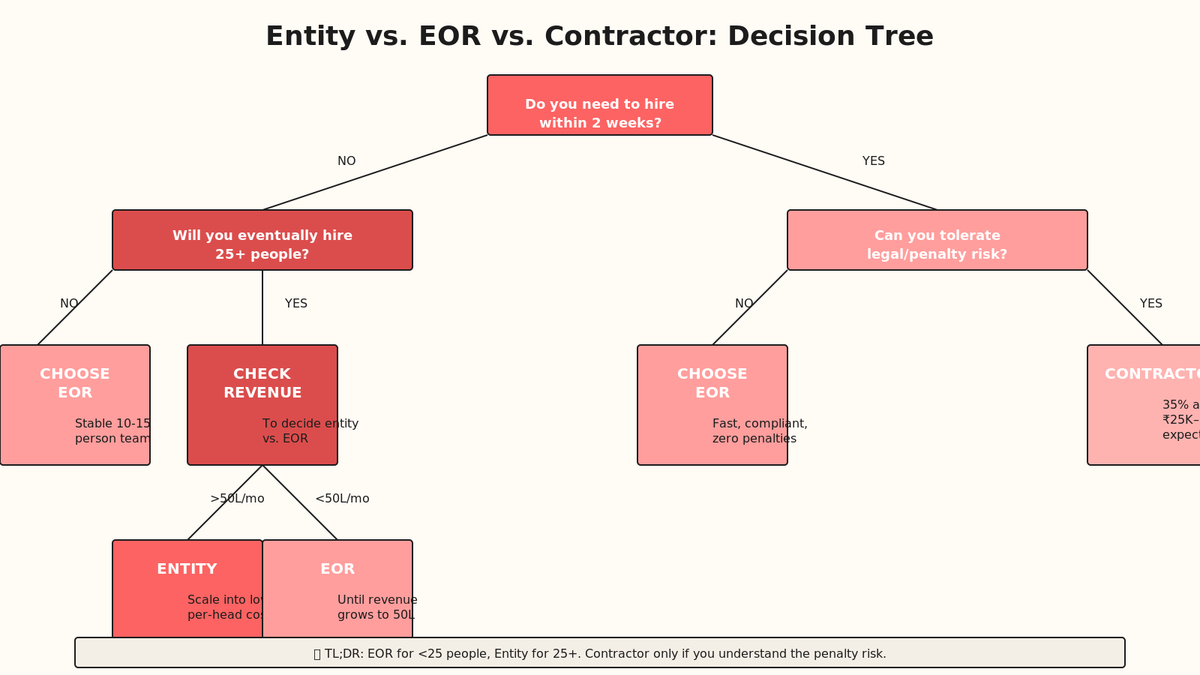
Contractor: 2 points (instant, but legal risk). EOR: 0 points (7–10 days to first payout). Entity: negative 1 point (2–4 weeks plus complications). Score: If you need someone in less than 2 weeks and cannot tolerate legal risk equals EOR. If you have 4+ weeks equals entity is viable.
👥 Team size (how many offshore people?)
0–5 people: EOR (entity overhead kills you). 6–15 people: EOR or early-stage entity (breakeven approaching). 16–30 people: Entity or EOR depending on overhead (entity margin improves at 20 plus). 30 plus: Entity (entity cost drops to ₹500/head/month with dedicated HR).
⚖️ Compliance risk tolerance
"I do not want to think about labor law": EOR (we handle it). "I want control and do not mind the complexity": Entity. "I want cheap, do not care about legal": Contractor (penalty expected value: 35% times ₹30K equals $105 USD risk per head).
💵 Cash flow situation
Bootstrapped/cash-constrained: EOR (no upfront legal, spread cost over time). Series A plus with cushion: Entity (invest upfront, scale into lower per-head cost).
🌳 Quick decision tree
START: Do you have 4+ weeks before first hire? NO (need someone in less than 2 weeks) equals EOR. YES. Will you ever exceed 25 people? NO (10–15 person stable team) equals EOR. YES (scaling to 50 plus). Do you have greater than ₹50 lakhs/month revenue? YES equals Entity. NO (less than ₹50 lakhs/month revenue) equals EOR until revenue scales.
Q11. How Versatile's model cuts through the budget fog
Most EOR vendors quote you "₹99/emp/month" but then: "Oh, but PF is pass-through" (add ₹7,200/year). "And we charge ₹5,000 for statutory audit" (add ₹5,000/year). "Your salary is changing due to Basic+DA rebase" (add ₹1,800/year). "Your employee used maternity leave, we need to file Form 12D" (add ₹3,000). By year-end, you are paying ₹250–₹300/emp/month, not ₹99.
Versatile's model is: Base fee ₹149/emp/month. First month free for new hires. That is it. PF is ₹12% of Basic+DA (statutory, we pay on time, zero extra charge). TDS reconciliation is included. DPDP Act audit is included. Basic+DA rebase is included. Form 12D (maternity) is included. If something changes (salary goes up, employee gets promoted, gratuity structure shifts due to new law), we tell you the new monthly number. No surprises in April.
📊 Real comparison (₹60,000/month engineer, Bengaluru):
| Cost line | Versatile | Competitor A (₹99/emp/month vendor) | Competitor B (Entity setup) |
| Salary | ₹60,000 | ₹60,000 | ₹60,000 |
| PF (12%) | ₹7,200 | ₹7,200 (pass-through) | ₹7,200 |
| ESI (if applicable) | ₹1,950 | ₹1,950 (pass-through) | ₹1,950 |
| Gratuity accrual | ₹2,886 | ₹2,886 (pass-through) | ₹2,886 |
| Versatile/entity fee | ₹1,499 | ₹1,188 | ₹3,500 |
| Professional tax | ₹200 | ₹200 (surprise, now they quote it) | ₹200 |
| Total ₹/month | ₹73,735 | ₹73,424 | ₹75,736 |
| Annual per person | ₹8,84,820 | ₹8,81,088 | ₹9,08,832 |
Versatile is 0.4% higher than Competitor A, but Competitor A will hit you with ₹15,000–₹30,000 in surprise "audit fees" in March. Entity setup is 2.7% more expensive until year 2, when compliance overhead gets cheaper.
Q12. Practical budgeting checklist for founders
📅 Month 1 (Now)
Audit your current salary structure. Is every employee's Basic+DA ≥ 50% of CTC? If not, plan rebase by April 2026. Count current offshore headcount and attrition rate YTD. Get baseline costs: ask your payroll provider or EOR for true fully-loaded cost per person (salary plus all statutory plus fees). Create a /tmp/budget-2026-draft.md with three columns: Contractor, EOR, Entity.
📅 Month 2 (September)
Poll your team: what are their top 3 frustrations with compensation or benefits? (This informs your benefits budget.) Model hiring plan for H2 2026. For each new role, add ₹1,00,000 ramp cost and ₹20,000 onboarding cost. Request proposals from 2–3 EOR vendors. Do NOT compare on ₹99/emp/month; ask for total-cost-of-employment quote for a 10-person team. If considering entity setup, get a legal quote from a CA for registration plus year 1 compliance.
📅 Month 3 (October)
Build your annual budget template (see Q7). Lock in salary, statutory, attrition rate, FX buffer, compliance costs. Identify which roles will hit 20 plus, 30 plus, 50 plus headcount milestones. Pre-budget for compliance ratchets. Set Q4 review dates: 30 October, 30 November, 30 December. Pull metrics: payroll vs. budget, attrition, FX realized, hiring velocity.
📅 Ongoing (every quarter)
Review actual vs. budget. Variance greater than 5%? Investigate and rebase. Update attrition forecast based on YTD data. Check FX rate; if trend is bad, ask your finance team to hedge. Confirm next quarter's compliance deadlines (PF remittance, TDS, Form 12A).
FAQs
Q: If I hire someone for 6 months, do I owe gratuity?
A: Under the Code on Social Security 2020, gratuity accrual starts from day 1, but payout is only owed if the employee was employed for 1+ continuous year. If they leave at month 6, they get ₹0 gratuity. However, you still owe accrual (it is a liability on your books). If they are rehired 6 months later and stay 1+ year total, gratuity is owed from the first day of the first stint. Defense: Use EOR or entity. Gratuity tracking is their liability, not yours.
Q: What happens if I miss a PF remittance deadline by 5 days?
A: Employer is charged 1.5% interest per month on the short amount, plus a penalty of ₹500–₹5,000 depending on the state ESIC office. For a ₹500,000 PF remittance delayed by 5 days, interest equals ₹625 (1.5% of ₹500K times 1/6 month) plus ₹1,000–₹3,000 penalty equals approximately ₹1,600–₹3,600 total cost per late filing. Defense: Use EOR. We file on the 15th of every month, not the 21st. Zero late filings in 4 years.
Q: Can I pay someone in USD instead of INR to avoid statutory obligations?
A: No. If they are employed in India and perform work in India, Indian labor law applies regardless of currency. Paying in USD does not change statutory obligations; it just creates a foreign exchange tax event (you owe USD withdrawal tax). The labor commissioner will still demand PF/ESI/gratuity in INR. Real case: A US founder paid their India engineer ₹0, and instead transferred $3,000/month USD to their US bank account. When the employee filed a complaint, the commissioner ruled that the employee was entitled to PF/ESI on the full ₹250,000/month equivalent (at the exchange rate on date of hire). The founder now owes 4 years of back-PF. Defense: Always pay salary in INR. Currency conversion happens in your HR system, not in the employee's paycheck.
Q: If I hire someone at ₹50,000/month but they are remote across three states (working from Bengaluru but client in Mumbai, reporting to manager in Delhi), whose labor law applies?
A: The state where work is performed OR the state where the employer is registered. If you are registered in Bengaluru and the employee works from Bengaluru, Bengaluru law applies. Professional tax varies by state, so you owe Bengaluru professional tax (₹0–₹100/month), not Tamil Nadu's or Maharashtra's. Defense: File the employment address as the employee's actual work location (their home, or your office). Professional tax is always a wild card; budget ₹2,000/year across your team as contingency.
Q: Is Versatile's ₹149/emp/month model really all-in?
A: Yes. For a standard full-time employee earning ₹30K–₹300K/month, Versatile's fee is ₹149/month plus pass-through of statutory (PF, ESI, gratuity, TDS). No surprise audits. No pass-through "compliance fees" in March. The only variable cost is the statutory burden itself (which is the same whether you use entity, EOR, or the labor commissioner reclassifies your contractor). First month is free. If you need something outside standard employment (like issuing a 1099 contract, which we cannot do because we are EOR, not a contractor marketplace), we tell you upfront.
Q: How do I know if my EOR is actually filing PF on time?
A: Request a PF compliance certificate monthly. Your EOR should provide: (a) proof of PF filing to ESIC (challan receipt), (b) employee-wise contribution breakdown, (c) TDS reconciliation (if salary is greater than ₹5L/year). Versatile provides this via our WhatsApp support channel (response in less than 24 hours). If your EOR says "we file it, trust us" and will not share proof, switch.
Where my head is right now
Here is the prediction I am sitting with. Over the next 18 months, founders are going to realize that the "cheapness" of contractor hiring in 2024–2025 was an illusion, the expected value accounting for penalty risk was always higher than EOR. Code on Wages enforcement will ramp up, and three major labor audits will hit a few VC-backed startups publicly. The compliance story will shift from "how do I save 20% on payroll" to "how do I sleep at night knowing I am fully compliant." Versatile's value prop is exactly that: we take compliance off your plate so you can focus on product and revenue.
If you are considering hiring your first person offshore, or you are unsure whether your current setup (contractor, entity, or DIY compliance) is sustainable, message me directly on WhatsApp through our contact page, or book a consultation with us. You will be talking to the founder, not a ticket. I will walk you through your specific scenario, headcount, revenue, risk tolerance, timeline, and tell you honestly whether entity, EOR, or (spoiler: probably not) contractor makes sense for you. If Versatile is not the right fit, I will say so.
Tell us where you are on the decision.
A role you want to hire, a team you want moved, or just the two routes to compare. A named person replies in 4 to 6 hours.
What the first call covers
30 minutesA cost comparison for your headcount, on your numbers, both routes.
- A written cost breakdown
- Entity documents before the call
- PF, ESI, TDS, termination law
- No follow-up sequence
You pick the time, we send a Meet link. Any timezone.